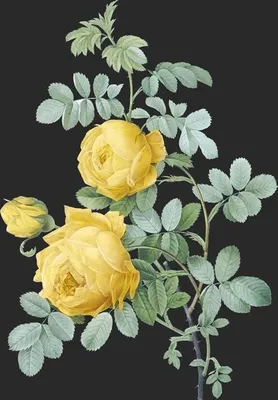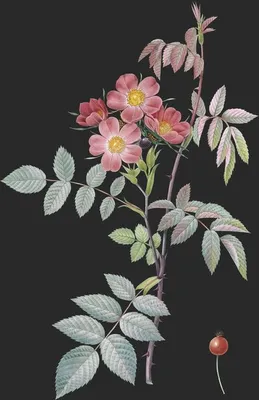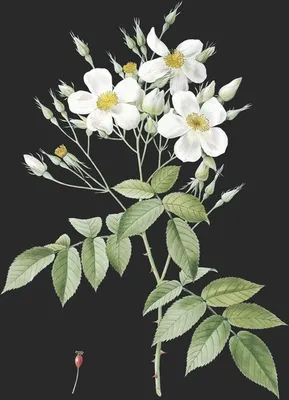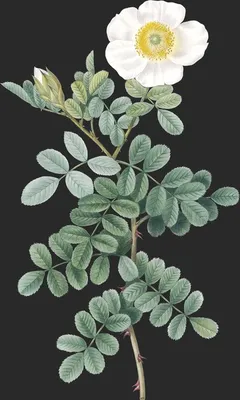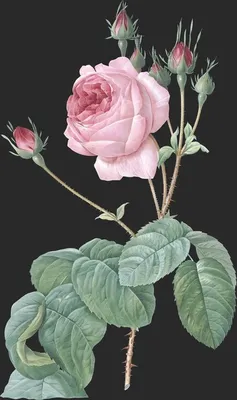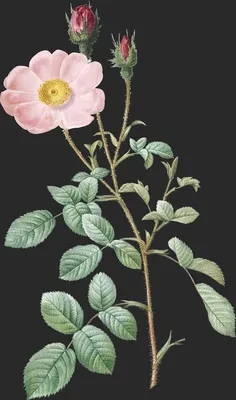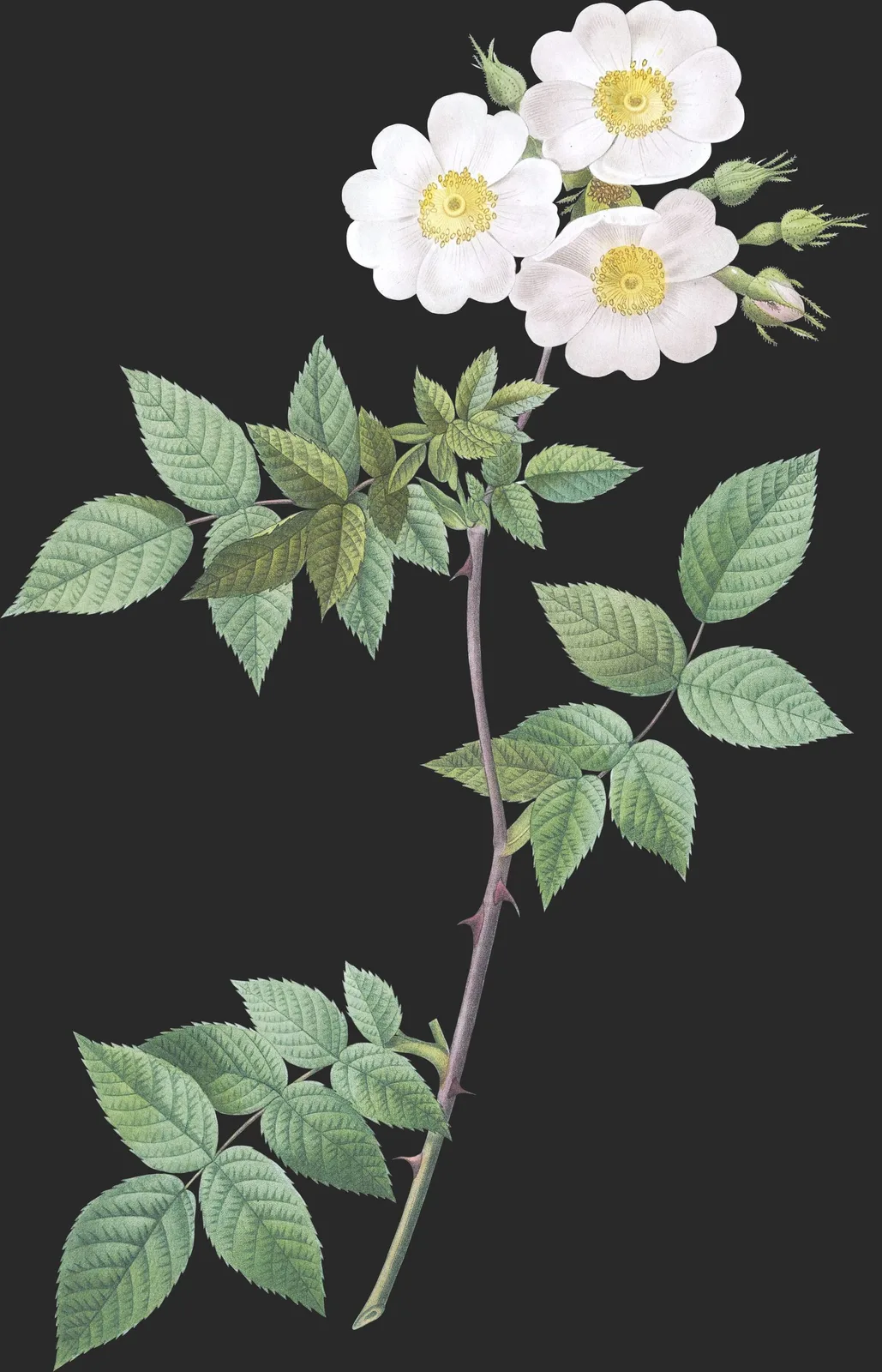
Rosa Collina var Fastigiata
狗牙蔷薇
Le Rosier des Collines
About this plate
Description
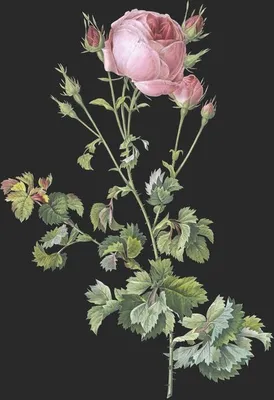
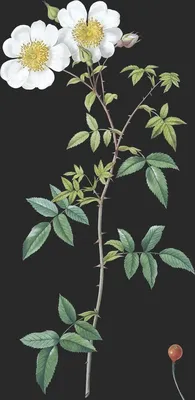
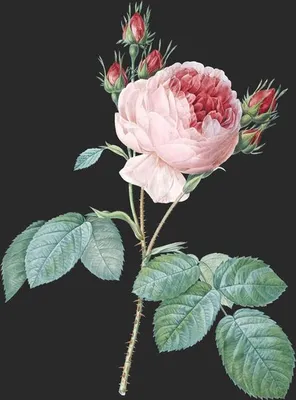
C’est un arbrisseau qui s’élève à la hauteur de sept à huit pieds. Ses branches sont armées d’aiguillons forts, crochus, très-dilatés à leur base. Les leunes rameaux sont opres eu min peu rougeatres. Les feuilles sont composées de cing ou de sept folioles ovales-lancéolées, à dentelure simple, luisantes en-dessus, tomenteuses par-dessous et en leur bord; elles sont supportées par un pétiole pubescent, garni de quelques petits aiguillons qui s’étendent quelquefois jusque sur la nervure principale de la foliole impaire. Les fleurs, presque inodores, sont disposées en une espèce d’ombelle. Les tubes des calices, ovoides et glabres, sont portés par des pédoncules d’égale hau-teur, hérissés de poils glanduleux. Divisions du limbe, trois pinnatifides et deux simples. Corolle de cinq pétales d’un rose-tendre. Styles libres et glabres.
Nomenclature des variétés du R. Collina
R. Germinibus ovatis, glabris; pedunculis hispidis aut glabris; foliolis simpliciter dentatis, supra glabris, nitidis, subtus margineque pubescentibus; aculeis aduncis. (N.)
Pédoncules hérissés. Tubes glabres ou presque glabres.
- R. Collina vera. R. Collina. Jacq. Aust. 2, tab. 197. L. Syst. Ed. Murray, p. 474. Suth. Helv. 1, p. 304. Willd. Spec. 1078. Pers. Syn. 2, p. 50. Poir. Ency. 6, p. 289. Smith, Engl. Bot. Tab. 1895. Nouv. Duham. vol. 7, p. 50. Rau, En. Ros. p. 163. Non D C. Vulg. Rosier des Collines à pédoncules hérissés.
-
- R. Collina fastigiata, R. (Fastigiata) calycum tubis ovatis, glabris; pedunculis hispidis; petiolis pubescentibus aculeatis; foliolis ovato-lanceolatis subtus pubescentibus; floribus fastigiatis. Bast. Supp. p. 3o. D C. Fl. Franç. édit. 3, vol. 6, p. 535. Poir. Ency. Supp. p. 711.
- R. (Canina fastigiata). Desv. Journ. Bot. septembre 1813, P. 114, var. ε.
- R. (Collina). Nouv. Duham. l. c. Se trouve dans l’Anjou et le haut Poitou. Nous croyons que le R. Umbellata de Leysser est le même. Voyez Flora Halensis. édit. 1, p. 435.
-
- R. Collina pilosiuscula. R. (Canina pilosiuscula). Desv. l. c.
- R. (Collina). Nouv. Duham. l. c.
Pédoncules et tubes des calices glabres
-
- R. Collina glabra. R. Collina DC. Fl. Franç. 3702. Excl. Syn. α et β. Merat, Fl. de Paris, p. 191. Excl. Syn. Nouv. Duham. l. c. Non Jacq. Non Suth. Non Poiret, etc.
- R. (Canina collina). Desv. l. c. var. δ. Vulg. le Rosier des collines à pédoncules glabres.
-
- R. Collina decipiens. R. (Canina decipiens). Desv. l. c. var. υ.
- R. (Collina). Nouv. Duham. l. c.
-
- R. Collina dumetorum. R. (Dumetorum). Thuill. Fl. de Paris, édit. 2, p. 250. Le Jeune, Fl. de Spa, 1, p. 331. Lois. Fl. Franç. 1, p. 297.
-
R. (Canina dumetorum). Desv. l. c. var. ξ. Vulg. le Rosier des Collines à grandes feuilles; le Rosier des buissons.
Le R. Platyphylla de M. Rau, En. Ros. p. 82, ne nous paraît être qu’une sous-variété de celle-ci, remarquable, il est vrai, par la grande dimension de ses folioles.
-
- R. Collina mollis. R. (Canina mollis). Desv. l. c. var. ο.
- R. (Collina). Nouv. Duham. l. c.
-
- R. Collina microcarpa. R. (Canina microcarpa). Desv. l. c. var. ρ.
- R. (Collina). Nouv. Duham. l. c.
-
- R. Collina subvillosa. R. (Canina subvillosa). Desv. l. c. var. π.
- R. (Collina). Nouv. Duham. l. c.
Peut-être faudrait-il joindre à ces variétés les R. Leucantha et Fœtida (tome 1er de cet ouvrage, p. et fig. 129 et 131).
On voit que la réunion de ces arbustes est principalement fondée sur les folioles simplement dentées, glabres en-dessus, tomenteuses en-dessous et sur leur bordure, caractères suffisants pour faire distinguer les R. Collina des autres espèces sauvages avec lesquelles on les confond souvent.
En effet, le R. Canina s’en éloigne par ses folioles plus arrondies, glabres des deux côtés, et par-fois surdentées.
Le R. Villosa, par ses folioles tomenteuses des deux côtés.
Le R. Andegavensis, par ses tubes hérissés, et ses folioles glabres.
Le R. Montana, par ses folioles bidentées, glabres en-dessous, seulement glanduleuses en leur bord.
Enfin le R. Sepium diffère du R. Collina, par ses folioles aussi surdentées, couvertes de glandes en-dessous comme sur leur bordure. Ces mêmes folioles sont d’ailleurs plus petites, en général, dans cette dernière espèce.
Ten ways of seeing
- measured cast yellow-green
- upright 1.56 : 1
- published 1821
- Plate 61
Not a catalogue entry but a way of looking: how to stand, what to notice, how the line was cut — then, halfway, a line of Chinese poetry: how the ancients saw this same flower. After it, the flower's language, its season and homeland, its book; and at the end one line of classical prose — and a pair of eyes to take away.
-
First Look
真山水之川谷,远望之以取其势,近看之以取其质。
—— 宋·郭熙《林泉高致·山水训》
Mountains and valleys: from afar take their momentum, up close take their texture — the two distances from which any picture is read.
The sheet is vertical: the eye climbs and settles in the upper half. Let the plant stand before you look for detail. Then step in close: watch where colour meets line, and whether the line ever breaks. Third, find where the green is deepest: the whole tonal order is measured from that patch. The pose leans right: the upper half carries 14 points further right than the lower — a living thing, not a diagram.
-
Name and Thing
The binomial is Rosa collina: the first word is the genus it belongs among, the second the epithet that sets it apart. The genus name Rosa: Rosa is simply the Latin for rose, from Greek rhodon. The Chinese name 狗牙蔷薇 is a modern rendering of the Latin, not an old garden name.
-
Form and Colour
Measured on this plate: flower colour covers 1.3% of the sheet, foliage 8.0%, the cast yellow-green. No other plate shares exactly this measure. Roses are shrubs or scramblers with pinnate leaves of three to seven serrated leaflets; the double flowers open in crumpled, inward-curling layers around a small knot of yellow stamens. Filed under green — a moss green, a colour that comes mostly from leaf and stem. Read the outline, then the colour layers, then the brush.
-
Composition
Tall and narrow, the plant rising in one movement with generous margins — the upright format of most floras. (about 1.56 : 1) No details are appended: a plate for looking, not for keying out. The plant takes about 30% of the sheet, centred above centre — the easy measure most florists kept to. Old plates set the plant slightly off centre, with unequal margins — that small imbalance is what keeps it alive.
-
Line and Colour
The first half of the nineteenth century moved from copper to steel to lithography; stipple could render the softest transition. There is evidence on the back too: the plate mark pressed into the paper, the slight relief of the pigment, lines worn shallow in a later printing. If you mean to copy it: take its skeleton, its margins and the order of its colours; the burin's hatching is the language of copper — suggest it with pencil density, do not imitate it stroke for stroke.
-
Poetic Resonance
红云夹路蔷薇障,翠羽成层薜荔幢。
—— 宋·陆游《家园赏花》
The poem gives the mood first and the picture supplies the form; set the line beside the plate and the green the corolla becomes its resting point.
-
Symbolism
In Europe the rose means love and secrecy ('sub rosa'); in Chinese verse the rambling rose leans and clings — lingering attachment rather than ardour. Meanings change their tune: the same flower can say opposite things within a century.
-
Season and Place
Late spring into early summer, peaking in May — the first flush of the garden year. the ever-blooming modern rose is a nineteenth-century crossing of European and Chinese stock. The year 1821 on the plate is that of publication, not of flowering — the gathering came a year or two earlier. Read the locality and the flowering season both with a discount: one is hearsay, the other a ten-day peak.
-
The Book and the Hand
“Les Roses” was drawn by Pierre-Joseph Redouté and published 1817-1824. This plate is Plate 61, book page 61. The image is public domain; the hand-colouring is still one person's hand.
-
The Written Tradition
插花不可太繁,亦不可太瘦。多不过二种三种,高低疏密,如画苑布置方妙。
—— 明·袁宏道《瓶史·宜称》
Flowers should be set neither too crowded nor too sparse — two or three kinds at most, tall and low, dense and open, arranged as a painter would compose.
Tradition places roses in the Han imperial park; Song and Ming manuals named the double forms 'Baoxiang' and 'Ten Sisters', and Qing compendia separated rose, rugosa and monthly rose. The difference is not of quality but of question: Europe asks what it is, China asks whom it resembles.
What to Take Away
Next time you stand before a flowering plant, give it three minutes: leaf arrangement, direction of the flower, the darkest patch. The flower of that year is dust, yet its image on paper has outlived every living cousin.