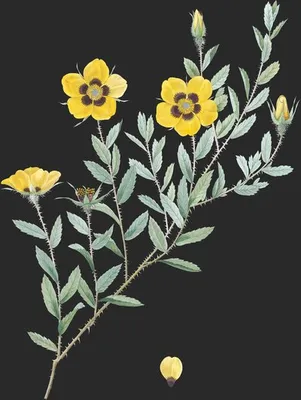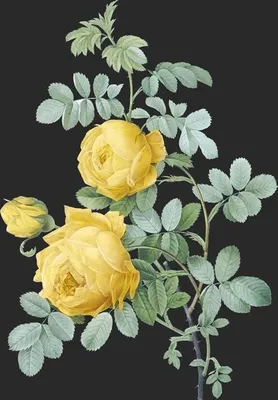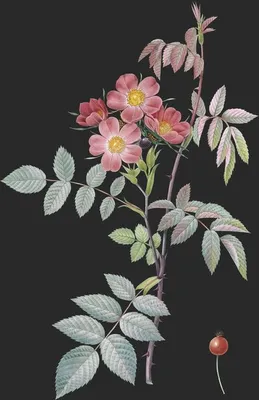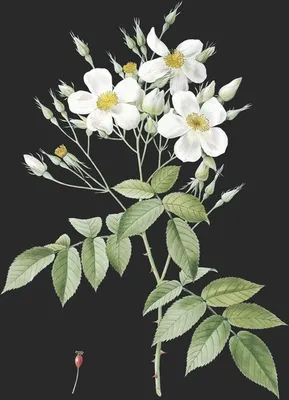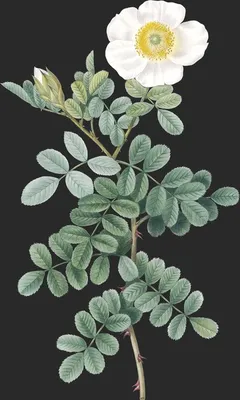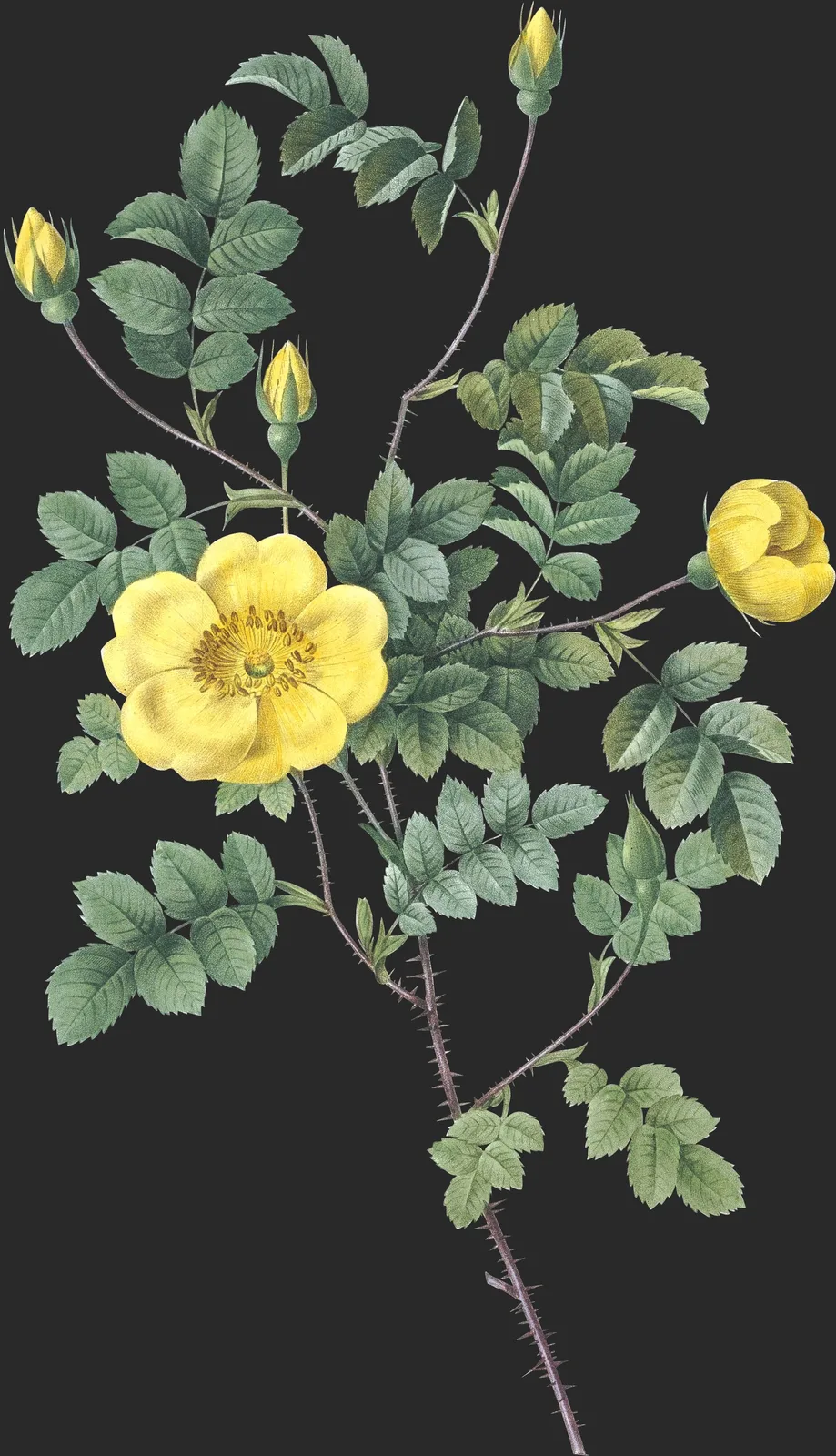
Rosa Eglanteria Luteola
L’Églantier Serin
L’Églantier Serin
Ten ways of seeing
- measured cast yellow-green
- upright 1.74 : 1
First Look
搜尽奇峰打草稿。
—— 清·石涛《苦瓜和尚画语录》
Exhaust the strange peaks, and then make the sketch.
The sheet is vertical: the eye climbs and settles in the upper half. Let the plant stand before you look for detail. Then step in close: watch where colour meets line, and whether the line ever breaks. Third, find where the green is deepest: the whole tonal order is measured from that patch. The pose leans left: the upper half carries 8 points further left than the lower — a living thing, not a diagram.
Name and Thing
Only the genus Rosa is given; species-level names came later. No established Chinese name exists, so it is cited by its binomial alone.
Form and Colour
Measured on this plate: flower colour covers 6.3% of the sheet, foliage 8.5%, the cast yellow-green. No other plate shares exactly this measure. Roses are shrubs or scramblers with pinnate leaves of three to seven serrated leaflets; the double flowers open in crumpled, inward-curling layers around a small knot of yellow stamens. a moss green. Read the outline, then the colour layers, then the brush.
Composition
The sheet is tall. No details are appended: a plate for looking, not for keying out. The plant takes about 31% of the sheet, centred above centre — the easy measure most florists kept to.
Line and Colour
The first half of the nineteenth century moved from copper to steel to lithography; stipple could render the softest transition. There is evidence on the back too: the plate mark pressed into the paper, the slight relief of the pigment, lines worn shallow in a later printing. If you mean to copy it: take its skeleton, its margins and the order of its colours; the burin's hatching is the language of copper — suggest it with pencil density, do not imitate it stroke for stroke.
Poetic Resonance
烟淡偏见梅花情,笔下一片黄昏晴。
—— 唐·白玉蟾《友人陳槱得楊補之三昧賞之以詩》
The poem gives the mood first and the picture supplies the form; set the line beside the plate and the green the corolla becomes its resting point.
Symbolism
In Europe the rose means love and secrecy ('sub rosa'); in Chinese verse the rambling rose leans and clings — lingering attachment rather than ardour. Flower language was added later; the flower knows nothing of it, and that innocence is part of its power.
Season and Place
Late spring into early summer, peaking in May — the first flush of the garden year. Widespread in the temperate north. Chinese gardeners knew roses since the Han. The year 1824 on the plate is that of publication, not of flowering — the gathering came a year or two earlier. Read the locality and the flowering season both with a discount: one is hearsay, the other a ten-day peak.
The Book and the Hand
“Les Roses” carries only Pierre-Joseph Redouté's name. A plate is collective work: drawer, engraver and colourist were different hands, and the unnamed ones decided how good it looks.
What to Take Away
Appreciation is not knowledge but habit — one more look each time. Two centuries on, the plant may still flower in some garden; the one on this sheet stopped in the season of 1824.
About this plate
Description
Arbrisseau très-rameux, semblable à l’églantier jaune dont nous avons donné la figure, mais plus petit dans toutes ses parties, et à tiges couvertes d’un grand nombre d’aiguillons de différente grandeur. Il s’élève à trois pieds ou environ. Ses feuilles se composent de sept, neuf, et parfois de onze folioles d’un vert un peu obscur, petites, presque rondes, glabres sur les deux faces, serraturées et glanduleuses en leur bord. Elles sont portées par un pétiole glabre, muni de quelques petits aiguillons jaunâtres, garni à sa base de deux stipules élargies au sommet, à bords glanduleux. Les fleurs nais-sent, ou solitaires, ou réunies par deux à l’extrémité des ra-muscules qui croissent le long des branches principales. Le tube du calice offre une forme globuleuse un peu déprimée; il est glabre ainsi que le long pédoncule qui le supporte. Les divisions du limbe, quelquefois entières, quelquefois pinnati-fides, sont cotonneuses à l’intérieur, et couvertes, extérieure-ment, d’un grand nombre de glandes sessiles. Corolle de cing pétales assez petits, d’un jaune serin, échancrés en cœur au sommet. La fleur donne une odeur désagréable, mais moins fétide que celle que répand le Rosa eglanteria punicea.
Enumération des variétés connues du R. Eglanteria, extraite du Prodrome de la monographie des espèces et variétés du genre Rosier, p. 99.
R. germinibus depresso-globosis, pedunculisque glabris, caule aculeis sparsis, rectis, petiolis scabris, foliolis acutis. L. spec. plant. 703.
-
- R. eglanteria lutea. Du Roi, Harb. 2, p. 347.
- R. lutea. Ait., Kew. 2, p. 200. Willd. Arb. 303. Id., spec. 1064. Miller, Dict., № 11. Du R. l. c. p. 344. Poir., Ency. 6, p. 289, № 20. Curt., Bot. Mag. tab. 363. Nouv. Duham. l. c. tab. 14, fig. 1.
- R. eglanteria. Scholl., Barb., № 399. Moench., Hass., № 418. Leyss., Hall., № 489, etc. Red. Roses 1, p. et fig. 69.
- R. lutea simplex. C. Bauh., Pin. 483. Besl., Eyst. tab. 5, fig. 1.
- R. fœtida. All., Ped., № 1792. Non Bast. Non DC.
- R. cerea. Roess. tab. 2. L’Églantier jaune.
- R. eglanteria luteola. Thy. l. c. L’Églantier serin. Arbrisseau moins grand que le précédent dans toutes ses parties.
-
- R. eglanteria punicea. Du R. l. c. Corn. Canad. 11. Roess. tab. 5. Red. Roses 1, p. et fig. 71.
- R. lutea β. Ait. l. c.—var. β. Willd. l. c.—β. Poiret, l. c.—β. DC. Catal. Monspel, p. 55.
- R. eglanteria β. DC. Fl. Franç. édit. 3, 3694.—var. β. Nouv. Duham. l. c. p. 45. L’Églantier ponceau; la Rose capucine; la Rose d’ Autriche.
La Rose tulipe de Du Pont (R. eglanteria tulipa, Gymn. Ros. p. 15) est une sous-variété de ce Rosier.
Ces arbrisseaux croissent en France, en Angleterre, en Allemagne, en Italie, et en Espagne.