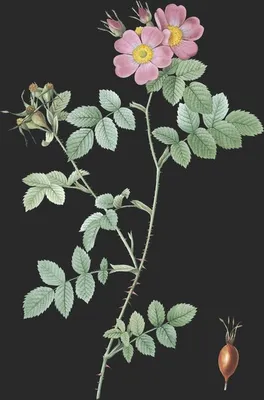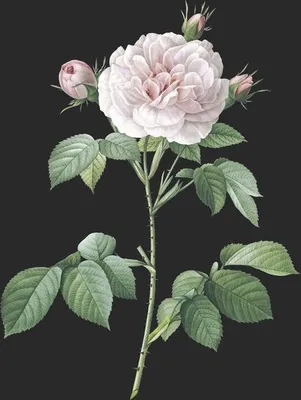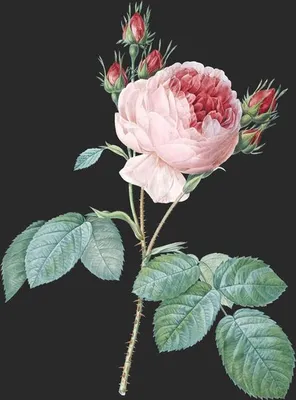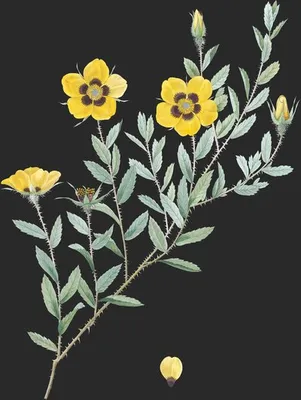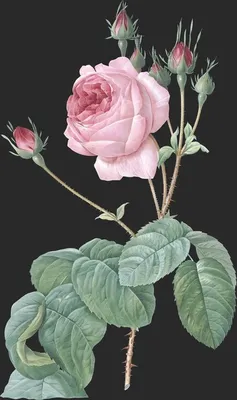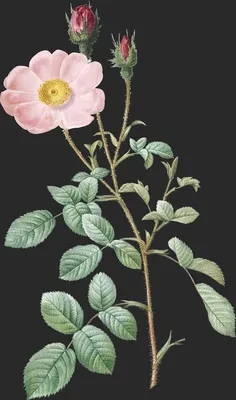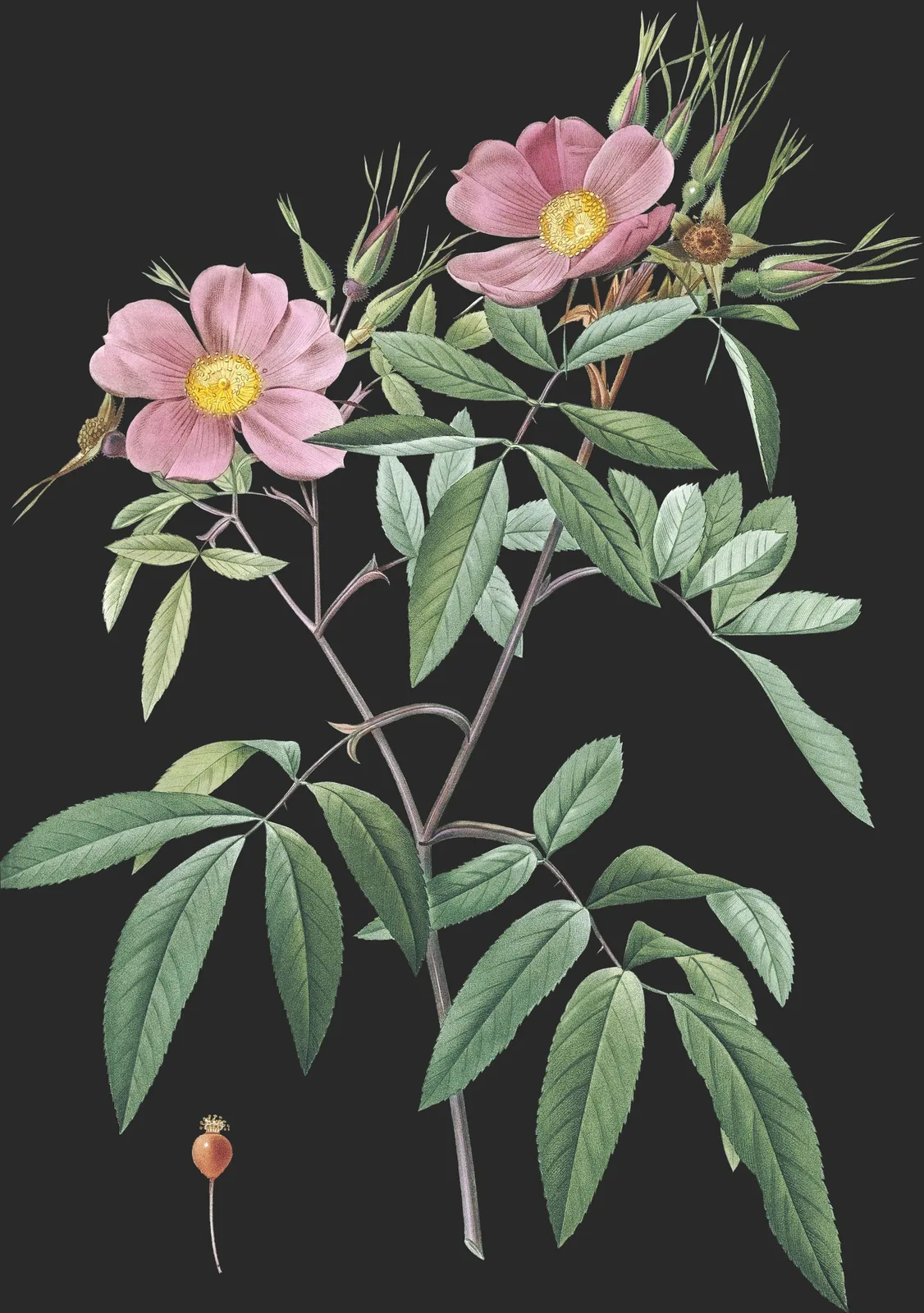
Rosa Hudsoniana var Salicifolia
Le Rosier D’Hudson
Le Rosier D’Hudson
Ten ways of seeing
- measured cast red
- upright 1.42 : 1
First Look
江馆清秋,晨起看竹,烟光日影露气,皆浮动于疏枝密叶之间。
—— 清·郑板桥《题画竹》
On an autumn morning at the river lodge I looked at the bamboo: mist, sunlight, dew, all drifting among the sparse and dense leaves.
The sheet is vertical: the eye climbs and settles in the upper half. Let the plant stand before you look for detail. Then step in close: watch where colour meets line, and whether the line ever breaks. Third, find where the green is deepest: the whole tonal order is measured from that patch.
Name and Thing
The binomial is Rosa hudsoniana: the first word is the genus it belongs among, the second the epithet that sets it apart. The genus name Rosa: Rosa is simply the Latin for rose, from Greek rhodon. No established Chinese name exists, so it is cited by its binomial alone.
Form and Colour
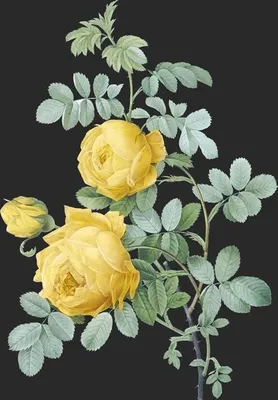
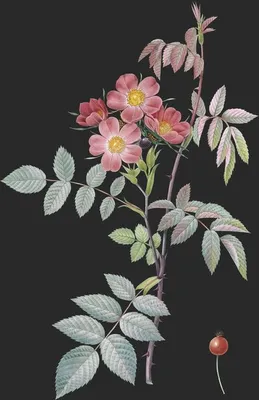
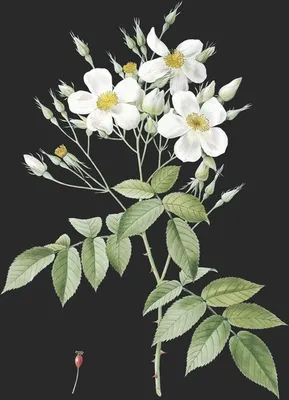
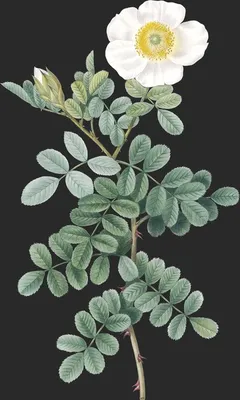
Measured on this plate: flower colour covers 4.6% of the sheet, foliage 8.7%, the cast red with a second note of yellow-green. No other plate shares exactly this measure. Roses are shrubs or scramblers with pinnate leaves of three to seven serrated leaflets; the double flowers open in crumpled, inward-curling layers around a small knot of yellow stamens. a moss green. Read the outline, then the colour layers, then the brush.
Composition
The sheet is tall. No details are appended: a plate for looking, not for keying out. The plant takes about 31% of the sheet, centred near the centre — the easy measure most florists kept to.
Line and Colour
The first half of the nineteenth century moved from copper to steel to lithography; stipple could render the softest transition. Take a loupe to three places: petal edge, leaf vein, caption. An unbroken line means engraving; colour crossing the outline means a hand. If you mean to copy it: take its skeleton, its margins and the order of its colours; the burin's hatching is the language of copper — suggest it with pencil density, do not imitate it stroke for stroke.
Poetic Resonance
粉圆双蕊髻中开。
—— 宋·晏几道《鹧鸪天》
The poem gives the mood first and the picture supplies the form; set the line beside the plate and the green the corolla becomes its resting point.
Symbolism
In Europe the rose means love and secrecy ('sub rosa'); in Chinese verse the rambling rose leans and clings — lingering attachment rather than ardour. Flower language was added later; the flower knows nothing of it, and that innocence is part of its power.
Season and Place
Late spring into early summer, peaking in May — the first flush of the garden year. Widespread in the temperate north. Chinese gardeners knew roses since the Han. The year 1817 on the plate is that of publication, not of flowering — the gathering came a year or two earlier. The bud and the ripe fruit on one branch tell the season; the name in the title often tells the journey.
The Book and the Hand
“Les Roses” carries only Pierre-Joseph Redouté's name. From drawing to plate the sheet passed through several hands — the engraver aimed at accuracy, the colourist at speed, and between them lies each plate's unevenness.
What to Take Away
If you keep one line, keep Guo Xi's: from afar its momentum, up close its texture. A flora exists to be consulted; look long enough and you forget to consult — someone in 1817 gave a whole day to a single flower.
About this plate
Description
Ce Rosier que M. Du Pont a communiqué, a été par lui-même confondu avec le Rosier de la Caroline, et par d’autres cultivateurs, avec le Rosier élégant (Blanda), dont il diffère essentiellement. L’arbuste s’élève à deux ou trois pieds. Ses tiges glabres, vertes, rougeâtres sur les parties exposées au soleil, sont absolument dépourvues d’aiguillons. Les feuilles se composent de cinq ou de sept folioles ovales-oblongues, assez semblables aux feuilles du saule (salix viminalis), vertes en dessus, glauques en dessous, finement et simplement den-tées, supportées par un petiole velu, souvent muni de deux ou trois aiguillons crochus, ayant à sa base des stipules bifides, allongées, repliées sur elles-mêmes. Les fleurs sont disposées en ombelle ou en cime à l’extrémité des rameaux. Elles sont supportées par des pédicelles assez souvent glanduleux, garnis de deux bractées ovales-pointues et ciliées. L’ovaire est généralement glabre; mais par-fois on y ren-contre, sur-tout à la base, quelques poils glanduleux. Les lobes du calice sont entiers, et très-longs. La corolle présente cinq pétales d’un joli rose un peu foncé, quelquefois arron-dis, mais très-souvent acuminés au sommet.
Observations
Nous avons dédié ce Rosier, sur lequel aucun naturaliste n’avait, jusqu’aujourd’hui, fixé son attention, au célèbre navigateur anglais Hudson, qui a découvert la baie qui porte son nom, et dans laquelle l’arbuste croît naturellement. Il est très-commun dans les pépinières: on le reproduit facilement par la semence, et il donne des fleurs dès la 3e année. Il n’exige que les soins ordinaires.
- R. Germinibus globosis pedunculisque glabris; foliolis simpliciter serratis; petiolis villosulis subaculeatis; lacinüs calycinis integris corollam inapertam superantibus; caule inermi, foribus corymbosis. (N.)
- R. foliolis oblongis, acutis, impari majori. (N.)
- R. Corymbosa (de la baie d’Hudson), Du Pont, choix des Roses, etc. p. 5. R. Carolina corymbosa, Ejusd. Catal. inedit, série 29, № 238.
-
Habitus. Frutex 2–3. pedalis, erectus, inermis. Foliola plerumque quina, rarius septena, elongata, supra viridia, subtus glaucescentia, simpliciter et nunquam iterum serrata. Petioli undique villosi, aculeis recurvis minimis 2–3. sapæ, præditi. Stipulae conduplicata, apice subdenticulatz, margine piloss. Pedunculi, corvmbosi vel cvmosi, glabri, in pedicellos 3–6. divisi. Pedicelli Subglabri duabus bracteis ad basim suffulti. Bracteae ovato lanceolats margine ciliata. Tubus calycis globosus, aliquando nonnullis setis glandulosis tectus sepius glaber. Laciniae calycina integerrimz apice dilatats, corollam superantes, intus et margine pilosæ, extus glanduloso-hispidæ. Petala 5. cordato-emarginata, amone purpurea, basi flavescentia. Stamina numerosissima. Stygmata rubra, in capitulum sessile.
Proxima R. Alpinæ, sed diversa
- foliolis simpliciter serratis:
- petiolis plerumque aculeatis:
- stipulis non dilatatis, sed conduplicatis:
- floribus Corymbosis.
R. Carolina discrepat à Rosa Hudsoniana aculeis stipularibus; Rosa autem Blanda differt caulibus primi anni aculeis rectis subreflexis tenuibus armatis, flori-busque albis.