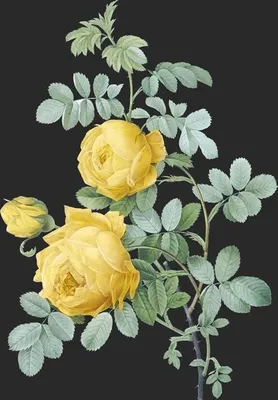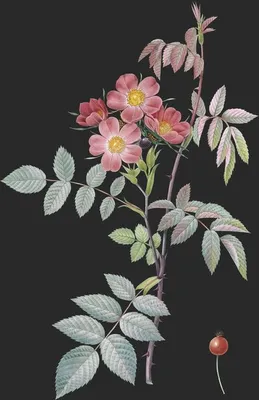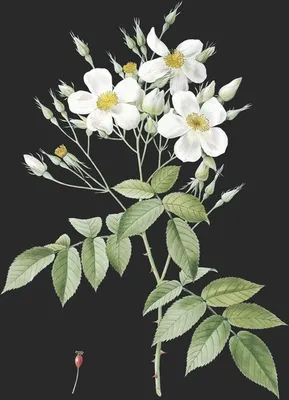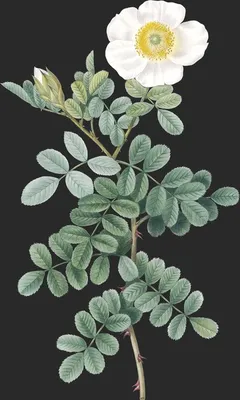
Rosa Reclinata var Flore Submultiplici
Le Rosier a Boutons Renversés
Le Rosier a Boutons Renversés
About this plate
Description
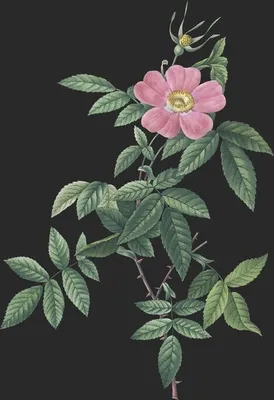
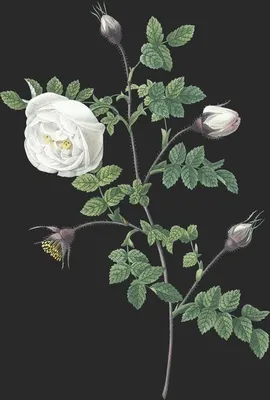
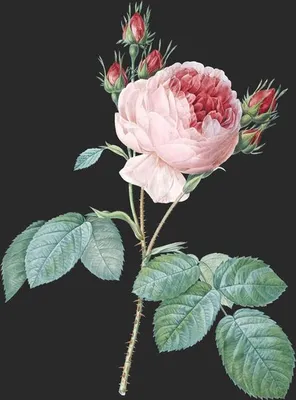
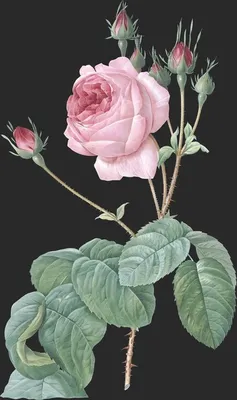
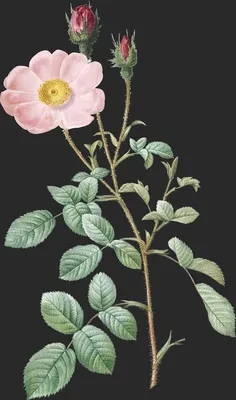
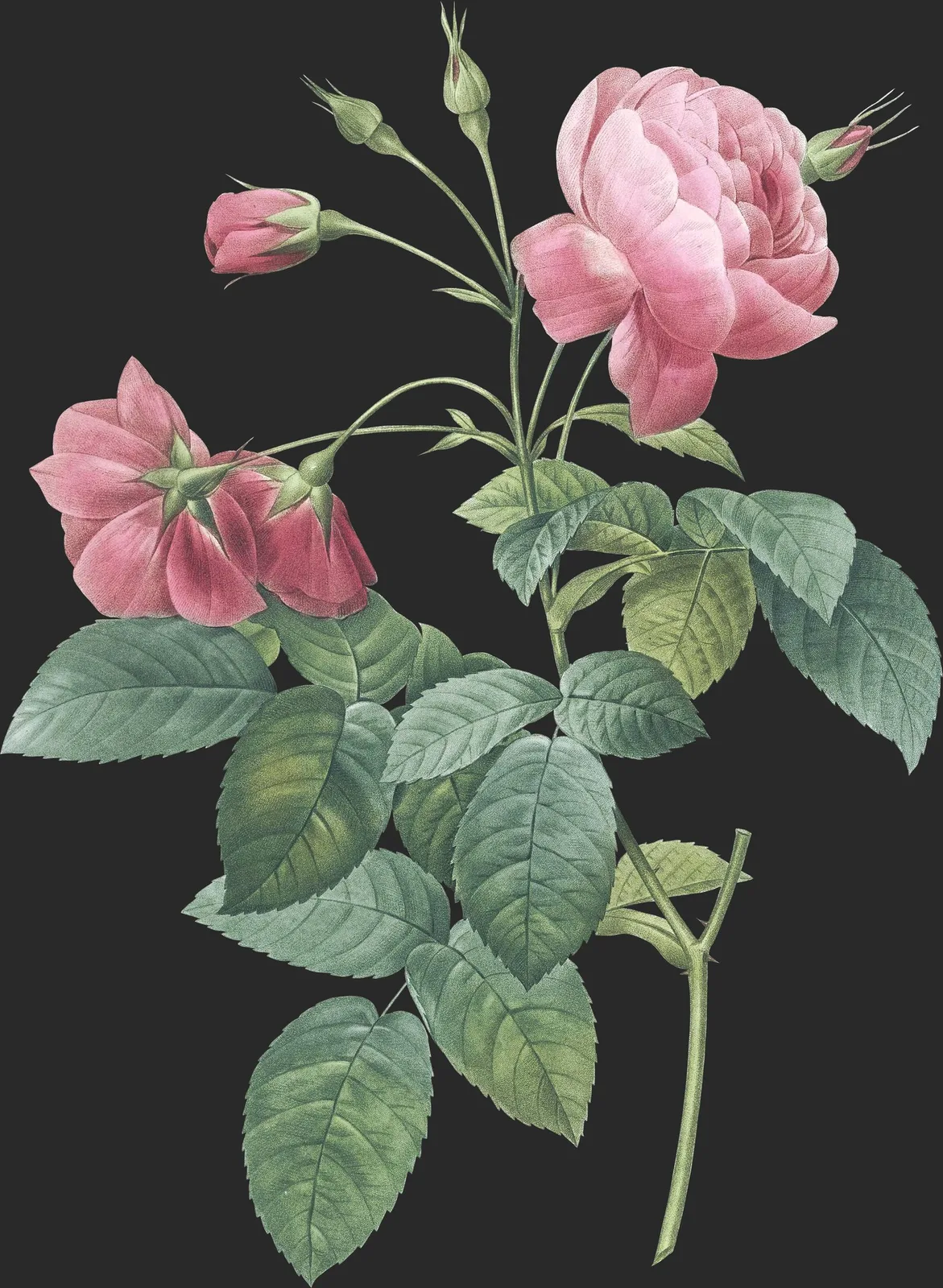
Les deux Rosiers qui nous occupent n’exigeront qu’une seule description, attendu qu’ils sont absolument les mêmes, avec la seule différence que l’un est à fleurs simples, et l’autre à fleurs composées d’une vingtaine de pétales.
Tous les deux sont susceptibles de s’élever à une très-grande hauteur si on a le soin de les palisser contre un treillage.. Les Rameaux sont généralement sans aiguillons: cependant il s’en rencontre parfois sur les branches inférieures. Les feuilles se composent de trois, cinq, et le plus souvent de sept folioles, glabres sur les deux faces, d’un vert-clair en-dessus, un peu plus pâle en-dessous, simplement dentées. Elles sont portées par un pétiole glabre, muni de petits aiguillons rougeâtres, ayant à sa base deux stipules décurrentes, pointues au sommet, denticulées en leur bord, lavées d’une teinte rouge dans leur jeu-nesse, et de couleur verdâtre au moment de la chute des feuilles. Les fleurs sont disposées plusieurs ensemble à l’extrémité des rameaux qui croissent le long des branches principales. Les boutons, avant l’anthèse, se courbent vers la terre d’une manière remarquable; mais ils se redressent avant l’épa-nouissement. Les tubes des calices sont courts, presque globu-leux, et glabres ainsi que les pédoncules et les divisions du limbe: ces mêmes divisions sont presque simples, aussi longues que les pétales, et dilatées en spatule au sommet. Les pétales sont échancrés en cœur, et d’un rose tendre. Le fruit est presque rond, et rouge à la maturité.
Observations
Le premier de ces Rosiers (celui à fleurs simples) est vraisemblablement un hybride issu d’un Rosier du Bengale et d’un Rosier des Alpes: il nous a été communiqué par M. Cugnot; il est assez rare. Le second, qui se trouve communément dans les jardins, et qu’on connaît sous le nom de Rosier Boursault, est un produit de la semence du premier. Tous deux se couvrent au printemps d’un grand nombre de fleurs qui persistent jusqu’à l’automne sur les pieds bien exposés. Ils n’exigent aucune culture.
R. germinibus subglobosis pedunculisque glabris; alabastris ante anthesin reclinatis; laciniis calycinis subintegris; caule subinermi. (N.)
Twelve ways of seeing
- measured cast red
- upright 1.37 : 1
- published 1824
- Plate 155
Not a catalogue entry but a way of looking: how to stand, what to notice, how the line was cut, when it flowers, where it came from, who made it — and then the poems and the classics that taught China to see the same flower. Read the twelve in order and the plate opens.
-
First Look
论画以形似,见与儿童邻。
—— 宋·苏轼《书鄢陵王主簿所画折枝》
To judge painting by likeness alone is the view of a child.
The sheet is vertical: the eye climbs and settles in the upper half. Let the plant stand before you look for detail. Then step in close: watch where colour meets line, and whether the line ever breaks. Third, find where the green is deepest: the whole tonal order is measured from that patch. The pose leans right: the upper half carries 9 points further right than the lower — a living thing, not a diagram.
-
Name and Thing
The binomial is Rosa reclinata: the first word is the genus it belongs among, the second the epithet that sets it apart. The genus name Rosa: Rosa is simply the Latin for rose, from Greek rhodon. No established Chinese name exists, so it is cited by its binomial alone.
-
Form and Colour
Measured on this plate: flower colour covers 8.2% of the sheet, foliage 11.2%, the cast red. No other plate shares exactly this measure. Roses are shrubs or scramblers with pinnate leaves of three to seven serrated leaflets; the double flowers open in crumpled, inward-curling layers around a small knot of yellow stamens. Filed under green — a moss green, a colour that comes mostly from leaf and stem. Read the outline, then the colour layers, then the brush.
-
Composition
Tall and narrow, the plant rising in one movement with generous margins — the upright format of most floras. (about 1.37 : 1) No details are appended: a plate for looking, not for keying out. The plant fills 39% of the sheet, centred near the centre — the herbarium way, drawn to be read whole. Blank paper is not unfinished work: it is where the eye rests.
-
Line and Colour
The first half of the nineteenth century moved from copper to steel to lithography; stipple could render the softest transition. Craft leaves franker evidence than inscriptions.
-
Season
Late spring into early summer, peaking in May — the first flush of the garden year. The year 1824 on the plate is that of publication, not of flowering — the gathering came a year or two earlier. The plate records ten days of peak; the other three hundred are leaf, fruit and rest.
-
Provenance
Widespread in the temperate north. Chinese gardeners knew roses since the Han; the ever-blooming modern rose is a nineteenth-century crossing of European and Chinese stock. In the same volume the kin are shelved together; set several plates side by side.
-
The Book and the Hand
“Les Roses” was drawn by Pierre-Joseph Redouté and published 1817-1824. This plate is Plate 155, book page 155. The image is public domain; the hand-colouring is still one person's hand.
-
Poetic Resonance
水晶帘动微风起,满架蔷薇一院香。
—— 唐·高骈《山亭夏日》
The crystal blind stirs as a breeze rises; a trellis of roses perfumes the whole courtyard.
The poem gives the mood first and the picture supplies the form; set the line beside the plate and the green the corolla becomes its resting point.
-
The Written Tradition
人无癖不可与交,以其无深情也。
—— 明·张岱《陶庵梦忆》
Never make a friend of a man without an obsession: he has no deep feeling.
Tradition places roses in the Han imperial park; Song and Ming manuals named the double forms 'Baoxiang' and 'Ten Sisters', and Qing compendia separated rose, rugosa and monthly rose. The difference is not of quality but of question: Europe asks what it is, China asks whom it resembles.
-
Symbolism
In Europe the rose means love and secrecy ('sub rosa'); in Chinese verse the rambling rose leans and clings — lingering attachment rather than ardour. In a flora it is a species first and a symbol second; the order is worth keeping.
-
What to Take Away
Next time you stand before a flowering plant, give it three minutes: leaf arrangement, direction of the flower, the darkest patch. The flower of that year is dust, yet its image on paper has outlived every living cousin.