Androdon æquatorialis
Androdon æquatorialis
Ecuadorian Tooth-bill
- 合集
- 古尔德蜂鸟图谱
- 绘者
- John Gould(约翰·古尔德)
- 年代
- 1887
- 图版号
- Pl. 361, Suppl. Vol.
- 原书页码
- p.361
- 授权
- CC0 1.0 Universal (Public domain)
关于本图版
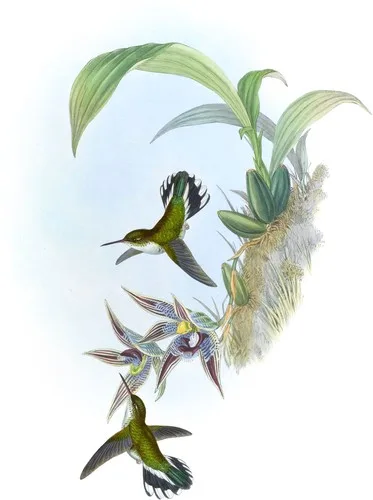
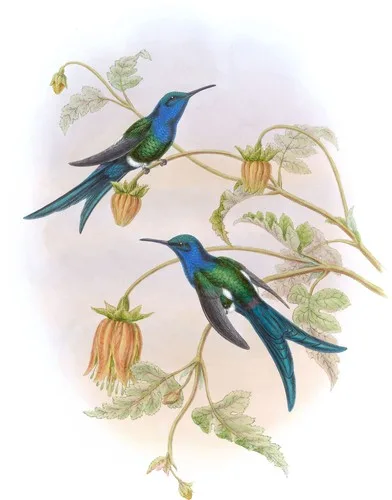
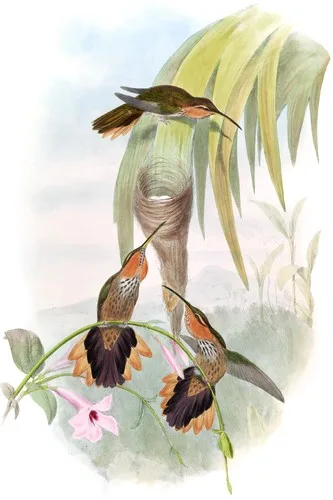
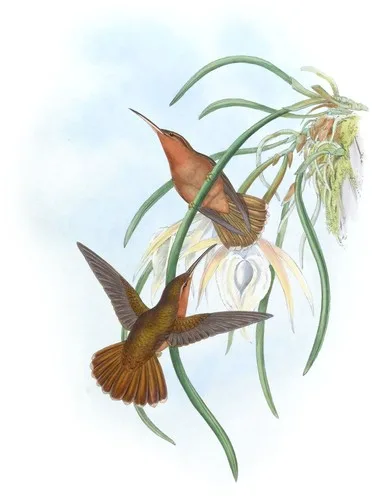
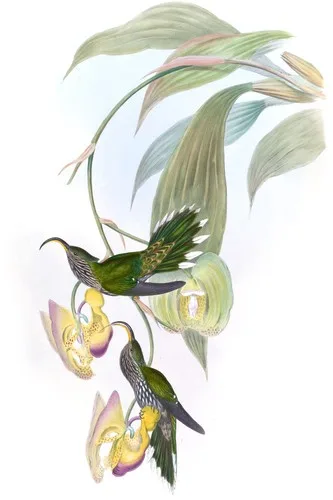
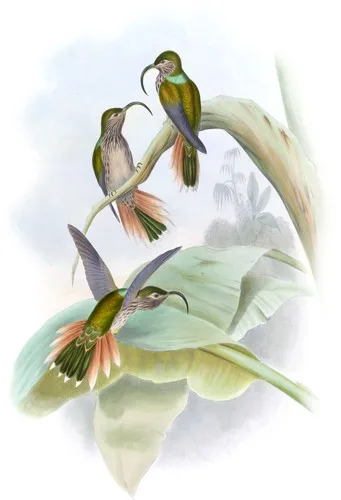
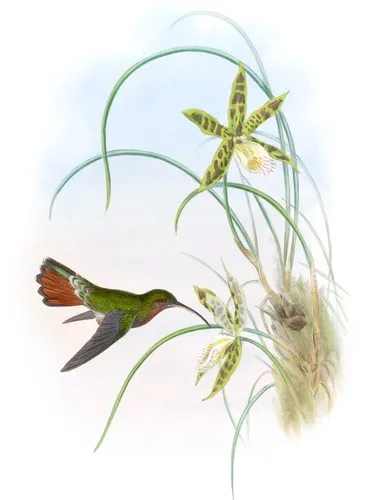
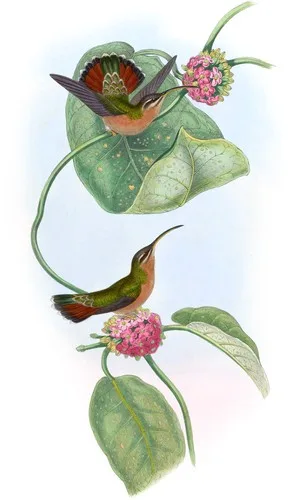
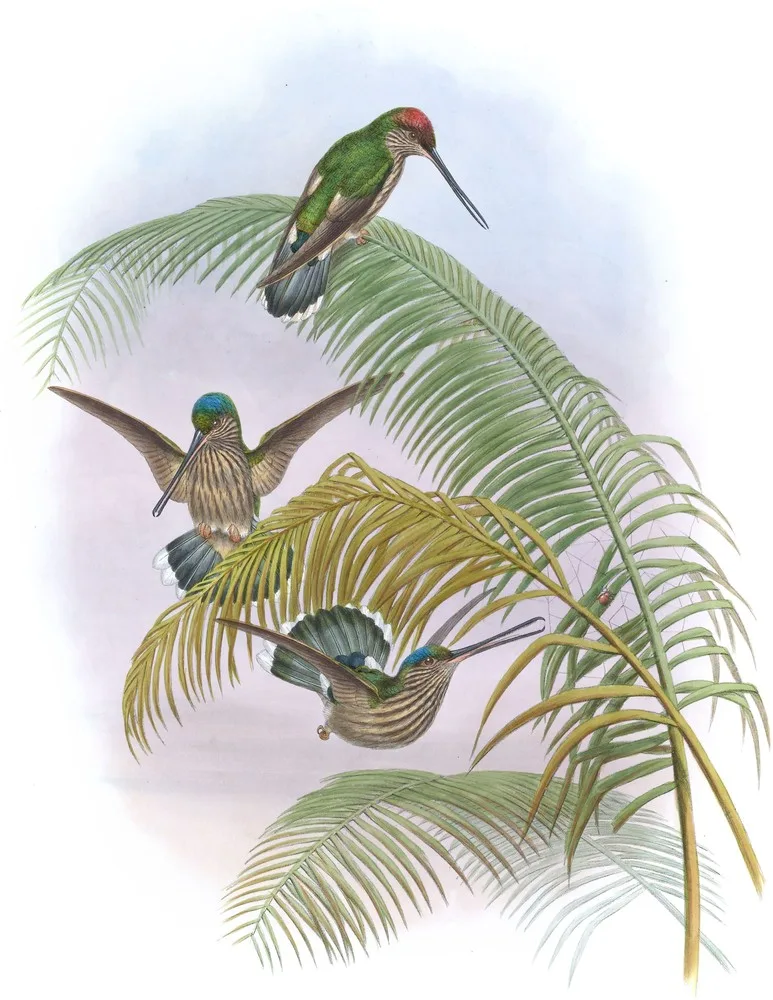
这幅图版出自《古尔德蜂鸟图谱》(Gould's Hummingbirds),由约翰·古尔德绘制,1849—1887 年间出版。图中描绘的是 Androdon æquatorialis,归入蜂鸟科(Trochilidae)。
全编共收录 421 幅图版,本图是其中一幅,原书将其列为 Pl. 361, Suppl. Vol.,见第 361 页,版式为纵幅。图像由公有领域原件扫描修复而来,细节在放大视图中仍清晰可辨。
原书文字(英文 / 法文)
Ecuador
It was a source of great pleasure to me that such an interesting form of Humming-bird had been discovered since my great Monograph was published.
Of this curious Humming-bird, according to my statement in the ‘Annals,’ I had but two specimens—one whose bill was armed with teeth, and a hook at the end of each mandible; the other was toothless in the same organ, and the upper bill did not end in a hook. Judging from this difference in the bills, the male only had teeth ending in a hook, the bill of the female is straighter and smooth at the edges, as will be seen by a glance at the drawing.
This singular form of Androdon has its alliances, although they are not very near; Gryphus, and Eutoxeres may be stated as two of them; these forms, I believe, run into Glaucis and Phaëthornis. The form about which I am now writing has moderately large wings, while the tail-feathers are half covered; tarsi and feet very small.
As I have never seen a line written on the history of the Ecuadorian Tooth-bill, I fear some repetition of my original description must be added; for myself, I literally do not know any thing about its habits and economy.
The following appeared in the ‘Annals ’:—
I send for insertion in your next Number a description of a new and very singular Humming-bird which I have lately received from Ecuador. Not only does it differ specifically from every other with which I am acquainted, but it also differs in its structure from every form comprised in the great family of Trochilidæ.
This new bird is so very singular that it is not easy to say to which section of the family it is most nearly related; but in some of its characters it assimilates with Gryphus, Eutoxeres, and Doryfera. In size it is about equal to Lampornis mango; the edges of its mandibles are thickly set with fine teeth, like those of Gryphus, but more strongly developed; the bill is very long for the size of the bird, and has rather an upward curvature; the wings are moderate in proportion to the body; and the tail is square or slightly rounded. The bird must be ranked among the dull-coloured species of its extensive family; at the same time it exhibits some approach to a metallic lustre in the blue or bronzy-red colouring of the hinder part of the crown. I say blue or bronzy-red, because the only specimens I have seen differ in this way, as they also do in the form of the bill,—the one with a blue crown having the toothing strongly developed, and the bill terminating in spiny hooks which cross each other when that organ is closed; whilst the other with a bronzy-red crown has a longer bill, the serrations are not developed, and the spiny hooks are wanting. The tarsi are partly bare of feathers; and the feet are small, pale in colour, and with very long black nails. The back in both is bronzy green; the rump apparently crossed with white feathers, while the upper tail-coverts are bluish; the tail-feathers are pale olive-grey at the base crossed with a band of blackish green near the tip, the three outer ones on each side being largely tipped with white; wings purplish brown, with epaulets of light grey, similar in form to those seen in Helianthea eos; all the under surface grey, with a conspicuous streak of blackish brown down the feathers of the throat, as in Eutoxeres.
Total length 5
inches, bill 1 , wing 1 , tail 1 . Hab. Ecuador.
References
- Androdon equatorialis, Gould, Ann. & Mag. Nat. Hist. 1863, vol. xii. p. 247.—Elliot’s Syn. p. 5, 1879.
- Gryphus æquatorialis, Muls. Hist. Nat. Ois.-Mouch. tom. i. p. 82, pl.