铜色蜂鸟属·Glaucis Mazeppa
Glaucis Mazeppa
Glaucis Mazeppa
Mazeppa Hermit
- 中文名
- 铜色蜂鸟属·Glaucis Mazeppa
- 学名
- Glaucis Mazeppa
- 合集
- 古尔德蜂鸟图谱
- 绘者
- John Gould(约翰·古尔德)
- 年代
- 1849
- 图版号
- Pl. 6, Vol. I
- 原书页码
- p.6
- 授权
- CC0 1.0 Universal (Public domain)
关于本图版
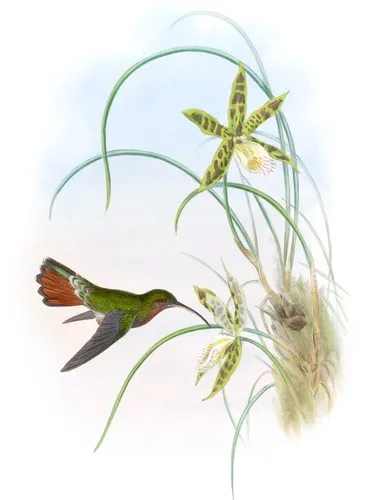
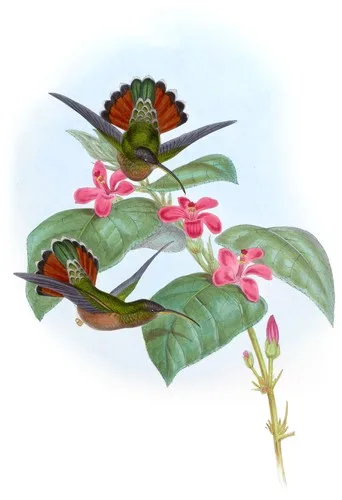
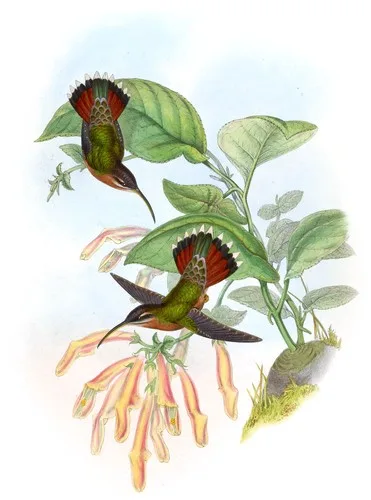
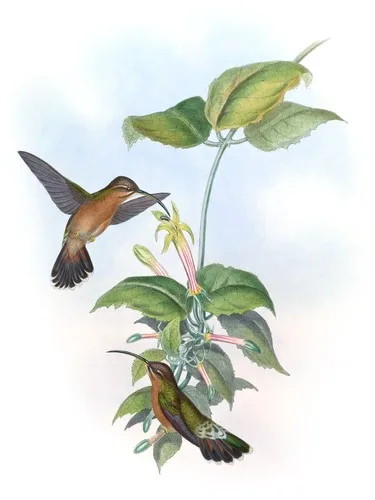
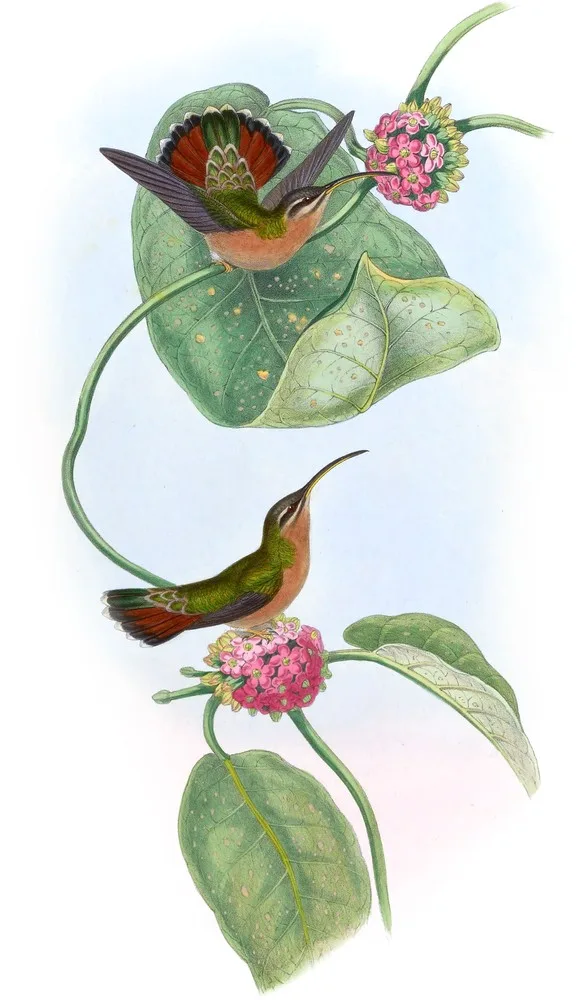
本图选自约翰·古尔德的《古尔德蜂鸟图谱》(Gould's Hummingbirds),原书 1849—1887 年间出版。图中描绘的是铜色蜂鸟,在分类体系中列于蜂鸟科(Trochilidae)。
该合集全编共 421 幅图版,此图为其中之一,图版编号 Pl. 6, Vol. I,对应原书第 6 页,版式为纵幅。扫描件取自公有领域原件,经高分辨率修复与色彩校正,可按原大放大查看线条与设色。
原书文字(英文 / 法文)
Cayenne, the Gunes and ihe fetanias of Trinidad and Tease
In figuring this bird as distinct from G. hirsuta, I must frankly admit that I am dealing with a difficulty in a manner which I believe no ornithologist can say is right or wrong.
It has for many years been questionable whether this small cinnamon-coloured bird be a distinct species or one of the sexes of G. hirsuta; and this doubt can never be satisfactorily solved until the bird has been observed in its native country while breeding, and dissection has been resorted to. As far as my experience goes, we find none of the little cinnamon-coloured birds, to which the term Mazeppa has been applied, in Southern Brazil or in the Andes of New Granada. In the former country the true G. hirsuta is common; and Mr. Lawrence’s G. affinis is abundant in the Andes. I must not fail to remark, however, that the true G. hirsuta, besides being found in Southern Brazil, is also an inhabitant of the Guianas and Trinidad—localities of which the G. Mazeppa is also a native. Under these circumstances of uncertainty I have thought it best to give a figure of this bird on a separate plate, which will at least serve to bring the matter prominently into view, and, I trust, be the means of directing the attention of persons who reside in those countries, particularly Trinidad, to the investigation of the subject, so as to set the question at rest.
I believe that the following note by Mr. Kirk has reference to this bird, as I have a specimen in my collection bearing his name and the locality of Tobago on the attached label.
“This little bird is the most restless of all the Humming-Bird tribe; it can scarcely be said to be seen at rest, but darting right and left, zigzag; at times, when suddenly surprised feeding, uttering a sharp squeak, it will dart off and disappear like a meteor; at other times it will seem as if suspended for several seconds by the point of the bill within three feet of a person’s face, after which it is sure to disappear like lightning; in these cases it truly assumes an attitude which a stranger might construe into a meditated attack upon his person. I have often been induced to strike at them with my fowling piece, from their proximity.”
—‘Horæ Zoologicæ,’ by Sir W. Jardine, Bart., in Ann. and Mag. Nat. Hist. vol. xx. p. 372.
Crown of the head dull brown; all the upper surface, wing- and tail-coverts bronzy green, the latter fringed with grey; wings purplish brown; under surface deep fawn-colour fading into buffy white on the chin; a small mark behind and a stripe below each eye of buffy white; two centre tail-feathers green at the base, the remainder rich deep cinnamon red at the base, the whole crossed near the extremity by a band of black, beyond which the tips are white; upper mandible black; lower mandible yellow at the base, black at the tip; feet yellow or flesh-colour.
The figures are of the size of life. The plant is the Marsdenia maculata.
References
- Trochilus Mazeppa, Less. Les Troch., p. 18. pl. 3; Jard. Nat. Lib. Humming-Birds, vol. ii. p. 130.
- Phacthornis Mazeppa, Jard. Nat. Lib. Humming Birds, vol. ii. p. 152.
- Phacthornis hirsutus, Jard. in Ann. and Mag. Nat. Hist., vol. xx. p. 372.
- Polytmus mazeppa, Gray & Mitch. Gen. of Birds, vol. ii. p. 108, Polytmus, sp. 32.
- Glaucis Mazeppa, Reichenb. Aufz. der Col., p. 15.