翘嘴蜂鸟
Avocettula recurvirostris
Avocettula recurvirostris
Fiery-tailed Avocet
- 中文名
- 翘嘴蜂鸟
- 学名
- Avocettula recurvirostris
- 合集
- 古尔德蜂鸟图谱
- 绘者
- John Gould(约翰·古尔德)
- 年代
- 1852
- 图版号
- Pl. 201, Vol. III
- 原书页码
- p.201
- 授权
- CC0 1.0 Universal (Public domain)
关于本图版
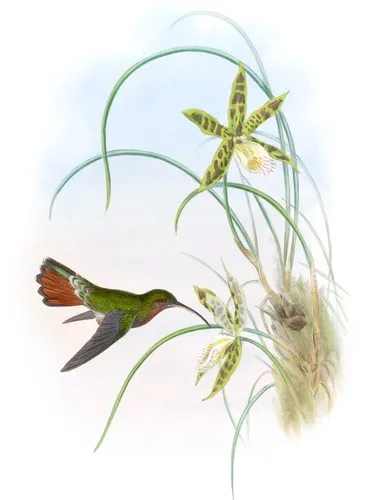
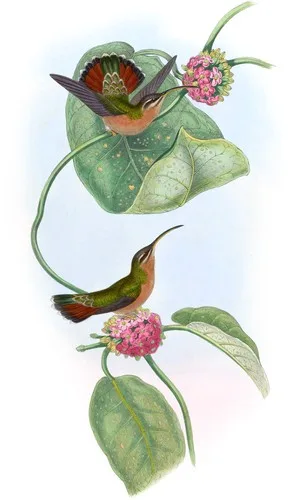
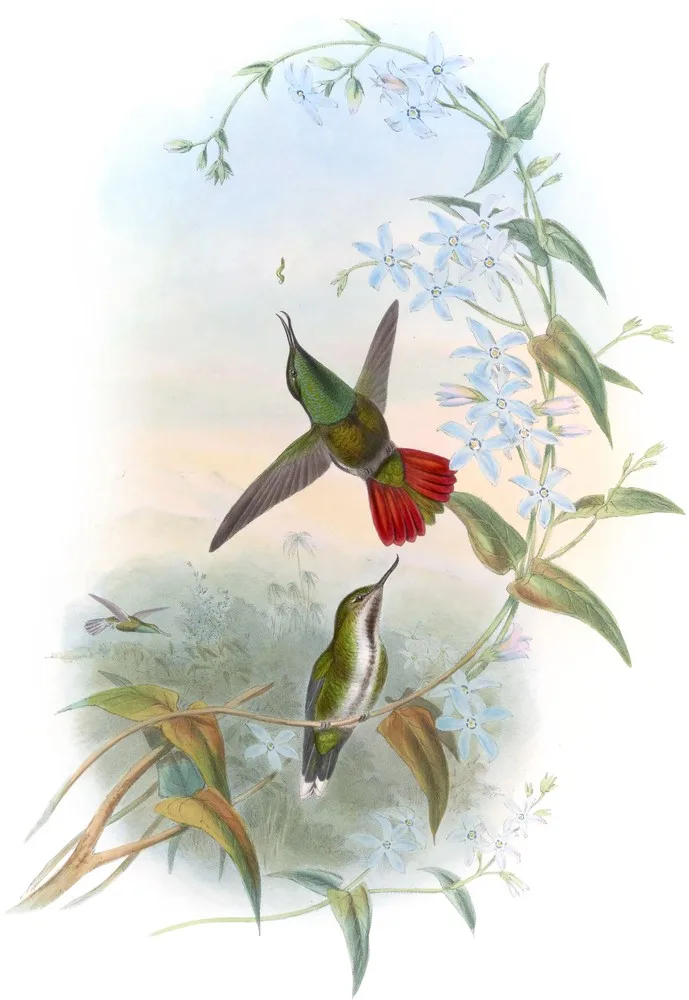
《古尔德蜂鸟图谱》(Gould's Hummingbirds)由约翰·古尔德绘制,1849—1887 年间印行,本图即其中一幅。图中描绘的是翘嘴蜂鸟,学名 Avocettula recurvirostris,在分类体系中列于蜂鸟科(Trochilidae)。
该合集全编共 421 幅图版,此图为其中之一,图版编号 Pl. 201, Vol. III,对应原书第 201 页,版式为纵幅。图像由公有领域原件扫描修复而来,细节在放大视图中仍清晰可辨。
原书文字(英文 / 法文)
The Guianas
The earliest record of the existence of this interesting bird will be found in the second volume of Swainson’s “Zoological Illustrations,” where a unique specimen, purchased by him at the sale of Bullock’s celebrated Collection, is figured and described.
He states that Bullock had received it from Peru; but all the specimens that have come under my notice have been collected in Cayenne and Demerara, and these, with the immediately adjoining countries, constitute, I believe, its true habitat: this may not, however, be the limit of its range, and it is possible that it may visit the distant country of Peru, but I think it very unlikely that it does, and apprehend that Bullock must have been misinformed as to the locality in which his specimens were procured. In the absence of any positive information respecting the habits and economy of this species, or the peculiar adaptation of its singularly-formed bill, Swainson has ventured upon the following hypothesis, which I repeat, without being able to verify or deny it in any particular:—
The extraordinary formation in the bill of this beautiful little creature is without parallel in any landbird yet discovered, and presents in miniature a striking resemblance to that of the Avoset. It is almost impossible to conjecture rightly the use of this singular formation; but it appears to me not very improbable, that the principal sustenance of the bird may be drawn from the pendent Bignonie, and other similar plants, so common in South America, whose corolla are long, and generally bent in their tube: the nectar being at the bottom, could not be readily reached either by a straight or incurved bill, though very easily by one corresponding to the shape of the flower.
At least three very distinct states of plumage characterize this species. In the fully adult, the green breast and the fiery under surface of the outer tail-feathers are the conspicuous features. In younger males, even after the bird has acquired the green on the throat, the tail is greenish or purplish black, with the three outer feathers tipped with white. In the females or young of the year (it is uncertain which), the throat and centre of the abdomen are black, bounded on either side by a streak of white; in this state, too, the outer tail-feathers are tipped with white.
I may remark that the Avocettula recurvirostris is by no means a common bird in the collections of Europe, and a long time will probably elapse before we are made acquainted with the peculiar purpose for which its curiously-formed bill is adapted.
M. Bourcier considers that the Ornismya avocetta of M. Lesson is the young of this species; in which opinion I coincide; but I believe that the specimen from which M. Lesson’s figure was taken had the tail of some other species surreptitiously appended to it instead of its own.
M. Bourcier informs me, that the Avocettula recurvirostris is found in Cayenne, that it is rare there, and that the chasseurs only meet with it in the interior of the great forests, where it lives isolated.
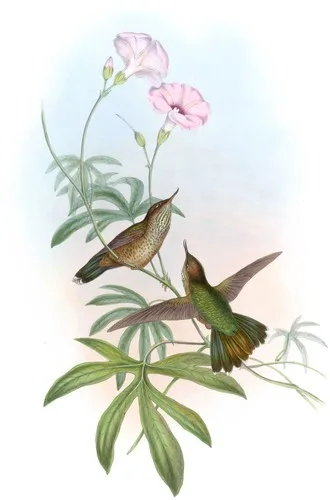
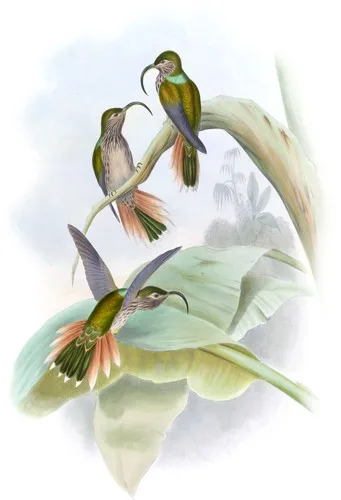
The male has the whole of the upper surface, abdomen, and under tail-coverts golden green; throat and breast shining emerald-green; down the centre of the abdomen a stripe of black; wings dark purplish black; thighs white; two centre tail-feathers greenish blue, the remainder coppery brown, margined on the basal half of the external web with bronzy green; under surface of all the tail-feathers rich, shining, fiery copper colour; bill and feet blackish brown.
At a younger age the colouring of the body and wings is very similar, but the tail is bronzy purple, tipped with white.
In another state, which may be that of the female or a young bird of the year, the centre of the throat and abdomen is brownish black, bounded on each side from the angle of the mouth with an irregular streak of white; the tail dark purple, glossed with green, and the lateral feathers, particularly the outer ones, largely tipped with white.
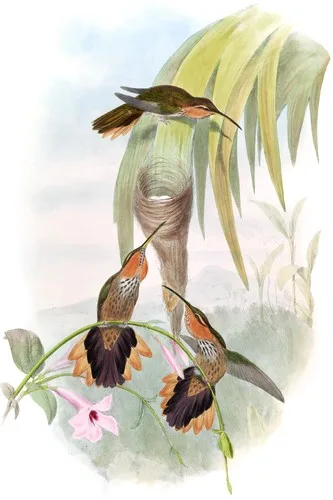
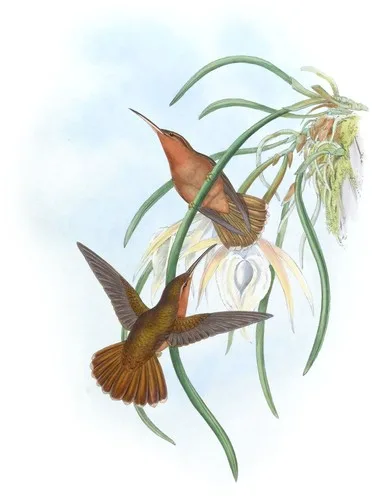
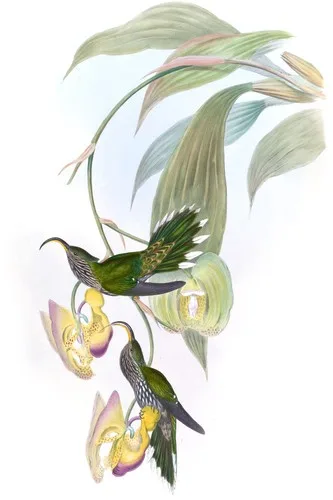
The figures represent a fully adult male and a female, or young bird of the year, of the size of life. The plant is the Tweedia versicolor.
References
- Trochilus recurvirostris, Swains. Zool. Il., vol. i. pl. 105.—Jard. Nat. Lib. Humming Birds, vol. i. p. 80. pl. 3.
- Mellisuga? recurvirostris, Steph. Cont. of Shaw’s Gen. Zool., vol. xiv. p. 248.
- Ornismya recurvirostris, Less. Hist. Nat. des Ois. Mou., p.129. pl. 37.—Ib. Supp., p. 166. pl. 34. —Ib. Traité d’Orn., p. 284.
- Campylopterus recurvirostris, Swains. Class. of Birds, vol. ii. p. 330.
- Hylocharis recurvirostris, Gray and Mitch. Gen. of Birds, vol. i. p. 114, Hylocharis, sp. 11.
- Curve-billed Humming Bird, Lath. Gen. Hist., vol. iv. p. 358.
- Avocettinus recurvirostris, Bonap. Consp. Gen. Av., p. 79, Avocettinus, sp. 1.
- Avocettula recurvirostris, Bonap. Rev. et Mag. de Zool. 1854, p. 256.—Reichenb. Aufz. der Colibris, p. 6.—Ib. Troch. enumer., p. 3. pl. dclxxix. figs. 4485–4489.
- Ornismya avocetta, Less. Supp. Hist. Nat. des Ois. Mou., p. 145. pl. 24.—Ib. Les Troch., p. 74. pl. 23.—Jard. Nat. Lib. Humming Birds, vol. i. p. 78. pl. 2.
- Avocettinus lessoni, Bonap. Consp. Gen. Av., p. 79, Avocettinus, sp. 2.
十观
- 纵幅 1.45∶1
- 1852 年刊
- 图版 201, Vol. III
第一眼
夫象物必在于形似,形似须全其骨气。
—— 唐·张彦远《历代名画记》
形似只是门槛,骨气才是要害。看一株植物,先看它立不立得住——这就是骨气。这一幅是竖的:眼睛从下往上走,落点在中段那只鸟身上。先别急着看羽毛,让姿态先立起来。第二步凑近一寸:看线与色的交界,色有没有压住线,线有没有断。第三步,把视线放到最深的那一小块:整幅的用色秩序,都是从那里排开的。
名与实
学名 Avocettula recurvirostris:前一词是属,管它归在哪一类;后一词是种加词,管它在这一类里凭什么与众不同。一百多年前的命名者,把一种植物的来历压进了两个词。中文名“翘嘴蜂鸟”是后人据学名回译的通行叫法,与古书里的旧名未必对得上——名与物之间,总隔着一层翻译。
形与色
翼小而振频极高,能悬停、能倒飞;羽色非颜料所致,是羽枝结构折射的光,随角度而变。此幅未作色相归档,只能就形制论。看羽:先看覆羽的层次,再看飞羽的排列,最后才看颜色——颜色是最后才被注意到的部分。
构图与呼吸
画幅高而窄,鸟栖在枝的中段,上下留白多——十九世纪鸟谱的标准版式,留给它飞走的余地。(高宽比约 1.45∶1)全幅只画一只,不作解剖附图——这类图更近于“观赏”,而非“鉴定”。老图谱爱把主株摆在偏中线的位置,左右留得不一样多:这一点偏心,正是画面活起来的原因。
一刀一色
十九世纪后半叶,石版与彩色石印渐成主流:颜色可以直接印出,不再依赖手工,线条反倒退居其次。图像的“准确”提高了,手性却淡了。先判断它是“印”的还是“画”的,再谈好不好看——这是看老版画最实用的一条规矩。想动笔临它的人记住一句:先铺大块的形与色,干后再收细部;石印的柔和层次来自薄涂与网点,水彩分两三遍淡铺即可逼近。
诗境
夫列子御风而行,泠然善也,旬有五日而后反。
—— 《庄子·逍遥游》
蜂鸟悬停于空,不落不飞,最近于“御风”。庄子说的是一种自由的姿态,蜂鸟把它做成了生理事实。古人写到这一层,已不只是赏花,是借花说人;画面则只负责把那朵花留住。
花语
阿兹特克以蜂鸟为战神与太阳的化身;欧洲维多利亚时代则以蜂鸟为收藏与装饰的极致,百万只羽毛被做成胸饰。中国旧籍无此鸟,故无象征——这空白本身,就是一部博物学交流史。花语是给人与人的关系用的;植物自己只关心有没有传粉的虫。这两套语言,可以并行不悖。
时与地
温带种类的蜂鸟则随花北迁,一年往返数千公里。仅产美洲,自阿拉斯加南部至火地岛,以安第斯山最为繁盛。中土无蜂鸟,汉籍不载,晚清海外游记始见其名。图上所记的 1852 年是刊行之年,不是采到那只鸟的年份;真正的观察记录通常比出版早一两年。图上的产地常是“据说来自”,图上的花期常是“盛开那十日”——两处都要打个折扣读。
书与人
《古尔德蜂鸟图谱》(Gould's Hummingbirds)由约翰·古尔德绘,成于1849-1887。此幅为其中图版 201, Vol. III,见原书第 201 页。图版今属公有领域,可以自由取用;但纸上那层手工上色,仍是两百年前某一个人的手。
带走一双眼睛
把这三件事带走:先整体后细节;先线后色;先看画再翻书。任何一张老图版,都可以用这三条读。1852 年的那只鸟早已化作尘土,它留在纸上的样子,却比任何一只活着的同类都长寿。