瑰丽蜂鸟属
Calothorax cyanopogon
Calothorax cyanopogon
Mexican Star
- 中文名
- 瑰丽蜂鸟属
- 学名
- Calothorax cyanopogon
- 合集
- 古尔德蜂鸟图谱
- 绘者
- John Gould(约翰·古尔德)
- 年代
- 1852
- 图版号
- Pl. 143, Vol. III
- 原书页码
- p.143
- 授权
- CC0 1.0 Universal (Public domain)
十观
- 纵幅 1.43∶1
第一眼
六法者何?一、气韵生动是也;二、骨法用笔是也;三、应物象形是也;四、随类赋彩是也;五、经营位置是也;六、传移模写是也。
—— 南齐·谢赫《古画品录》
一千五百年前的六条标准:气韵、用笔、形似、设色、构图、临摹。你在这幅图上一样样对过去,就是一次完整的读画。这一幅是竖的:眼睛从下往上走,落点在中段那只鸟身上。先别急着看羽毛,让姿态先立起来。第二步凑近一寸:看线与色的交界,色有没有压住线,线有没有断。第三步,把视线放到最深的那一小块:整幅的用色秩序,都是从那里排开的。
名与实
学名 Calothorax cyanopogon:前一词是属,管它归在哪一类;后一词是种加词,管它在这一类里凭什么与众不同。一百多年前的命名者,把一种植物的来历压进了两个词。中文名“瑰丽蜂鸟属”是后人据学名回译的通行叫法,与古书里的旧名未必对得上——名与物之间,总隔着一层翻译。
形与色
蜂鸟为美洲最小之鸟,喙细长如针,舌分叉成管,可伸入花心吸蜜;翼小而振频极高,能悬停、能倒飞。此幅未作色相归档,只能就形制论。别只看花:叶脉的走向、萼片的长短、甚至茎上的毛,都是画家用来区分物种的证据。
构图与呼吸
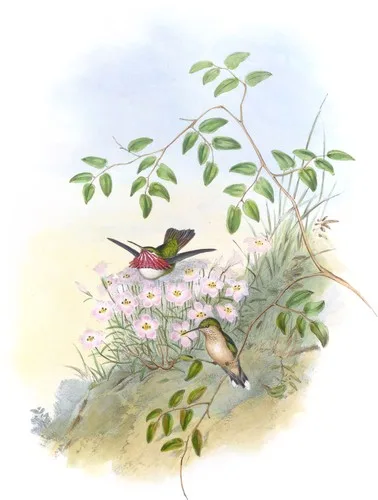
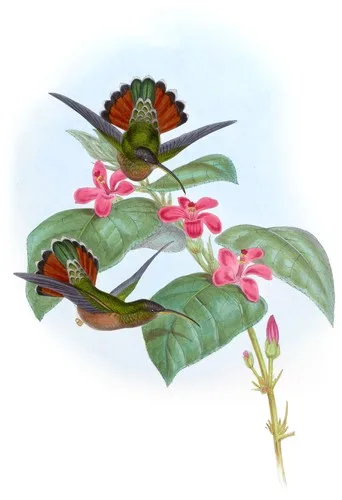
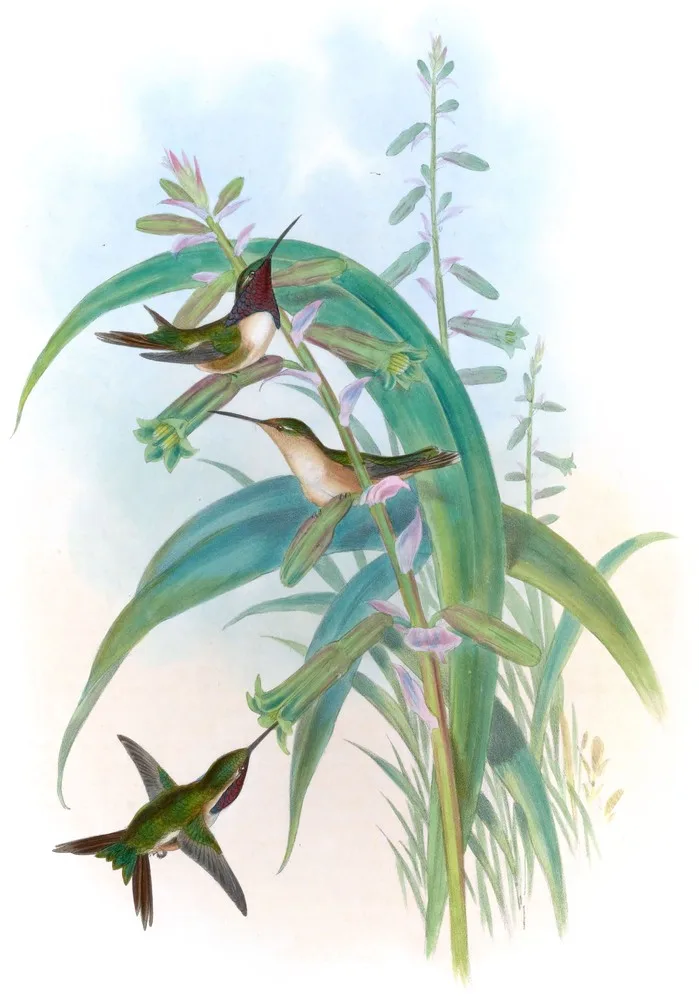
画幅高而窄,鸟栖在枝的中段,上下留白多——十九世纪鸟谱的标准版式,留给它飞走的余地。全幅只画一只,不作解剖附图——这类图更近于“观赏”,而非“鉴定”。试着用拇指遮住空白处——画面立刻变闷;放开,它才重新“喘上气”。留白,是给主体让出的气口。
一刀一色
十九世纪后半叶,石版与彩色石印渐成主流:颜色可以直接印出,不再依赖手工,线条反倒退居其次。图像的“准确”提高了,手性却淡了。拿放大镜(或手机微距)看三处:喙缘、覆羽、题名。线若连续不断,是刻的;色若越过轮廓半毫米,是手涂的。想动笔临它的人记住一句:先铺大块的形与色,干后再收细部;石印的柔和层次来自薄涂与网点,水彩分两三遍淡铺即可逼近。
诗境
夫列子御风而行,泠然善也,旬有五日而后反。
—— 《庄子·逍遥游》
蜂鸟悬停于空,不落不飞,最近于“御风”。庄子说的是一种自由的姿态,蜂鸟把它做成了生理事实。诗以气行,画以形立;两种“看”叠在一起,才是看画的意思。
花语
阿兹特克以蜂鸟为战神与太阳的化身;欧洲维多利亚时代则以蜂鸟为收藏与装饰的极致,百万只羽毛被做成胸饰。中国旧籍无此鸟,故无象征——这空白本身,就是一部博物学交流史。花语是后人添上去的,花本身并不知道;但这层“不知道”,正是它最动人的地方。
时与地
热带美洲几乎全年可见,花期即其季节。仅产美洲,自阿拉斯加南部至火地岛,以安第斯山最为繁盛。中土无蜂鸟,汉籍不载,晚清海外游记始见其名。图上所记的 1852 年是刊行之年,不是采到那只鸟的年份;真正的观察记录通常比出版早一两年。图上的产地常是“据说来自”,图上的花期常是“盛开那十日”——两处都要打个折扣读。
书与人
《古尔德蜂鸟图谱》只署了约翰·古尔德一个人的名字。版画是集体工程:绘图、刻版、上色各有其人,真正决定这幅图好不好看的,常是没留下名字的刻工与上色师。
带走一双眼睛
鉴赏力不是知识,是习惯:每次多看一眼,十年之后你看什么都和别人不一样。图谱的用意是“以备查考”,看久了却会忘记查考:1852 年的一个人,为一只鸟花了整整一天。
关于本图版
此图原刊于《古尔德蜂鸟图谱》(Gould's Hummingbirds),绘者为约翰·古尔德,成书于 1849—1887 年间。瑰丽蜂鸟(Calothorax cyanopogon)是本图的主角,归入蜂鸟科(Trochilidae)。
全编共收录 421 幅图版,本图是其中一幅,原书将其列为 Pl. 143, Vol. III,见第 143 页,版式为纵幅。扫描件取自公有领域原件,经高分辨率修复与色彩校正,可按原大放大查看线条与设色。
原书文字(英文 / 法文)
The table land of Northern Mexico
This beautiful species, so well known by its trivial name of “Mexican Star,” is a denizen of the table-lands of that rich country Xalapa, the land of perpetual spring and of an unsurpassed climate.
It was in this fine region that the bird came under the observation of the late Mr. Bullock, to whom we are indebted for all that is known respecting it, and which is comprised in the following extracts from his “Six Months in Mexico”:—
The house I resided in at Xalapa for several weeks was only one story high, enclosing, like most of the Spanish houses, a small garden in the centre, the roof projecting six or seven feet from the walls, covering a walk all round, and leaving a small space only between the tiles and the trees which grew in the centre. From the edges of these tiles to the branches of the trees in the garden, the spiders had spread their innumerable webs so closely and compactly that they resembled a net. I have frequently watched, with much amusement, the cautious peregrination of the Humming-Bird, who, advancing beneath the web, entered the various labyrinths and cells in search of entangled flies; but as the larger spiders did not tamely surrender their booty, the invader was often compelled to retreat: being within a few feet, I could observe all their evolutions with great precision. The active little bird generally passed once or twice round the court, as if to reconnoitre his ground, and commenced his attack by going carefully under the nets of the wily insect, and seizing by surprise the smallest entangled flies, or those that were most feeble. In ascending the angular traps of the spider, great care and skill was required; sometimes he had scarcely room for his little wings to perform their office, and the least deviation would have entangled him in the complex machinery of the web, and involved him in ruin. It was only the works of the smaller spider that he durst attack, as the larger sort rose to the defence of their citadels, when the besieger would shoot off like a sunbeam, and could only be traced by the luminous glow of his refulgent colours. The bird generally spent about ten minutes in this predatory excursion, and then alighted on a branch of the Avocata to rest and refresh himself, placing his crimson star-like breast to the sun, which then presented all the glowing fire of the ruby, and surpassed in lustre the diadem of monarchs. Europeans who have seen only the stuffed remains of these little feathered gems in museums have been charmed with their beautiful appearance; but those who have examined them whilst living, displaying their moving crests, throats and tails, like the Peacock, in the sun, can never look with pleasure on their mutilated forms. I have carefully preserved about two hundred specimens, in the best possible manner, yet they are still but the shadow of what they were in real life. The reason is obvious; for the sides of the lamine, or fibres of each feather, being of a different colour from the surface, will change when seen in a front or oblique direction; and as each lamina or fibre turns upon the axis of the quill, the least motion, when living, causes the feathers to change suddenly to the most opposite hues. Thus the one from Nootka Sound changes its expanded throat from the most vivid fire-colour to light green; the Topaz-throated does the same, and the Mexican Star changes from bright crimson to blue.
The sexes vary greatly in their plumage, so much so that the male and female could not have been known had they not been seen constantly together, and proved to be so by dissection. They breed in Mexico in June and July; and the nest is a beautiful specimen of the architectural talent of these birds: it is neatly constructed with cotton or the down of thistles, to which is fastened on the outside, by some glutinous substance, a white, flat lichen resembling ours.
The female lays two eggs, perfectly white, and large for the size of the bird; and the Indians informed me they were hatched in three weeks by the male and female sitting alternately, Ww hen attending their young, they attack any bird indiscriminately that approaches the nest. Their motions when under the influence of anger or fear are very violent, and their flight rapid as an arrow—the eye cannot follow them; but the shrill piercing shriek which they utter on the wing may be heard when the bird is invisible. They attack the eyes of the larger birds, and their sharp needle-like bill is a truly formidable weapon in this kind of warfare. Nothing can exceed their fierceness when one of their own species invades their territory during the breeding season. Under the influence of jealousy they become perfect furies; their throats swell, their crests, tails and wings expand; they fight in the air (uttering a shrill noise) till one falls exhausted to the ground. I witnessed a combat of this kind near Otumba, during a heavy fall of rain, every separate drop of which I supposed sufficient to have beaten the puny warriors to the earth.
In sleeping they frequently suspend themselves by the feet, with their heads downwards, in the manner of some Parrots.
These birds were great favourites of the ancient Mexicans. ‘They used the feathers as ornaments for their superb mantles in the’ time of Montezuma, and in embroidering the pictures so much extolled by Cortez. Their name signifies in the Indian language ‘beams or locks of the sun’: and their feathers are still worn by the Indian ladies as ornaments for the ears.
I have numerous specimens of this bird in my collection, and observe that those procured in one locality differ somewhat from those obtained in another; for instance, the examples collected by my friend Floresi in the neighbourhood of the Real del Monte Mines are larger and altogether more powerful birds than those brought to this country by M. Salle and other collectors from Cordova. Bullock speaks with great truth when he states that the sexes differ considerably, for it is only those persons who are conversant with this extensive group as a whole, who can, with any degree of certainty, pair many of the species.
I have not yet seen this species from Guatemala; neither has it, so far as my knowledge extends, been procured in Texas; consequently Mexico Proper must be considered its restricted habitat.
It is just possible that this bird may be the Cynanthus Lucifer of Swainson, in which case his name ought to have the priority, but from the curtness of his description it is very difficult to decide this point; it is certainly the bird figured by Lesson under the name of cyanopogon; I have therefore adopted that appellation, which, moreover, has the advantage of being appropriate, while the other is not.
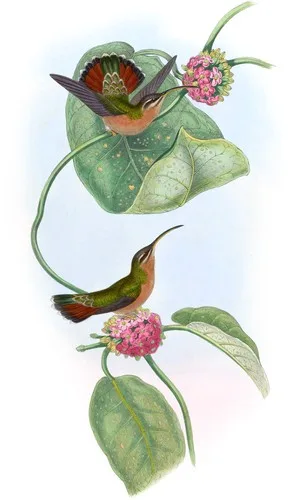
The male has the head, upper surface, wing- and tail-coverts bronzy-green; wings purple-brown; tail darker purple-brown; chin, chest, and elongated feathers on the sides of the neck changeable deep metallic purple; breast buffy-white; flanks and centre of the abdomen bronzy-green; vent and under tail-coverts white; bill and feet blackish-brown.
The female has the head and upper surface bronzy-green; wings pale purplish-brown; four central tailfeathers dark bronzy-green; the lateral feathers sandy-buff at the base, then black, and tipped with white; under surface white, stained with buff, particularly on the flanks and under tail-coverts.
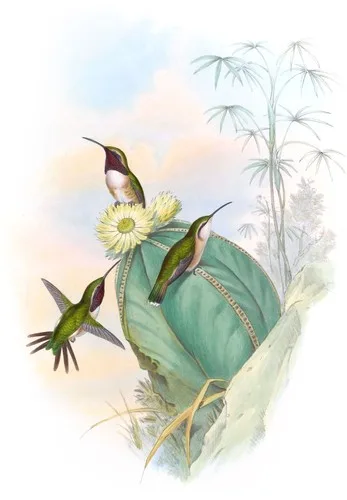
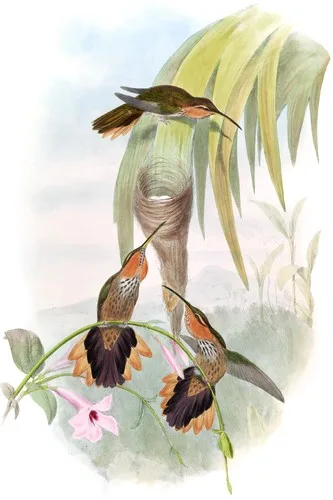
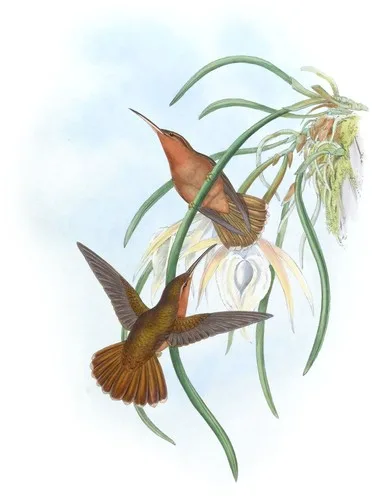
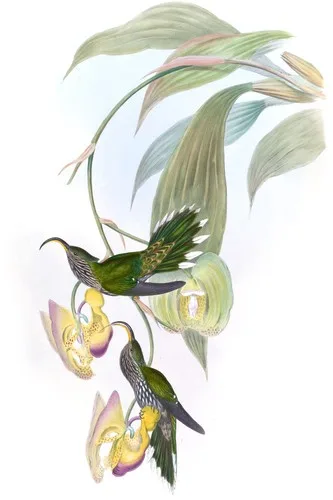
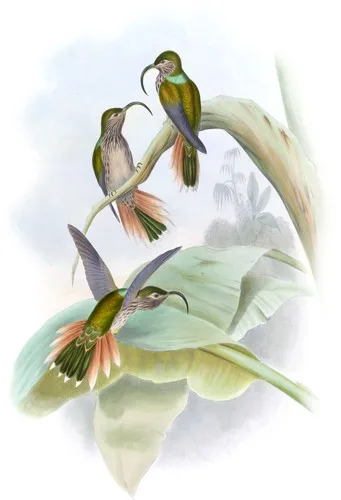
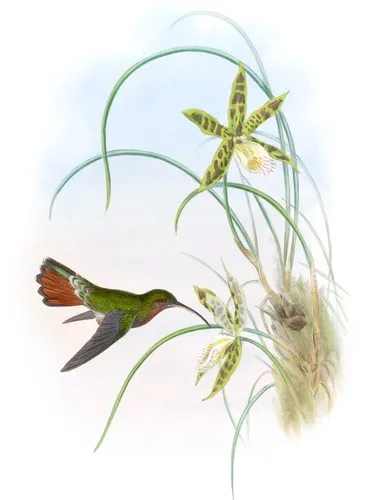
The Plate represents two males and a female, of the natural size. The plant is the Beschorneria tubiflora.
References
- Cynanthus Lucifer, Swains. in Phil. Mag. 1827, p. 442?
- Ornismya cyanopogon, Less. Hist. Nat. des Ois. Mou., p. 50. pl. 5.—Ib. Supp. à l’Hist. Nat. des Ois. Mou., pp. 117, 119. pls. 9, 10.—Ib. Traité d’Orn., p. 274.—Ib. Ind. Gen. et Syn. des Ois. du Gen. Trochilus, p. xxiii.
- Calothorax lucifer, Gray and Mitch. Gen. of Birds, vol. i. p. 110, Calothorax, sp. 10.—Bonap. Consp. Gen. Av., p: 85, Calothorax, sp. 1.
- Trochilus cyanopogon, Jard. Nat. Lib. Humming-Birds, vol. ii. pl. 14.
- Trochilus lucifer, Jard. Nat. Lib. Humming-Birds, vol. ii. p. 79.
- Lucifer cyanopogon, Reich. Aufz. der Col., p. 13.—Bonap. Rev. et Mag. de Zool. 1854, p. 257.
- Trochilus simplex, Less. Traité d’Orm., p. 291?—Ib. Hist. Nat. des Col., p. 86. pl. 23?