Campyloterus lazulus
Campyloterus lazulus
Lazuline Sabre-wing
- 学名
- Campyloterus lazulus
- 合集
- 古尔德蜂鸟图谱
- 绘者
- John Gould(约翰·古尔德)
- 年代
- 1850
- 图版号
- Pl. 44, Vol. II
- 原书页码
- p.44
- 授权
- CC0 1.0 Universal (Public domain)
关于本图版
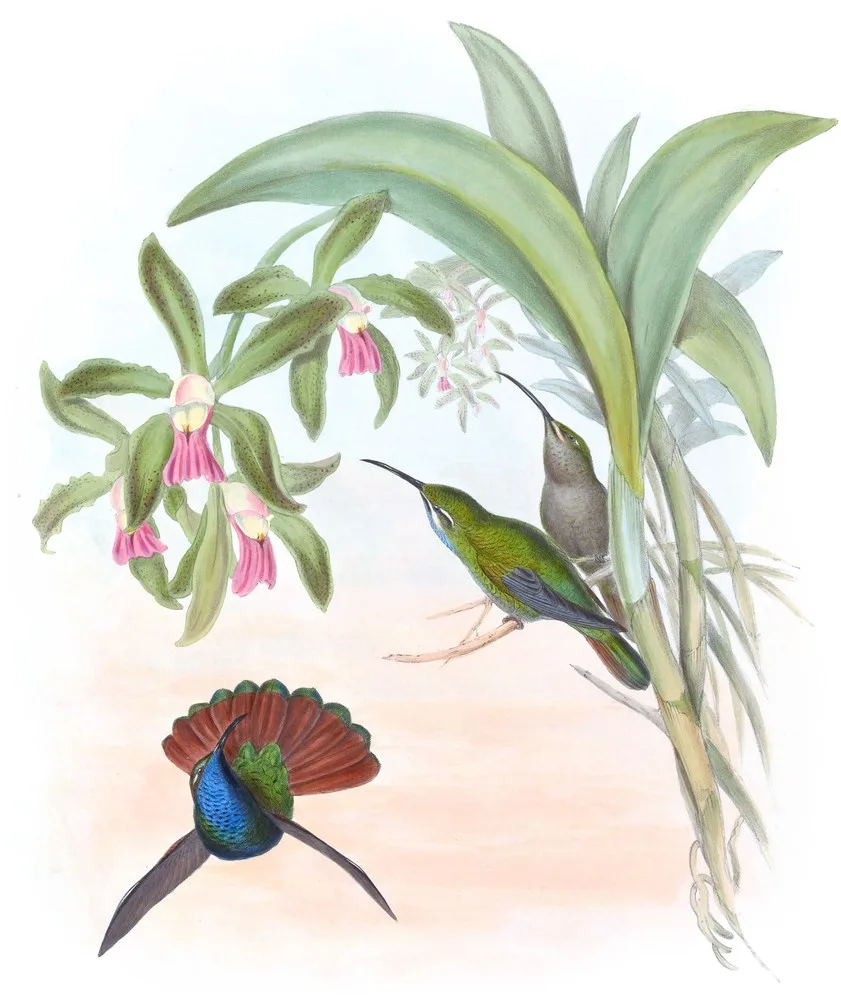
此图原刊于《古尔德蜂鸟图谱》(Gould's Hummingbirds),绘者为约翰·古尔德,成书于 1849—1887 年间。图中描绘的是 Campyloterus lazulus,归入蜂鸟科(Trochilidae)。
全编共收录 421 幅图版,本图是其中一幅,原书将其列为 Pl. 44, Vol. II,见第 44 页,版式为纵幅。图为公有领域原件的修复扫描,构图与设色未经改动。
原书文字(英文 / 法文)
Venezuela, the hilly parts of New Granada generally, and Ecuador, from which latter country I have received specimens through Professor Jameson, collected near Barza
It will be seen that I have followed preceding ornithologists in considering the Trochilus lazulus of Vieillot’s “Galerie des Oiseaux,” and the T. fadcatus of Swainson’s “Zoological Illustrations,” as identical; at the same time I must remark, that neither of their figures nor the accompanying descriptions are quite correct; Vieillot figuring and describing the under tail-coverts as white, and Swainson as green, whereas these feathers are really deep chestnut; with this exception the two figures agree with the bird here represented.
It is just possible that the bird described by these authors, and which is still in the Paris Museum, may be different from the one I have figured, but, if it be, surely additional examples would have reached Europe during the long interval which has elapsed since the dispersion of Bullock’s collection, of which the Paris specimen formed a part.
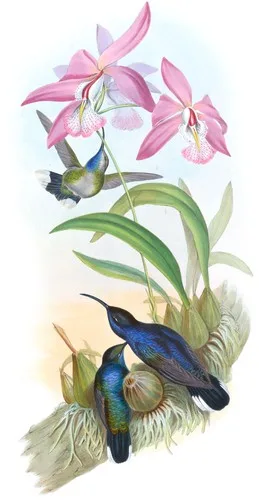
The native habitat of this fine species—for it is a truly beautiful bird—is the Caraccas, Venezuela, and the high parts of Columbia generally: many fine examples were brought from the former country by Mr. Dyson, and numerous specimens are from time to time received in collections from Bogota. As will be seen on reference to the accompanying Plate, the sexes differ materially in their colouring: the young males, again, differ from both in presenting an intermediate kind of plumage, with more or less blue on the throat and under surface.
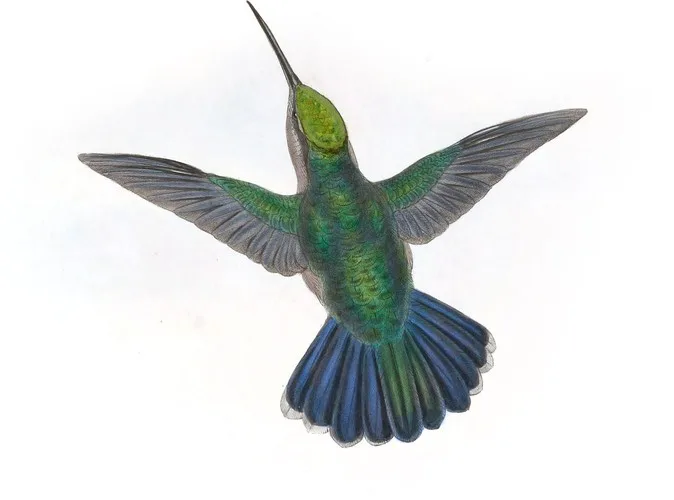
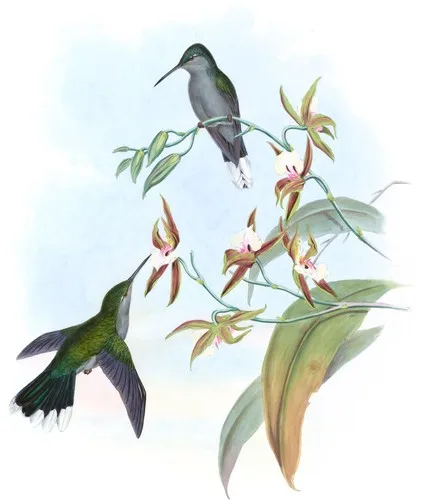
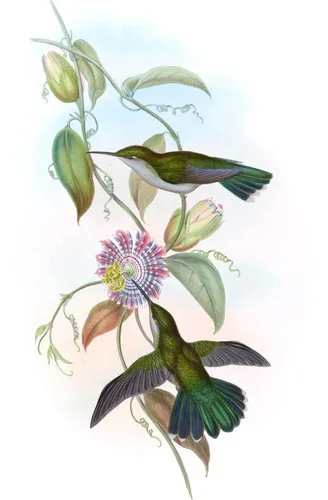
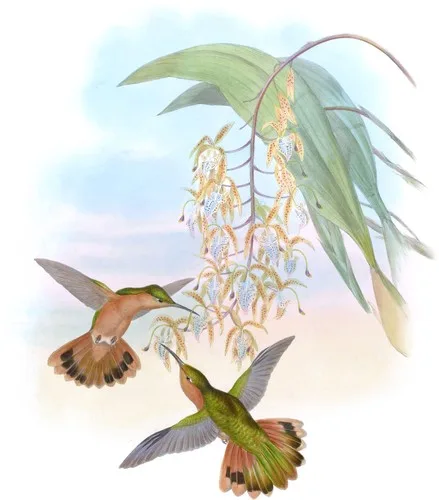
The male has the head, all the upper surface, wing- and tail-coverts glittering grass-green; wings purplish brown; tail very deep chestnut, with in some instances all the feathers, and in others only the two middle ones, broadly tipped with deep green; throat rich deep shining blue, blending into the green of the upper surface, and the finer glittering green of the flanks and abdomen; under tail-coverts chestnut, slightly tipped in some instances with green; bill black.
The female has all the upper surface and wing-coverts bronzy green; rump and upper tail-coverts purer green; wings purplish brown; central tail-feathers bronzy green; the remainder deep chestnut, more or less margined or fringed with black; under surface, including the under tail-coverts, deep brownish grey.
The figures are the size of life. The plant is the Cattleyia guttata.
References
- Trochilus lazulus, Vieill. Ency. Méth. Orn., part ii. p. 557.—Ib. Gal. des Ois., tom. i. p. 296. pl. 179.—Bonap. Consp. Gen. Av., p. 71, Campylopterus, sp. 1.
- Trochilus faleatus, Swains. Zool. Ul., vol. u. pl. 83.—Less. Hist. Nat. des Ois. Mou., p. 126. pl. 36.
- Mellisuga lazulus, Gray and Mitch. Gen. of Birds, vol. i. p. 107, Polytmus, sp. 3.
- Campylopterus lazulus, Bonap. Rev. et Mag. de Zool. 1854, p. 250.
- Saepiopterus lazulus, Reichenb. Aufz. der Colibris, p. 11.—Ib. Troch. enumer., p. 9. pl. dccc. fig. 4863.