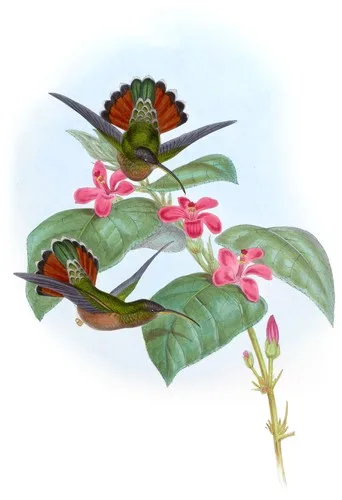
露珠草属·Circe Doubledayi
Circe Doubledayi
Circe Doubledayi
Doubleday’s Humming-Bird
- 中文名
- 露珠草属·Circe Doubledayi
- 学名
- Circe Doubledayi
- 合集
- 古尔德蜂鸟图谱
- 绘者
- John Gould(约翰·古尔德)
- 年代
- 1861
- 图版号
- Pl. 339, Vol. V
- 原书页码
- p.339
- 授权
- CC0 1.0 Universal (Public domain)
关于本图版
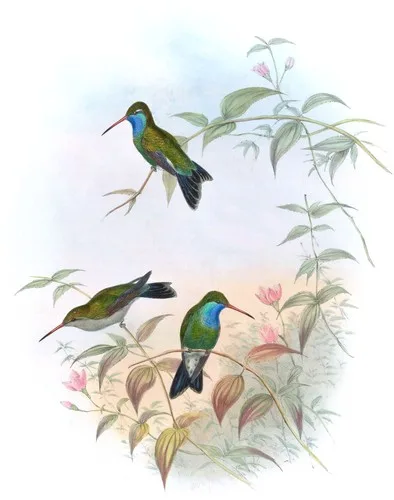
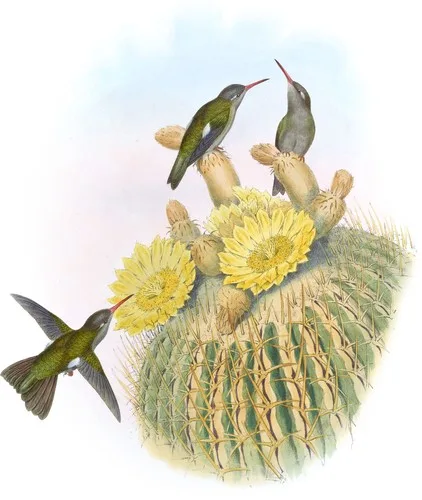
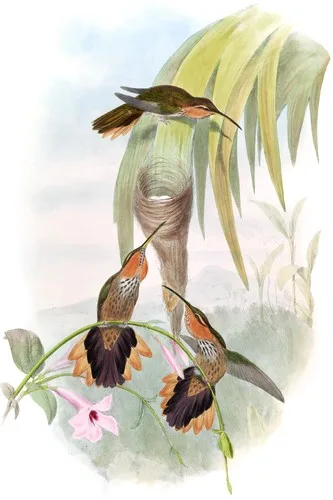
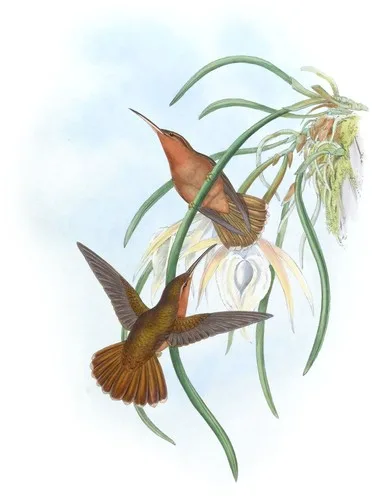
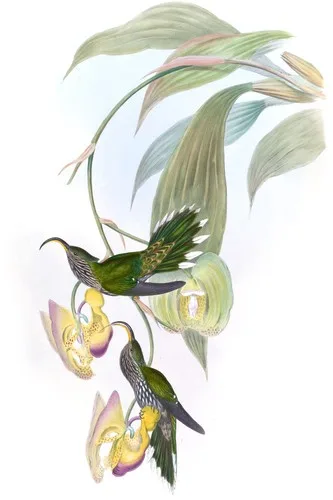
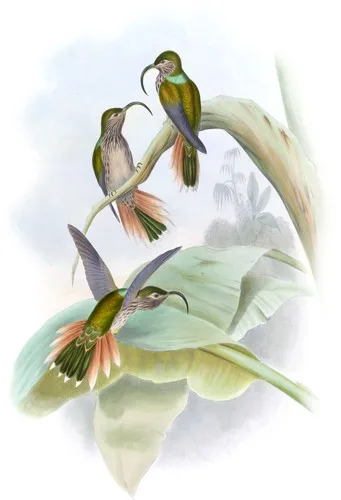
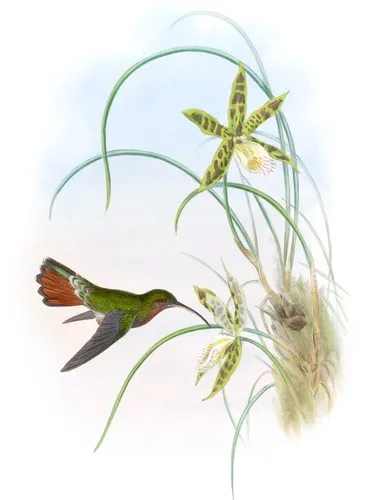
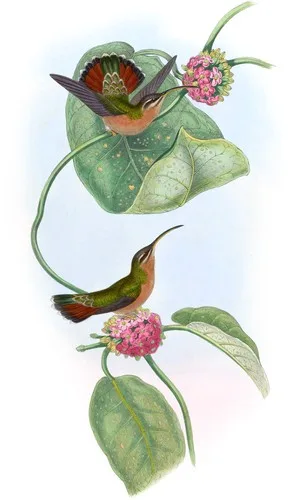
这幅图版出自《古尔德蜂鸟图谱》(Gould's Hummingbirds),由约翰·古尔德绘制,1849—1887 年间出版。画面主体是露珠草,归入蜂鸟科(Trochilidae)。
全编共收录 421 幅图版,本图是其中一幅,原书将其列为 Pl. 339, Vol. V,见第 339 页,版式为纵幅。图像由公有领域原件扫描修复而来,细节在放大视图中仍清晰可辨。
原书文字(英文 / 法文)
Mexico; locality Chimantla, according to Dr. Saucerotte.
So far as my knowledge extends, two specimens only of this bird have as yet reached Europe; one of these is in the collection formed by the late George Loddiges, the other in my own.
It is a bird of great interest to me, since it happens to be a species which will not clash with any other: I mean, has no near ally with which it can be confounded. It is true that the Circe latirostris has a similarly marked tail, and also a blue breast, but it is destitute of the glittering bluish-green crown; and it is moreover fully a third larger than the present bird.
When M. Bourcier described the Circe Doubledayi, no satisfactory information was on record as to the country of which it is a native, and the Rio Negro was given as the one in which it was presumed it might be found; but that part of South America is not, I believe, the locality in which it may_be looked for; like the Circe latirostris, it will, I think, prove to be a native of the more northern country of Mexico. I have two reasons for believing this: in the first place, all the Humming-Birds with obscure tippings to their tails, such as latirostris, Caniveti, auriceps, &c., are denizens of that country; and in the second, the specimen in my collection, which was kindly given to me by my warm-hearted friend Saucerotte, has the words “Chimantla, Mexico,” written on the label attached to it.
It will be seen, by the above list of synonyms, that I have found it necessary to include therein the specific name of Lereboulleti, proposed for this species by Dr. Saucerotte; that name is attached to the specimen above mentioned,—a circumstance which enables me satisfactorily to determine that Lereboulleti of Saucerotte and Doubledayi of Bourcier are identical; the latter name, having the priority, is necessarily the one adopted.
In naming this bird after one who has since departed, M. Bourcier was desirous of paying a just compliment to an able entomologist and most amiable man: the name of Doubleday is too well known among the workers in natural history to need any comments upon his many merits at my hands.
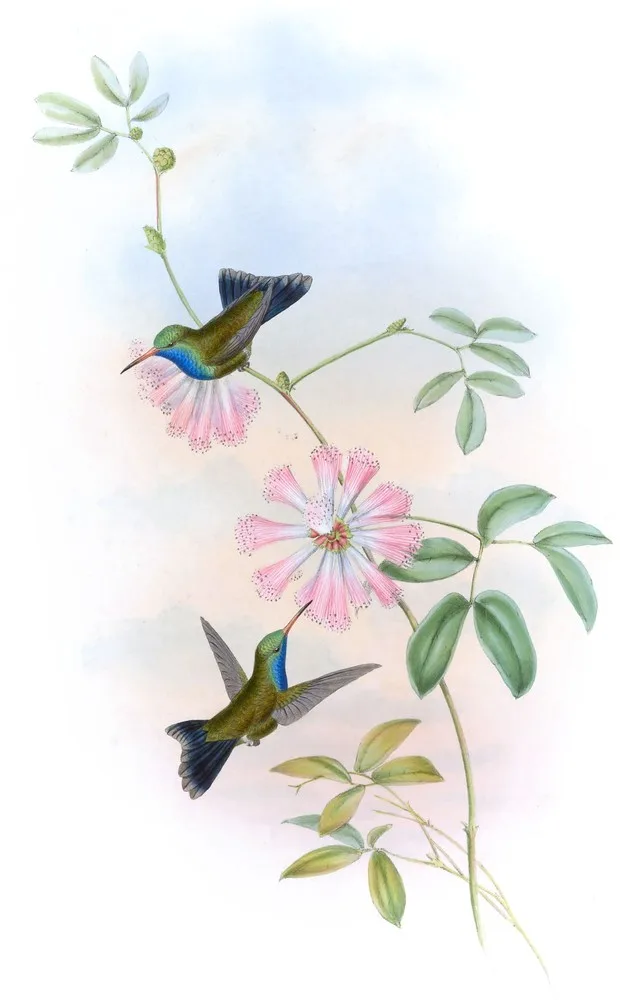
Crown of the head shining metallic bluish green; throat brilliant blue, passing into green on the breast; all the upper surface, wing-coverts, upper tail-coverts, and abdomen dark bronzy green; wings purplish brown; tail black, glossed with steel-blue and tipped with brownish grey, which lessens in extent as the feathers recede from the centre; under tail-coverts brown, edged with grey; bill apparently red at the base, with a darker tip.
The Plate represents a bird, which appears to be an adult male, of the size of life. The plant is the Calliandra Harrisii.
References
- Trochilus Doubledayi, Boure. in Proc. of Zool. Soc., part xv. p. 46.—Ib. in Rey. Zool. 1847, p. 259.
- Thaumatias doubledayi, Bonap. Consp. Gen. Av., p. 78, Thaumatias, sp. 11.
- Cyanophaia Doubledayi, Reichenb. Auf. der Col., p. 10.
- Hylocharis Doubledayi, Gray and Mitch. Gen. of Birds, vol. i. p. 114, Hylocharis, sp. 32.
- Sapphironia doubledayi, Bonap. Rev. et Mag. de Zool. 1854, p. 256.
- Trochilus Lereboulleti, Sauc. MSS.