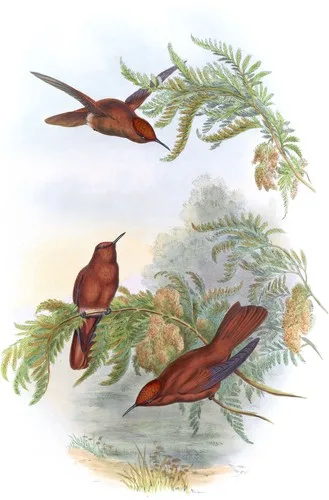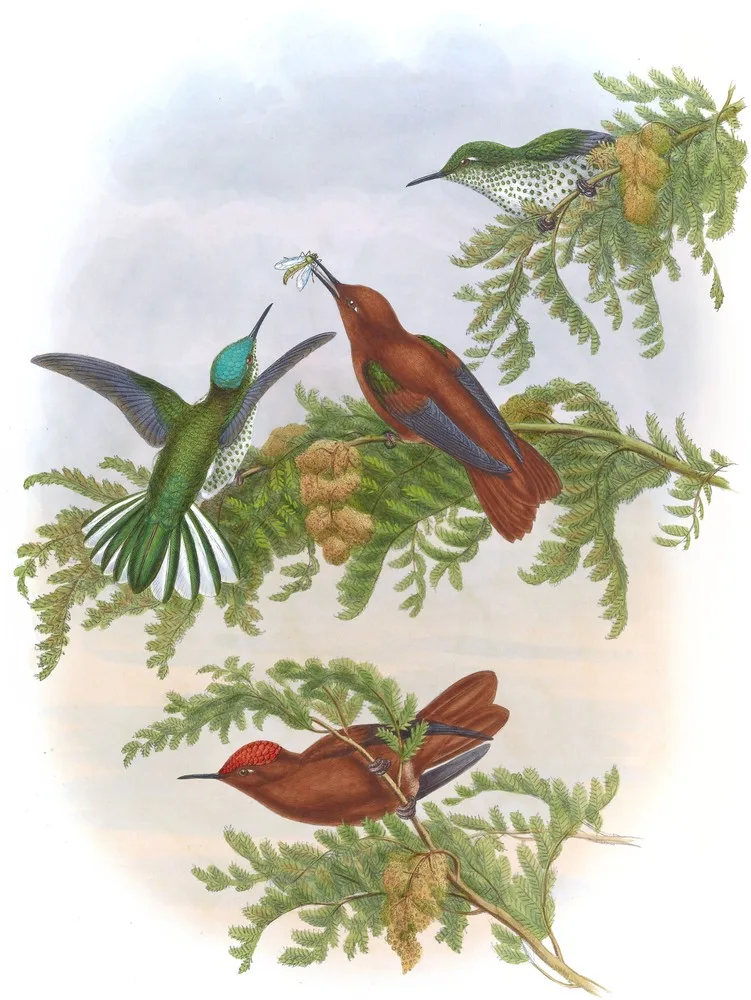
Eustephanus fernandensis
Eustephanus fernandensis
Cinnamon Firecrown
- 学名
- Eustephanus fernandensis
- 合集
- 古尔德蜂鸟图谱
- 绘者
- John Gould(约翰·古尔德)
- 年代
- 1887
- 图版号
- Pl. 386, Suppl. Vol.
- 原书页码
- p.386
- 主色
- 黄
- 授权
- CC0 1.0 Universal (Public domain)
关于本图版
《古尔德蜂鸟图谱》(Gould's Hummingbirds)由约翰·古尔德绘制,1849—1887 年间印行,本图即其中一幅。画面主体为 Eustephanus fernandensis,在分类体系中列于蜂鸟科(Trochilidae)。
该合集全编共 421 幅图版,此图为其中之一,图版编号 Pl. 386, Suppl. Vol.,对应原书第 386 页,版式为纵幅,画面以黄为主色。图像由公有领域原件扫描修复而来,细节在放大视图中仍清晰可辨。
原书文字(英文 / 法文)
Amongst the advantages which the issue of the present ‘Supplement’ bestows on me may be reckoned the opportunity which it gives of correcting certain mistakes in the ‘Monograph,’ which were due to the imperfect knowledge possessed by ornithologists at the period when the latter work was written.
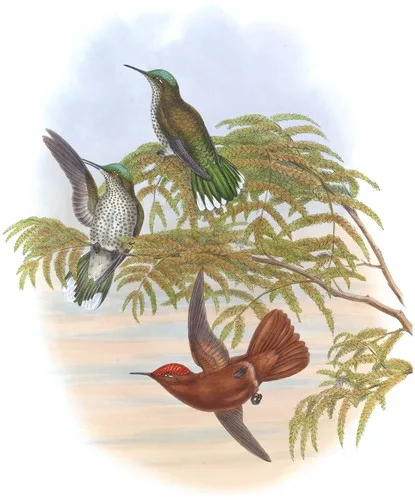
Such a case is the present, in which, from lack of the requisite knowledge, I figured the two sexes of the Cinnamon Firecrown as distinct species, under the names of E. fernandensis and E. stokesti; and now that I am giving for the first time a Plate of the more recently discovered E. leyboldi, I have seized the opportunity to refigure the two sexes of E. fernandensis.
The Juan-Fernandez group of islands was for a long time almost a ¢erra incognita to the naturalist; and until Dr. Sclater published a list in ‘The Ibis’ of 1871 we were ignorant of the number of birds inhabiting them. The largest island of the group is Mas-a-tierra, or Juan Fernandez, which is situated about 380 miles from the coast of Chili; and the second is named Mas-a-fuera, which is about 450 miles from the Chilian coast. There are also a number of small islets belonging to the group.
On these two islands no less than three species of Humming-birds are known to exist, one of them, E. galeritus, a well-known Chilian species, being found on Mas-a-tierra. To this same island, however, is confined Eustephanus fernandensis, while E. leyboldi inhabits Mas-a-fuera. The group was first visited by a naturalist in 1825, when Captain King procured some Humming-birds on Mas-a-tierra, and named them as belonging to two distinct species, without apparently suspecting they were sexes of the same bird. Indeed so different in style of coloration are the male and female of E. fernandensis, that any one might be excused for considering them distinct. When Mr. Bridges visited the same island in 1854, he brought back a large number of specimens both of E. fernandensis and of the so-called E. stokeszii, but without a single indication as to the sexes of the specimens, which were examined by me at the time. According to Dr. Sclater, however, Mr. Bridges was quite aware that E. stokesii was only the female bird; for he himself informed the late M. Jules Verreaux of the fact in a conversation he had with him in Paris after his return from South America (Ibis, 1871, p. 179, note). I can only say that not the slightest indication of this was noted on Mr. Bridges’s specimens; nor was I informed of it by Mr. Cuming, who was his agent.
Mr. E. C. Reed, of the Santiago Museum, who visited Juan Fernandez in 1870 and again in 1872, says that he dissected all the specimens he shot, and found that in all cases the red birds were males, and the green females. “It is” he remarks, “a very strong bird. It hovers over flowers, then darts away like an arrow to a distance of several hundred yards; I have never seen any other small bird fly so rapidly. It feeds principally from the beautiful purple flowers of the Citharexylon. It has a loud shrill cry.” Mr. Bridges found the bird so fearless of man that it could be killed with a stick, so close did it approach. On a closer acquaintance with man it would appear to have become more shy during the twenty years that have elapsed since that gentleman visited the island.
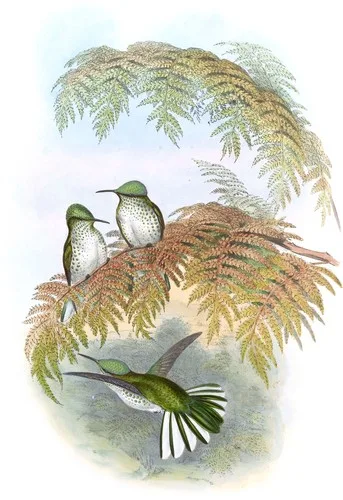
I will now give a short description of the old red male and the adult green female, with the addition of the full-grown young of both sexes, which differ from their parents by having no bright colouring on the crown. This anomaly will be seen in the illustration more clearly than in any description I could write.
Old male.—Forehead and crown metallic fiery red; the entire plumage of the body and colouring of the tail-feathers deep cinnamon-red; wing-coverts the same; primaries and secondaries purplish brown; vent buffy white; bill black.
Young male.—Like the old male, except the crown, which has not the slightest trace of metallic red; the spurious wing green; whitish green runs up the shoulder.
Old female.—Crown of the head metallic bluish green, with a bronzy lustre; wings purplish brown, the spurious wing glossed with green; the central tail-feathers and the outer webs of the four next on each side grass-green; the inner webs of these lateral feathers white, deepening into green at the tip of the outer webs, under surface white with a spangle of shining green at the end of each feather of chin, throat, and flanks, the spangles being (in consequence of the smaller size of the feathers) most numerous on the chin; under tail-coverts white with green centres.
The young female is like the old female; but she has no glittering feathers on the crown.
References
- Trochilus fernandensis, King, Proc. Zool. Soc. part 1. p. 30.—Gray, Handl. B. i. p. 147, no. 1899.
- Trochilus stokesii, King, tom. cit. p. 80.—Lesson, Troch. p. 135. pl. 50—Jard. Naturalist’s Library, Humming Birds, ii. p. 55, pl. 5.
- Ornismya cinnamomea, Gerv. Mag. de Zool. v. Oiseaux, pl. 43.
- Ornismya robinson, Lesson, Oiseaux-Mouches, Velins, pl. 7.—De Lattre & Less. Rev. Zool. 1839, p. 18.
- Mellisuga stokes, Gray, Gen. B. i. p. 113.
- Mellisuga gray, Gray, tom. cit. p. 113.
- Sephanoides stokesii, Bonap. Consp. Av. i. p. 82.—Id. Rev. et Mag. de Zool. 1854, p. 256.
- Sephanoides fernandensis, Bonap. Consp. Av. i. p. 82.—Id. Rev. et Mag. de Zool. 1854, p. 265.
- Lustephanus stokesii, Gould, Monogr. Trochil. iv. pl. 266.
- Eustephanus fernandensis, Gould, Monogr. Trochil. iv. pl. 267.—Cab. & Heine, Mus. Hein. i. p. 76.—Scel. & Salv. Nomencl. Av. Neotr. p. 90.—Reed, Ibis, 1874, p. 82 — Muls. Oiseaux-Mouches, p. 76.—Elliot, Synopsis Trochil. p. 93.
十二观
- 黄色主调
- 纵幅 1.33∶1
- 1887 年刊
- 图版 386, Suppl. Vol.
这不是词条,是一条看画的次序:先站定看整体,再看名字与形色、构图与刀工,然后问它几时开、从哪里来、经了谁的手;最后是中国诗文——同一朵花,中国古人是怎么看的。十二观读完,这幅图就打开了。
-
第一眼
论画以形似,见与儿童邻。
—— 宋·苏轼《书鄢陵王主簿所画折枝》
只求画得像,是小孩的眼光。苏轼不是不要形似,是说形似之后还有一层:神。这一幅是竖的:眼睛从下往上走,落点在中段那只鸟身上。先别急着看羽毛,让姿态先立起来。第二步凑近一寸:看线与色的交界,色有没有压住线,线有没有断。第三步,找黄色最重的一小块:整幅的明暗秩序,是从那里排开的。
-
名与实
学名 Eustephanus fernandensis:前一词是属,管它归在哪一类;后一词是种加词,管它在这一类里凭什么与众不同。一百多年前的命名者,把一种植物的来历压进了两个词。此幅尚无通行中文名,姑以学名相称;在没有本地名字的地方,学名就是它唯一的身份证。
-
形与色
蜂鸟为美洲最小之鸟,喙细长如针,舌分叉成管,可伸入花心吸蜜;翼小而振频极高,能悬停、能倒飞。此幅以黄为主,黄如蜜蜡,浅处几乎透光。羽毛的色最难画:它不是颜料调出来的,是光在羽枝上的折返,头一转就换一种颜色。画幅高而窄,形与色的关系因此看得格外清楚:先读轮廓,再读色层,最后才看笔触。
-
构图与呼吸
画幅高而窄,鸟栖在枝的中段,上下留白多——十九世纪鸟谱的标准版式,留给它飞走的余地。(高宽比约 1.33∶1)全幅只画一只,不作解剖附图——这类图更近于“观赏”,而非“鉴定”。试着用拇指遮住空白处——画面立刻变闷;放开,它才重新“喘上气”。留白,是给主体让出的气口。
-
一刀一色
十九世纪后半叶,石版与彩色石印渐成主流:颜色可以直接印出,不再依赖手工,线条反倒退居其次。图像的“准确”提高了,手性却淡了。先判断它是“印”的还是“画”的,再谈好不好看——这是看老版画最实用的一条规矩。
-
时序
热带美洲几乎全年可见,花期即其季节;温带种类的蜂鸟则随花北迁,一年往返数千公里。图上所记的 1887 年是刊行之年,不是采到那只鸟的年份;真正的观察记录通常比出版早一两年。图谱记的是十余日的盛况;剩下的三百多天,植物在长叶、结果、休眠——图只截了它最像自己的一刻。
-
故土
仅产美洲,自阿拉斯加南部至火地岛,以安第斯山最为繁盛。中土无蜂鸟,汉籍不载,晚清海外游记始见其名。产地写在图上的,往往是“据说来自”;真正的野外记录,要等采集人回来才敢落笔。
-
书与人
《古尔德蜂鸟图谱》(Gould's Hummingbirds)由约翰·古尔德绘,成于1849-1887。此幅为其中图版 386, Suppl. Vol.,见原书第 386 页。图版今属公有领域,可以自由取用;但纸上那层手工上色,仍是两百年前某一个人的手。
-
诗境
夫列子御风而行,泠然善也,旬有五日而后反。
—— 《庄子·逍遥游》
蜂鸟悬停于空,不落不飞,最近于“御风”。庄子说的是一种自由的姿态,蜂鸟把它做成了生理事实。诗以气行,画以形立;两种“看”叠在一起,才是看画的意思。
-
文心
竖划三寸,当千仞之高;横墨数尺,体百里之迥。
—— 南朝宋·宗炳《画山水序》
三寸的竖线可当千仞高山,几尺横墨能容百里之远。一只蜂鸟只有拇指大,画家却要在几厘米里放下整片花丛——尺度从来不是障碍。古尔德《蜂鸟图谱》(1849—1887)以石版手工上色,金箔衬底,使羽色在纸上仍有金属光;这套图册本身就是十九世纪印刷与收藏狂热合流的产物。中外的分别不在谁高明,而在问的问题不同:欧洲问它是什么,中国问它像谁。两个问题都答了,一幅图才算读完。
-
花语
阿兹特克以蜂鸟为战神与太阳的化身;欧洲维多利亚时代则以蜂鸟为收藏与装饰的极致,百万只羽毛被做成胸饰。中国旧籍无此鸟,故无象征——这空白本身,就是一部博物学交流史。此幅偏黄,在花语里总要再加重一分情绪。在图谱里,它首先是一个物种,其次才是一种象征——这个次序值得记住。
-
带走一双眼睛
如果只能记一句,就记郭熙那八个字:远望取其势,近看取其质。看图、看花、看人,都一样。二百年后,这只鸟的后代或许仍在某处活着;而纸上这一只,永远停在 1887 年的那个季节。