铜色蜂鸟属
Glaucis melanura
Glaucis melanura
Black-tailed Hermit
- 中文名
- 铜色蜂鸟属
- 学名
- Glaucis melanura
- 合集
- 古尔德蜂鸟图谱
- 绘者
- John Gould(约翰·古尔德)
- 年代
- 1849
- 图版号
- Pl. 9, Vol. I
- 原书页码
- p.9
- 授权
- CC0 1.0 Universal (Public domain)
十观
- 纵幅 1.33∶1
第一眼
江馆清秋,晨起看竹,烟光日影露气,皆浮动于疏枝密叶之间。
—— 清·郑板桥《题画竹》
郑板桥说他画竹,是先看见“烟光日影露气”在枝叶间浮动,才动手。看画时找这一层空气,比记住花的名字更要紧。这一幅是竖的:眼睛从下往上走,落点在中段那只鸟身上。先别急着看羽毛,让姿态先立起来。第二步凑近一寸:看线与色的交界,色有没有压住线,线有没有断。第三步,把视线放到最深的那一小块:整幅的用色秩序,都是从那里排开的。
名与实
学名 Glaucis melanura:前一词是属,管它归在哪一类;后一词是种加词,管它在这一类里凭什么与众不同。双名制的好处是唯一:全世界叫这个名字的,只能是这一种。中文名“铜色蜂鸟属”是后人据学名回译的通行叫法,与古书里的旧名未必对得上——名与物之间,总隔着一层翻译。
形与色
翼小而振频极高,能悬停、能倒飞;羽色非颜料所致,是羽枝结构折射的光,随角度而变。此幅未作色相归档,只能就形制论。看羽:先看覆羽的层次,再看飞羽的排列,最后才看颜色——颜色是最后才被注意到的部分。
构图与呼吸
画幅高而窄,鸟栖在枝的中段,上下留白多——十九世纪鸟谱的标准版式,留给它飞走的余地。全幅只画一只,不作解剖附图——这类图更近于“观赏”,而非“鉴定”。老图谱爱把主株摆在偏中线的位置,左右留得不一样多:这一点偏心,正是画面活起来的原因。
一刀一色
十九世纪上半叶是铜版、钢版与石版交替的时期。点刻能把明暗过渡做得极细,雷杜德的玫瑰即以此著称;石版则更宜表现柔和的色层。先判断它是“印”的还是“画”的,再谈好不好看——这是看老版画最实用的一条规矩。想动笔临它的人记住一句:临它的骨架、留白与设色次序就好;刀口的排线是铜版与刻刀的语言,铅笔不必硬学,用疏密代替它。
诗境
夫列子御风而行,泠然善也,旬有五日而后反。
—— 《庄子·逍遥游》
蜂鸟悬停于空,不落不飞,最近于“御风”。庄子说的是一种自由的姿态,蜂鸟把它做成了生理事实。诗以气行,画以形立;两种“看”叠在一起,才是看画的意思。
花语
阿兹特克以蜂鸟为战神与太阳的化身;欧洲维多利亚时代则以蜂鸟为收藏与装饰的极致,百万只羽毛被做成胸饰。中国旧籍无此鸟,故无象征——这空白本身,就是一部博物学交流史。象征会随世道改口:同一只鸟,在一个世纪里可以说完全相反的话。
时与地
温带种类的蜂鸟则随花北迁,一年往返数千公里。仅产美洲,自阿拉斯加南部至火地岛,以安第斯山最为繁盛。中土无蜂鸟,汉籍不载,晚清海外游记始见其名。图上所记的 1849 年是刊行之年,不是采到那只鸟的年份;真正的观察记录通常比出版早一两年。那一代人对这类鸟的知识,多半来自标本与笼养。看这一类图,不妨把产地和季节都当“据说”来读。
书与人
《古尔德蜂鸟图谱》只署了约翰·古尔德一个人的名字。从画稿到成图要过好几双手:转刻的人求准,上色的人求快——快与准之间,就是各幅之间深浅不一的来历。
带走一双眼睛
如果只能记一句,就记郭熙那八个字:远望取其势,近看取其质。看图、看花、看人,都一样。二百年后,这只鸟的后代或许仍在某处活着;而纸上这一只,永远停在 1849 年的那个季节。
关于本图版
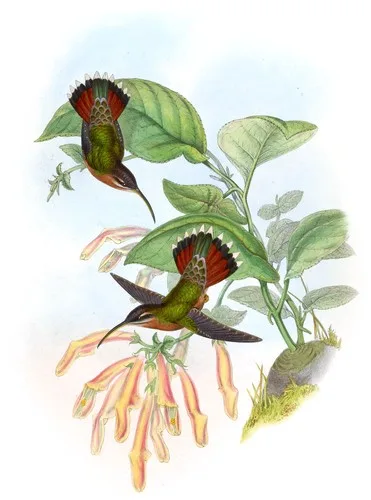
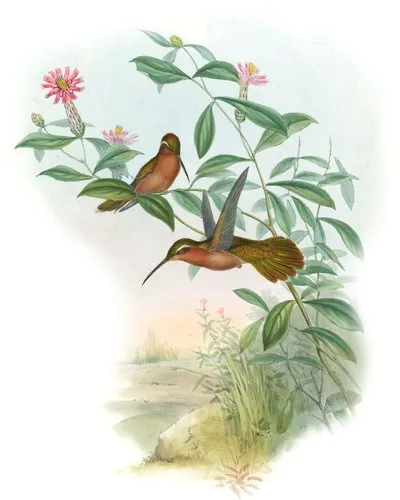
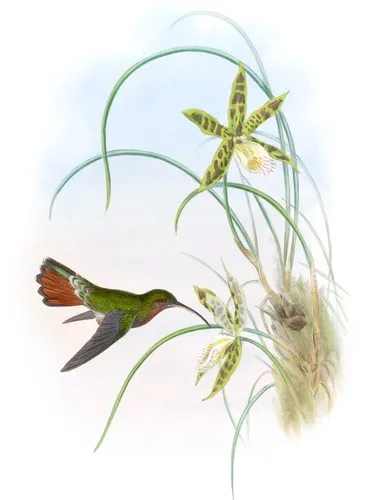
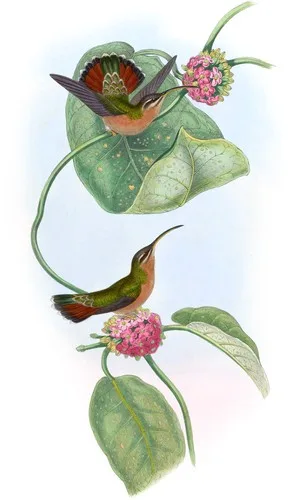
此图原刊于《古尔德蜂鸟图谱》(Gould's Hummingbirds),绘者为约翰·古尔德,成书于 1849—1887 年间。铜色蜂鸟(Glaucis melanura)是本图的主角,归入蜂鸟科(Trochilidae)。
全编共收录 421 幅图版,本图是其中一幅,原书将其列为 Pl. 9, Vol. I,见第 9 页,版式为纵幅。图为公有领域原件的修复扫描,构图与设色未经改动。
原书文字(英文 / 法文)
The banks of the Rio Napo and the Rio Not
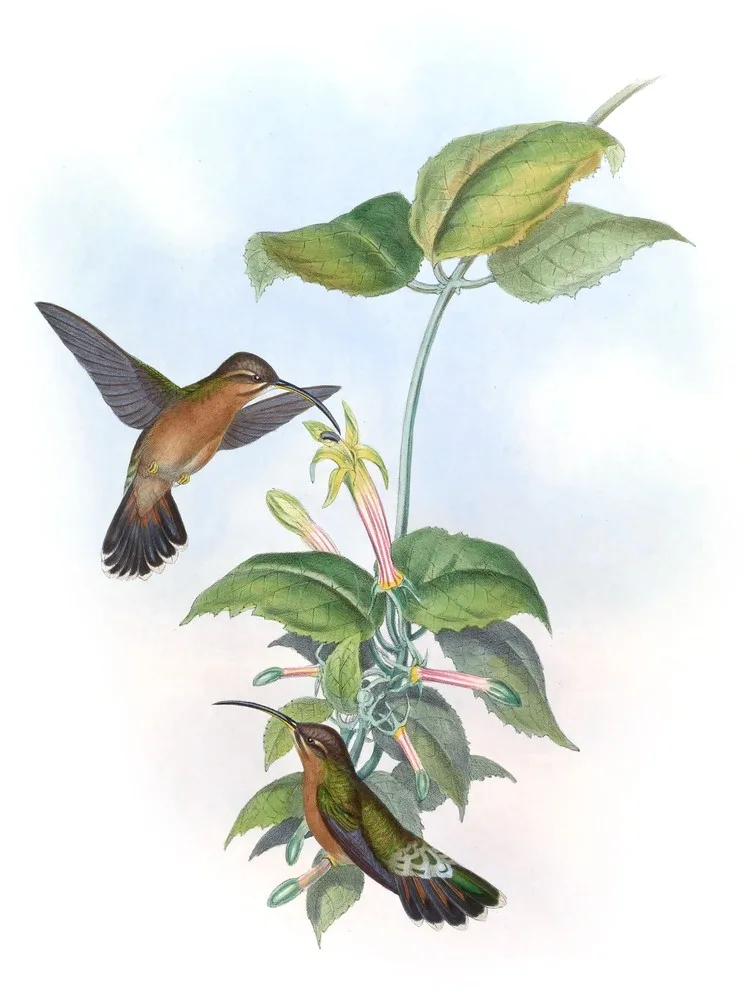
The bird figured in the accompanying Plate must not be confounded with either of the species I have mentioned in my account of Glaucis hirsutus; it is much smaller than either of them, and moreover has a far greater amount of black colouring in its tail—the extreme base, and that only of the inner webs of the feathers, being marked with chestnut; in fact, when the tail is closed and viewed from beneath, it appears to be entirely black, the under coverts concealing the buff colouring at its base.
I possess two specimens of this bird, one of which was received from the Napo, the other, a very fine one, from the Rio Negro.
Centre of the throat, chest, and under surface buff; a streak of dark brown passes downwards from the base of the lower mandible, between which and the ear-coverts is a stripe of buff; there is also a line of buff behind the eye; crown of the head brown; back of the neck, upper surface, and two middle tail-feathers golden-green; upper tail-coverts narrowly edged with grey; basal portion of the inner webs and the shafts of the four lateral tail-feathers rich reddish-buff approaching to chestnut, the remainder of these feathers being black, tipped with white; bill black, except the under base of the mandible, which is yellow.
The figures in the accompanying Plate are as near the size of life as possible. The plant is the Siphocampylus Orbignianus.
References
- Glaucis melanura, Gould in Proc. of Zool. Soc., part xxviii. p. 304.