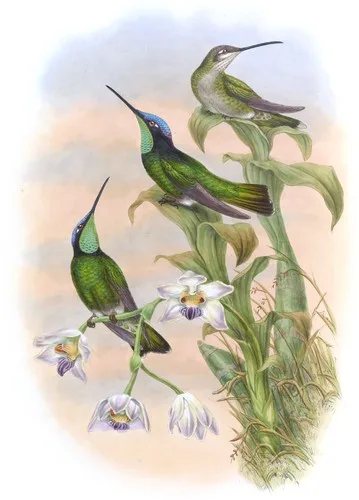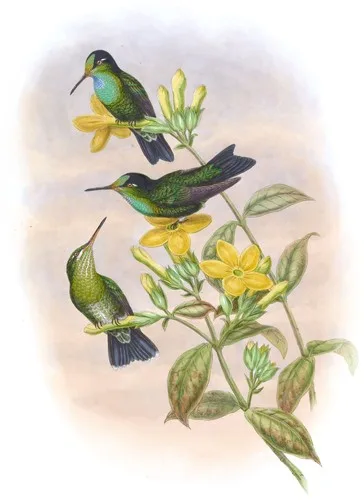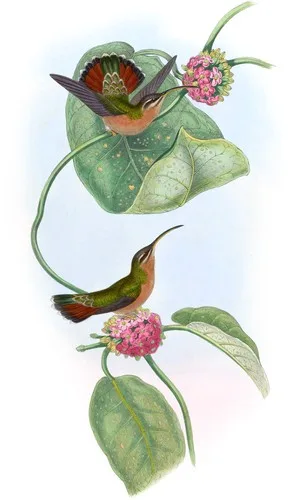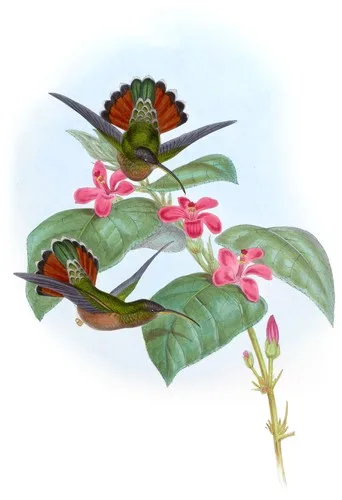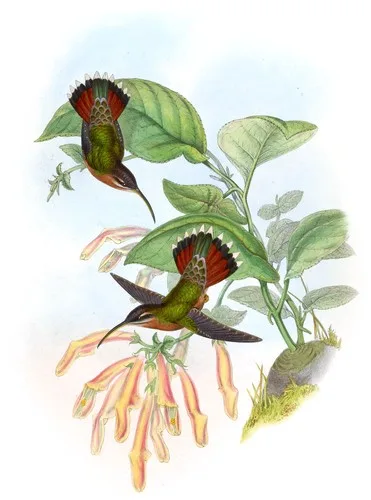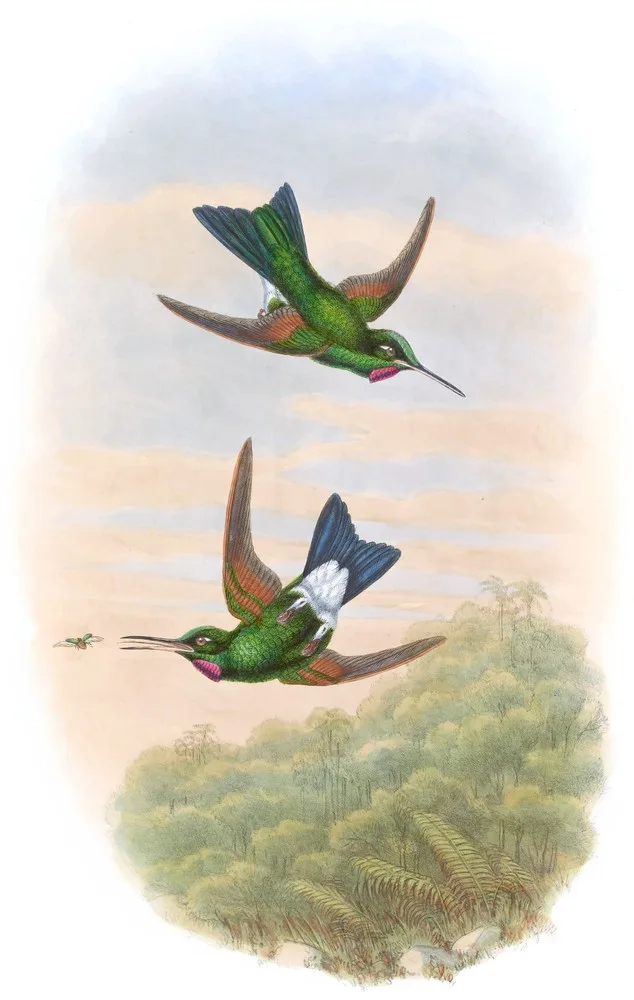
Lampraster branickii
Lampraster branickii
Count Branicki’s Humming-bird
- 学名
- Lampraster branickii
- 合集
- 古尔德蜂鸟图谱
- 绘者
- John Gould(约翰·古尔德)
- 年代
- 1887
- 图版号
- Pl. 374, Suppl. Vol.
- 原书页码
- p.374
- 授权
- CC0 1.0 Universal (Public domain)
关于本图版
《古尔德蜂鸟图谱》(Gould's Hummingbirds)由约翰·古尔德绘制,1849—1887 年间印行,本图即其中一幅。画面主体为 Lampraster branickii,在分类体系中列于蜂鸟科(Trochilidae)。
该合集全编共 421 幅图版,此图为其中之一,图版编号 Pl. 374, Suppl. Vol.,对应原书第 374 页,版式为纵幅。扫描件取自公有领域原件,经高分辨率修复与色彩校正,可按原大放大查看线条与设色。
原书文字(英文 / 法文)
The genus Lampraster has been placed by Mr. D. G. Elliot between Eugenia and Heliodoxa.
The single specimen of this fine species of Humming-bird was obtained by Mr. Jelski at Monterico in Peru, and the male bird described by Dr. Taczanowski still remains unique in the Warsaw Museum. The name of the late Count Branicki, attached to it by Dr. Taczanowski, will serve to commemorate the noble and generous patron of the Warsaw Museum, by whose liberality the important researches of Messrs. Jelski and Stolzmann were carried out in Peru and other countries of South America—researches so well executed that the Warsaw Museum contains a series of more than one thousand species of birds from Peru alone, a result due to the enterprise and energy of the two celebrated Polish travellers mentioned above.
We transcribe the description given by Dr. Taczanowski in his ‘Ornithologie du Pérou’:—
Adult male. Entirely green, the feathers of the crown appearing to be a little darker and bordered by a narrow border of black, separated by a longitudinal median band starting from the base of the bill and prolonged to the vertex, formed of scaly plumes of a very brilliant green changing into blue; the green of the wing-coverts is distinctly more golden than the back; the fore part of the throat divided by a sort of shield formed of scale-like feathers of a rosy-red colour, taking a slight tone of violet under certain lights, and passing into golden and then into green under other reflections of light; chin brilliant green; rest of the lower parts of the body of a shade analogous to that of the back, but becoming very brilliant under favourable rays of light; anal region downy and the under tail-coverts white, as well as the tarsal plumes and a spot behind the eye; wings violet-brown, with the secondaries of a cinnamon-rufous at the extremity, which is dark, the outer quills bordered with rufous; tail-feathers black, with a slight lustre of violet-blue, the two middle ones green; bill black, with the base of the lower mandible white for a large extent, straight for the entire length, half as long again as the head; feet brownish, the tarsus clothed with short plumes. Total length 3·9 inches, bill 1·0, wing 2·65, tail 1·5.
The figures in the Plate represent the adult male in two positions, of the size of life, and have been drawn from the unique type specimen lent us by Dr. Taczanowski.
[R. B. S.]
References
- Lampraster branickii, Tacz. Proc. Zool. Soc. 1874, p. 140, pl. xxi. fig. 1.—Mulsant, Hist. Nat. Oiseaux-Mouches, ii. p. 200 (1876).—Elliot, Synopsis of the HummingBirds, p. 63 (1878).—Eudes-Deslongchamps, Ann. Mus. Caen, i. p. 290, pl. v. fig. 8 (1880).—Tacz. Orn. Pérou, i. p. 286 (1884).
十二观
- 纵幅 1.58∶1
- 1887 年刊
- 图版 374, Suppl. Vol.
这不是词条,是一条看画的次序:先站定看整体,再看名字与形色、构图与刀工,然后问它几时开、从哪里来、经了谁的手;最后是中国诗文——同一朵花,中国古人是怎么看的。十二观读完,这幅图就打开了。
-
第一眼
江馆清秋,晨起看竹,烟光日影露气,皆浮动于疏枝密叶之间。
—— 清·郑板桥《题画竹》
郑板桥说他画竹,是先看见“烟光日影露气”在枝叶间浮动,才动手。看画时找这一层空气,比记住花的名字更要紧。这一幅是竖的:眼睛从下往上走,落点在上半部。先让整株立起来,再看细节。第二步凑近一寸:看线与色的交界,色有没有压住线,线有没有断。第三步,把视线放到最深的那一小块:整幅的用色秩序,都是从那里排开的。
-
名与实
学名 Lampraster branickii:前一词是属,管它归在哪一类;后一词是种加词,管它在这一类里凭什么与众不同。一百多年前的命名者,把一种植物的来历压进了两个词。此幅尚无通行中文名,姑以学名相称;在没有本地名字的地方,学名就是它唯一的身份证。
-
形与色
菊为多年生草本,叶羽状深裂、有毛,头状花序:外圈舌状花如瓣,内圈管状花如盘,一“花”实为千百小花聚成。此幅未作色相归档,只能就形制论。此幅只画一个种,形制的每一处都摊在纸面上,没有遮掩。
-
构图与呼吸
画幅高而窄,主株一路向上,上下留白多,是图谱中最常见的立轴式构图。(高宽比约 1.58∶1)全幅只画一株,不作解剖附图——这类图更近于“观赏”,而非“鉴定”。空白不是没画完,是给眼睛留的落脚处:一张图若四边都塞满,花反而会闷。
-
一刀一色
十九世纪后半叶,石版与彩色石印渐成主流:颜色可以直接印出,不再依赖手工,线条反倒退居其次。图像的“准确”提高了,手性却淡了。先判断它是“印”的还是“画”的,再谈好不好看——这是看老版画最实用的一条规矩。
-
时序
深秋,九月重阳前后开。霜降之后百花开尽,唯菊独盛,故为“节花”。图上所记的 1887 年是刊行之年,不是花期;真正的花藏在原书的采集记录里,通常比出版早一两年。要判断一幅图的季节,不必看题跋:看叶的老嫩、花与果是否同在枝上,也就八九不离十了。
-
故土
中国原产,后传入日本,成为皇室纹章;十七世纪经荷兰人传入欧洲,十九世纪英国育出大批花型。这类植物的旅程比图版本身更长:从一座山到另一座山,从一种语言换到另一种语言。
-
书与人
《古尔德蜂鸟图谱》(Gould's Hummingbirds)由约翰·古尔德绘,成于1849-1887。此幅为其中图版 374, Suppl. Vol.,见原书第 374 页。图谱是集体工程:绘图、刻版、上色、编纂各有其人,署名的往往只有第一个。
-
诗境
今日暂同芳菊酒,明朝应作断蓬飞。
—— 唐·王之涣《九日送别》
“今日暂同芳菊酒”——古人写到这一层,已不只是赏花,是借花说人;画面则只负责把那朵花留住。
-
文心
菊春生夏茂,秋花冬实,备受四气,饱经露霜,叶枯不落,花槁不零。
—— 明·李时珍《本草纲目·草部》
二十四个字写完菊的一年。最后两句才是重点:叶枯而不落,花干而不坠——中国人爱菊,爱的是这份“不肯掉”。《本草纲目》说菊“其苗可蔬,叶可啜,花可饵,根实可药,囊之可枕,酿之可饮”,一株植物从苗到根全无弃物,是本草式的彻底。读古文不必求全解,先认下这一句:它把“看花”换成了“看人”,你再看这幅图,眼里就多了一层。
-
花语
日本以菊为皇权;欧洲则以菊为秋末的最后一点热烈。象征会随世道改口:同一株植物,在一个世纪里可以说完全相反的话。
-
带走一双眼睛
如果只能记一句,就记郭熙那八个字:远望取其势,近看取其质。看图、看花、看人,都一样。二百年后,这株植物的后代或许仍在某处活着;而纸上这一株,永远停在 1887 年的那个季节。