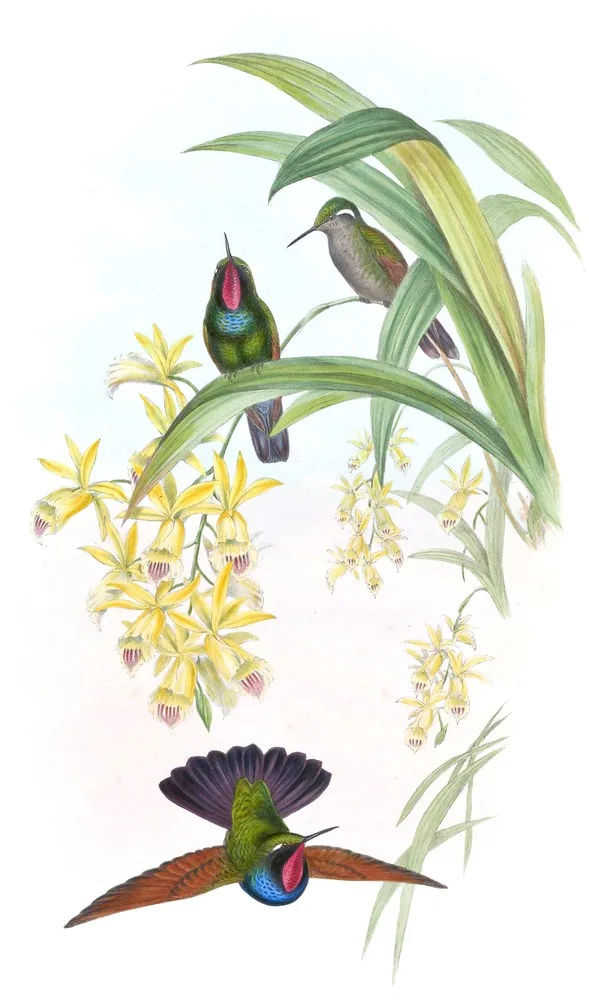
Lamprolæma Rhami
Lamprolæma Rhami
De Rahm’s Garnet
- 合集
- 古尔德蜂鸟图谱
- 绘者
- John Gould(约翰·古尔德)
- 年代
- 1850
- 图版号
- Pl. 61, Vol. II
- 原书页码
- p.61
- 授权
- CC0 1.0 Universal (Public domain)
十观
- 纵幅 1.70∶1
第一眼
论画以形似,见与儿童邻。
—— 宋·苏轼《书鄢陵王主簿所画折枝》
只求画得像,是小孩的眼光。苏轼不是不要形似,是说形似之后还有一层:神。这一幅是竖的:眼睛从下往上走,落点在中段那只鸟身上。先别急着看羽毛,让姿态先立起来。第二步凑近一寸:看线与色的交界,色有没有压住线,线有没有断。第三步,把视线放到最深的那一小块:整幅的用色秩序,都是从那里排开的。
名与实
学名缺席时,画面本身就是唯一的证据。此幅既无通行中文名,学名也不可靠,只能以原书题名相称——图谱里总有几幅这样的图,只能靠画面本身说话。
形与色
翼小而振频极高,能悬停、能倒飞;羽色非颜料所致,是羽枝结构折射的光,随角度而变。此幅未作色相归档,只能就形制论。此幅只画一个种,形制的每一处都摊在纸面上,没有遮掩。
构图与呼吸
画幅高而窄,鸟栖在枝的中段,上下留白多——十九世纪鸟谱的标准版式,留给它飞走的余地。全幅只画一只,不作解剖附图——这类图更近于“观赏”,而非“鉴定”。空白不是没画完,是给眼睛留的落脚处:一张图若四边都塞满,花反而会闷。
一刀一色
十九世纪后半叶,石版与彩色石印渐成主流:颜色可以直接印出,不再依赖手工,线条反倒退居其次。图像的“准确”提高了,手性却淡了。工艺留下的破绽比题跋更诚实:刻工不会撒谎,上色的人赶时间的时候会。想动笔临它的人记住一句:先铺大块的形与色,干后再收细部;石印的柔和层次来自薄涂与网点,水彩分两三遍淡铺即可逼近。
诗境
穿花蛱蝶深深见,点水蜻蜓款款飞。
—— 唐·杜甫《曲江二首》
中土无蜂鸟,然“穿花”之态,杜甫早已写过:贴着花心走,是采蜜者的共同姿态。把这一句放回画面:画面就是诗句的落点——诗先写气,画后写形,两者在此处接上了。
花语
阿兹特克以蜂鸟为战神与太阳的化身;欧洲维多利亚时代则以蜂鸟为收藏与装饰的极致,百万只羽毛被做成胸饰。中国旧籍无此鸟,故无象征——这空白本身,就是一部博物学交流史。花语是后人添上去的,花本身并不知道;但这层“不知道”,正是它最动人的地方。
时与地
温带种类的蜂鸟则随花北迁,一年往返数千公里。仅产美洲,自阿拉斯加南部至火地岛,以安第斯山最为繁盛。中土无蜂鸟,汉籍不载,晚清海外游记始见其名。图上所记的 1850 年是刊行之年,不是采到那只鸟的年份;真正的观察记录通常比出版早一两年。看叶的老嫩、花与果是否同在枝上,季节便八九不离十;看题名里藏着的地名,来路也猜得出七分。
书与人
《古尔德蜂鸟图谱》只署了约翰·古尔德一个人的名字。图版今属公有领域,可以自由取用;但纸上那层手工上色,仍是两百年前某一个人的手。
带走一双眼睛
如果只能记一句,就记郭熙那八个字:远望取其势,近看取其质。看图、看花、看人,都一样。二百年后,这只鸟的后代或许仍在某处活着;而纸上这一只,永远停在 1850 年的那个季节。
关于本图版
此图原刊于《古尔德蜂鸟图谱》(Gould's Hummingbirds),绘者为约翰·古尔德,成书于 1849—1887 年间。图中描绘的是 Lamprolæma Rhami,归入蜂鸟科(Trochilidae)。
全编共收录 421 幅图版,本图是其中一幅,原书将其列为 Pl. 61, Vol. II,见第 61 页,版式为纵幅。图为公有领域原件的修复扫描,构图与设色未经改动。
原书文字(英文 / 法文)
Guatemala
The information I have been able to obtain from various sources respecting this fine species enables me to state that it inhabits the temperate regions of Guatemala and Mexico, and that it neither frequents the high mountain ranges nor the hot forests of the lower lands, but dwells in a country of perpetual spring, with a temperature similar to our own at midsummer, and where the Trochilidæ are unsurpassed in beauty by those of any other part of the world.
M. Rafael Montes de Oca informs me that this fine bird is occasionally met with in the neighbourhood of Jalapa, and M. Auguste Salle collected numerous examples of both sexes near Cordova.
For our first knowledge of this species we are indebted to the researches of M. Bourcier, by whom specimens were transmitted to M. Lesson, who described it in the “Revue Zoologique” for 1838, under the specific appellation of Rhami, in honour of M. de Rham of New York. ‘This Humming Bird,” says M. Lesson, “which is rare even in its native country, inhabits the thickest forests, procures its food from the flowers of a species of Loranthus, a parasitic plant found on the highest branches of the loftiest trees, and evinces a preference for situations of moderate temperature.”
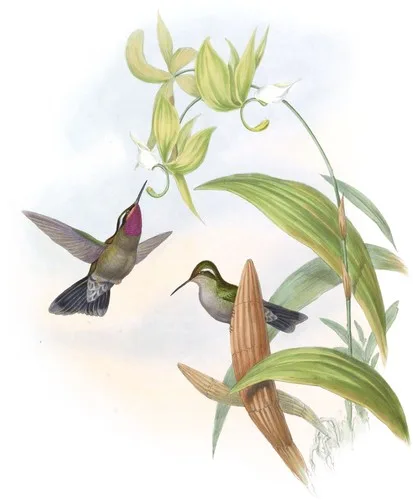
The male has the crown of the head, all the upper surface, lesser wing-coverts, and upper tail-coverts deep grass-green; greater wing-coverts, secondaries, and the basal two-thirds of the primaries dark chestnutred, the tips of the secondaries and the apical third of the primaries dark purplish brown; on the chin and centre of the throat, an oblong mark of fine metallic amethystine-red, bounded on each side by a stripe of black, the whole surrounded by a broad mark of deep metallic-blue; under surface of the body and under tail-coverts dark brown; tail very dark purple; bill and feet blackish brown.
In immature males the central throat-mark is surrounded by bluish green, instead of the fine blue which forms so conspicuous a feature in the adult.
The female differs in being destitute of the rich markings on the throat, the whole of her under surface being light greyish brown, with a somewhat darker hue near the tip of the breast-feathers; the red of the wings is less extensive, and the outer tail-feathers are tipped with grey.
The figures are the size of life. The plant is the Galeandra Baueri.
References
- Ornismya Rhami, Less. Rev. Zool. 1838, p. 315.
- Ornismia Rhami, De Latt. et Less. Rev. Zool. 1839, p. 13.
- Mellisuga Rhami, Gray and Mitch. Gen. of Birds, vol. i. p. 112, Mellisuga, sp. 24.
- Lampornis rhami, Bonap. Consp. Gen. Av., p: 72, Lamporms, sp. 13.
- Delattria rhami, Bonap. Rev. et Mag. de Zool. 1854, p. 253.
- Lamprolaima Rhami, Reichenb. Aufz. der Colibris, p. 9.
- Heliodoxa Rham, Reichenb. Troch. enumer., p. 6. pl. dccxlvi. figs. 4712, 4713.