紫辉尾蜂鸟
Metallura tyrianthina
Metallura tyrianthina
Tyrian-Tail
- 中文名
- 紫辉尾蜂鸟
- 学名
- Metallura tyrianthina
- 合集
- 古尔德蜂鸟图谱
- 绘者
- John Gould(约翰·古尔德)
- 年代
- 1852
- 图版号
- Pl. 195, Vol. III
- 原书页码
- p.195
- 授权
- CC0 1.0 Universal (Public domain)
十观
- 纵幅 1.44∶1
第一眼
论画以形似,见与儿童邻。
—— 宋·苏轼《书鄢陵王主簿所画折枝》
只求画得像,是小孩的眼光。苏轼不是不要形似,是说形似之后还有一层:神。这一幅是竖的:眼睛从下往上走,落点在中段那只鸟身上。先别急着看羽毛,让姿态先立起来。第二步凑近一寸:看线与色的交界,色有没有压住线,线有没有断。第三步,把视线放到最深的那一小块:整幅的用色秩序,都是从那里排开的。
名与实
学名 Metallura tyrianthina:前一词是属,管它归在哪一类;后一词是种加词,管它在这一类里凭什么与众不同。一百多年前的命名者,把一种植物的来历压进了两个词。中文名“紫辉尾蜂鸟”是后人据学名回译的通行叫法,与古书里的旧名未必对得上——名与物之间,总隔着一层翻译。
形与色
翼小而振频极高,能悬停、能倒飞;羽色非颜料所致,是羽枝结构折射的光,随角度而变。此幅未作色相归档,只能就形制论。看形制不必求全:记住喙形、翼式与栖姿,这一类的骨架就立住了。
构图与呼吸
画幅高而窄,鸟栖在枝的中段,上下留白多——十九世纪鸟谱的标准版式,留给它飞走的余地。全幅只画一只,不作解剖附图——这类图更近于“观赏”,而非“鉴定”。老图谱爱把主株摆在偏中线的位置,左右留得不一样多:这一点偏心,正是画面活起来的原因。
一刀一色
十九世纪后半叶,石版与彩色石印渐成主流:颜色可以直接印出,不再依赖手工,线条反倒退居其次。图像的“准确”提高了,手性却淡了。拿放大镜(或手机微距)看三处:喙缘、覆羽、题名。线若连续不断,是刻的;色若越过轮廓半毫米,是手涂的。想动笔临它的人记住一句:先铺大块的形与色,干后再收细部;石印的柔和层次来自薄涂与网点,水彩分两三遍淡铺即可逼近。
诗境
穿花蛱蝶深深见,点水蜻蜓款款飞。
—— 唐·杜甫《曲江二首》
中土无蜂鸟,然“穿花”之态,杜甫早已写过:贴着花心走,是采蜜者的共同姿态。把这一句放回画面:画面就是诗句的落点——诗先写气,画后写形,两者在此处接上了。
花语
阿兹特克以蜂鸟为战神与太阳的化身;欧洲维多利亚时代则以蜂鸟为收藏与装饰的极致,百万只羽毛被做成胸饰。中国旧籍无此鸟,故无象征——这空白本身,就是一部博物学交流史。象征多半来自形状与气味:像杯的、像泪的、香的、臭的——先有形状,后有意义。
时与地
热带美洲几乎全年可见,花期即其季节。仅产美洲,自阿拉斯加南部至火地岛,以安第斯山最为繁盛。中土无蜂鸟,汉籍不载,晚清海外游记始见其名。图上所记的 1852 年是刊行之年,不是采到那只鸟的年份;真正的观察记录通常比出版早一两年。图上的产地常是“据说来自”,图上的花期常是“盛开那十日”——两处都要打个折扣读。
书与人
《古尔德蜂鸟图谱》只署了约翰·古尔德一个人的名字。版画是集体工程:绘图、刻版、上色各有其人,真正决定这幅图好不好看的,常是没留下名字的刻工与上色师。
带走一双眼睛
把这三件事带走:先整体后细节;先线后色;先看画再翻书。任何一张老图版,都可以用这三条读。图谱的用意是“以备查考”,看久了却会忘记查考:1852 年的一个人,为一只鸟花了整整一天。
关于本图版
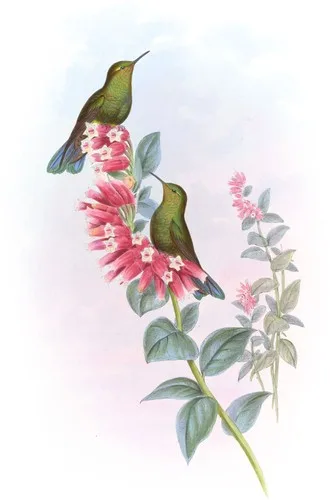
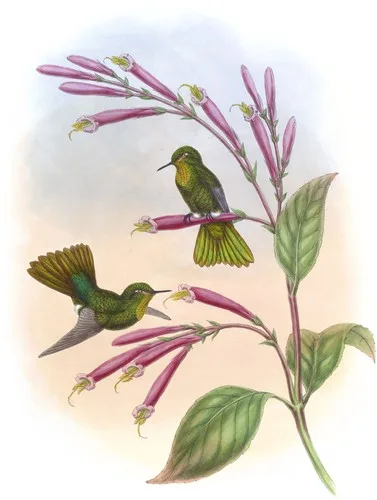
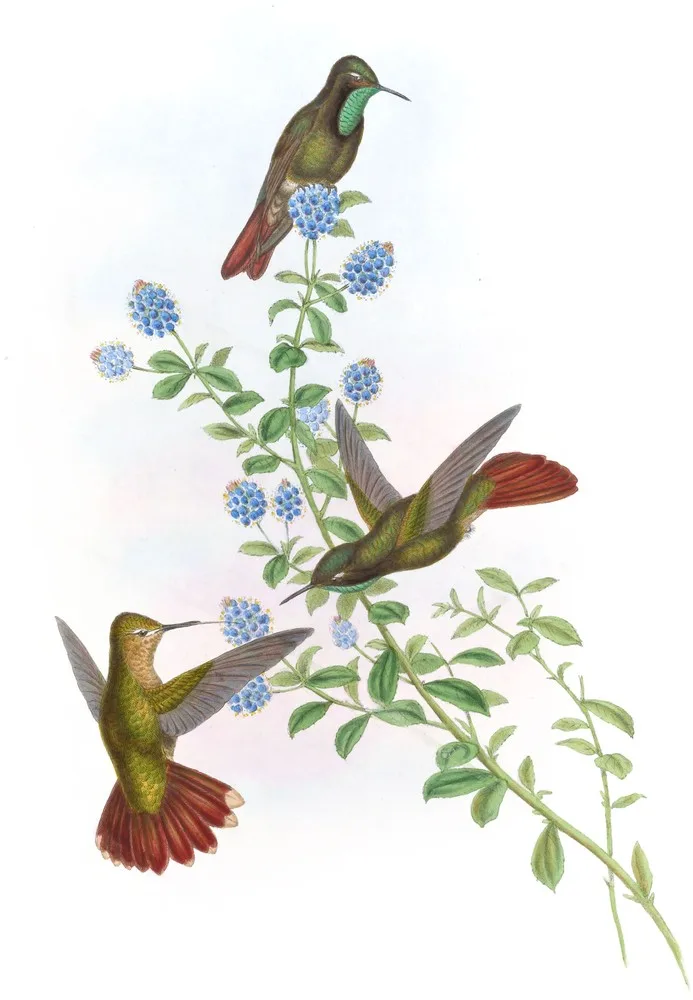
《古尔德蜂鸟图谱》(Gould's Hummingbirds)由约翰·古尔德绘制,1849—1887 年间印行,本图即其中一幅。画面主体是紫辉尾蜂鸟(Metallura tyrianthina),在分类体系中列于蜂鸟科(Trochilidae)。
该合集全编共 421 幅图版,此图为其中之一,图版编号 Pl. 195, Vol. III,对应原书第 195 页,版式为纵幅。扫描件取自公有领域原件,经高分辨率修复与色彩校正,可按原大放大查看线条与设色。
原书文字(英文 / 法文)
New Granada
The Metallura tyrianthina was first described by the late Mr. George Loddiges in the “ Proceedings of the Committee of Science and Correspondence of the Zoological Society of London” for the year 1832; it afterwards received the name of Allardi from M. Bourcier in 1839, and that of Paulinæ, in honour of Mademoiselle Pauline Barthod, from M. Boissonneau, in 1840.
It is without exception one of the commonest species of the genus, and enjoys an extremely wide range of habitat, extending over at least 15 degrees of latitude, being abundant all along the Andean ranges, from the Gulf of Darien to Ecuador. It appears to be especially numerous in the neighbourhood of Santa Fé de Bogota, a large number of examples being contained in every collection sent from that country. It has been figured by Sir William Jardine in his “Contributions to Ornithology” for 1850, where he has also given some interesting notes furnished to him by Professor Jameson of Quito, and M. Bourcier, which notes I take the liberty of extracting:—
Professor Jameson gives the western declivity of Pichincha as the habitat of this species, and states that ‘it feeds generally on the flowers of a blue lupine, and that its habits resembled more those of an insect than one of the feathered tribe.’
This species is scattered over all the mountains of New Grenada and Ecuador; it is met with on all the woody mountains, and also in the valleys (feeding from the flowers of all the different kinds of plants and orchids) visited by other species of the Trochlidæ. It braves the cold, and is one of the Humming-birds which is found on the flowers of the last shrubs which are met with in the high regions of the Paramos (cold mountains covered with grass, which separate the surrounding rocks of sand covered with snow from the other spots clothed with wood).
This Humming-bird has a rapid flight; it lives solitary, and makes its nest in ravines, among groups of plants, shaded from the sun and rain; like the other species, it lays two white eggs.
The female is red under the belly, without any fine colour on the throat. The young are covered with a blackish plumage. I never heard this species utter a cry.
The sexes differ considerably in colour, the female being much less gaily attired than her mate; she is also somewhat smaller in size.
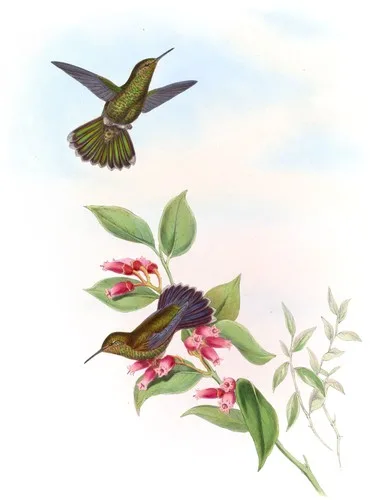
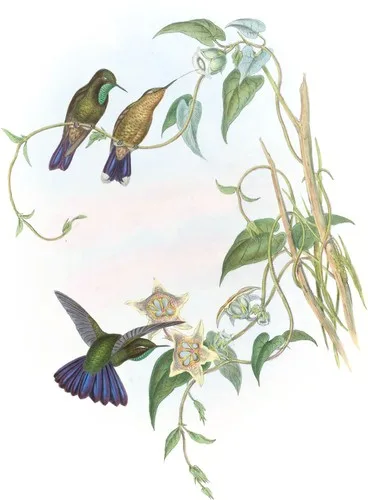
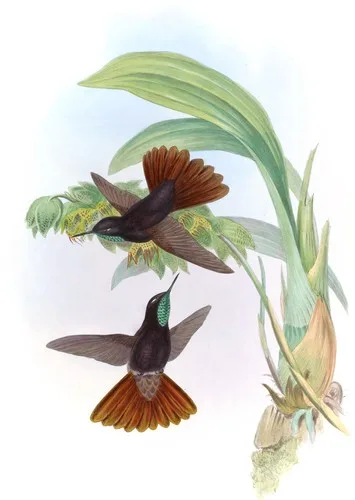
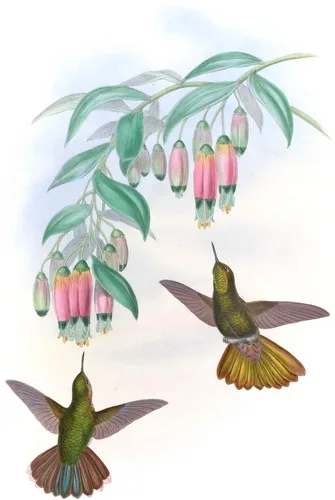
The male has the upper and under surface and wing-coverts dark dull bronzy green; a small spot of white behind the eye; down the throat a lengthened mark of luminous green, bounded on each side by blackish brown; wings purplish brown; tail rich purplish bronze; bill black.
The female has the plumage of the upper surface golden-bronze; tail bronzy purple, lighter than that of the male, the lateral feathers tipped with greyish white; no trace of the green gorget, the throat and the whole of the under surface being mottled with light grey, reddish, and here and there reflexions of green; behind the eye.a spot of white.
The figures are of the natural size. The plant is the Ceanothus Lobbianus.
References
- Trochilus tyrianthinus, Lodd. in Proc. of Comm. of Sei. and Corr. of Zool. Soc., pt. 11. p. 6.
- Ornismya Allardi, Boure. Rev. Zool. 1839, p. 294.—Ib. Ann. Sci. Phys. &e. de Lyon, 1840, p. 226. pls. 3, 4.
- Ornismya Paulinæ, Boiss. Rev. Zool. 1839, p. 354.—Ib. Mag. de Zool. 1840, pl. I3.
- Trochilus Allardi, Jard. Cont. to Orn. 1850, pp. 81–9, 151. pl. 55.
- Mellisuga tyrianthinus, Gray and Mitch. Gen. of Birds, vol. i. p. 112, Mellisuga, sp. 36.
- Metallura tyrianthina, Reich. Auf. der Col., p. 8.
- Metallura tyrianthinus, Bonap. Consp. Gen. Av., p. 75, Metallura, sp. 4.—Ib. Rev. Zool. 1854, p. 253.