刺嘴蜂鸟属
Ramphomicron microrhyncha
Ramphomicron microrhyncha
Thorn-bill
- 中文名
- 刺嘴蜂鸟属
- 学名
- Ramphomicron microrhyncha
- 合集
- 古尔德蜂鸟图谱
- 绘者
- John Gould(约翰·古尔德)
- 年代
- 1852
- 图版号
- Pl. 189, Vol. III
- 原书页码
- p.189
- 授权
- CC0 1.0 Universal (Public domain)
关于本图版
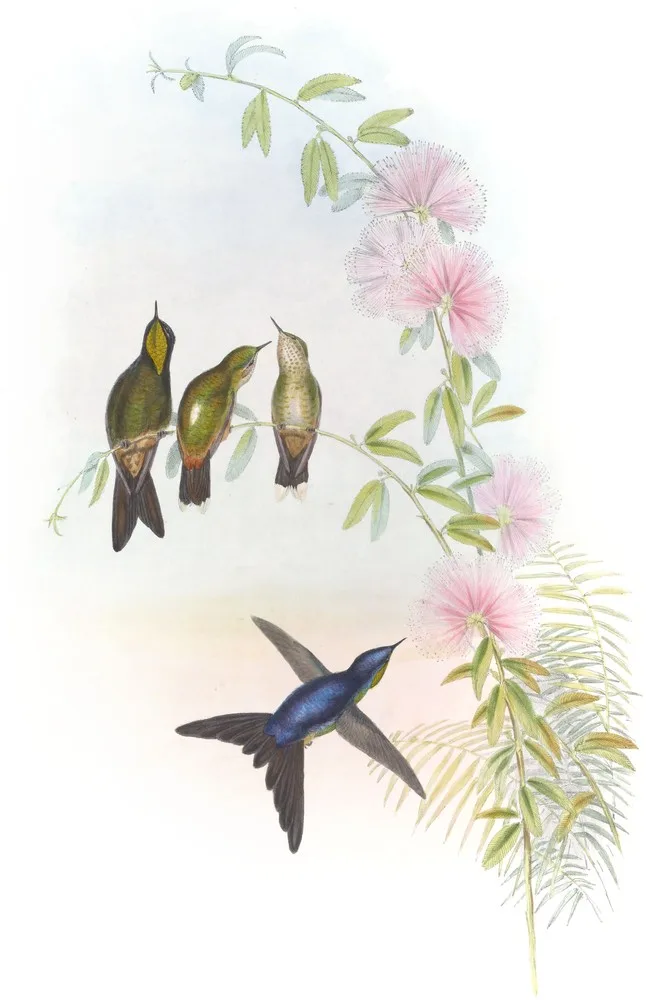
《古尔德蜂鸟图谱》(Gould's Hummingbirds)由约翰·古尔德绘制,1849—1887 年间印行,本图即其中一幅。图中描绘的是刺嘴蜂鸟,学名 Ramphomicron microrhyncha,在分类体系中列于蜂鸟科(Trochilidae)。
该合集全编共 421 幅图版,此图为其中之一,图版编号 Pl. 189, Vol. III,对应原书第 189 页,版式为纵幅。图像由公有领域原件扫描修复而来,细节在放大视图中仍清晰可辨。
原书文字(英文 / 法文)
The Andes from the Equator to seven degrees north
In the accompanying Plate, I have vainly attempted to illustrate this very lovely species, which (strange as it may seem) always conjures up in my mind a remembrance of the glow-worm, whose evening torch so charmingly illumines the dark lane-sides of our own country; for indeed in its plumage, a gleam of intense lustre is contrasted with the tone of the general plumage.
The glow-worm shines in the dark, but this bird, on the contrary, is most glorious in the glare of the sun; when its throat, opposed to bright light, becomes transcendently brilliant; the surrounding dark colouring tending to render it more conspicuous: the beautiful violet-coloured back, relieved by the dark hue of the wings, and the black tail, all combined with the utmost harmony, and in the most elegant form, render this bird an object of no ordinary interest. As its name implies, the bill is remarkably small, and in fact, there is no species yet discovered that has this organ so diminutive: how minute then must be the insects upon which it feeds, how small must be the flowers from which they are obtained, and how active must it be to procure a sufficient supply of these microscopic creatures for the sustenance of life! M. Bourcier informs me that it is a migratory species, and that in Ecuador, where he had killed many specimens, he had seen it obtaining its insect food from the low composite plants, with open daisy-like tufts of yellow flowers, growing on the hill sides at an elevation of from eight to twelve thousand feet, to which it seemed to be so partial, that wherever he found these plants, there he was quite certain to find the bird also. M. Bourcier adds, that a great number may be killed before adult males in full plumage are procured, and that the preparation of specimens for the cabinet is very difficult, from the readiness with which the feathers are detached from the skin. It is usually met with in small companies; flies very gently, and never rises far from the ground. From Ecuador, which I believe to be its most southern limit, it is found far to the southward of Santa Fé de Bogota, and doubtless inhabits all the districts between these distant localities. It will be seen then, that, like its congeners, it is strictly an Andean species. Although now very common in our collections, it is only within the last few years that the bird was discovered and sent to Europe.
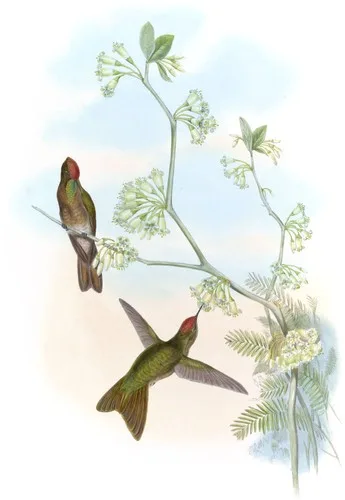
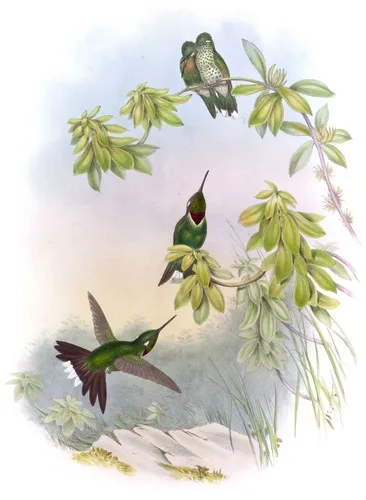
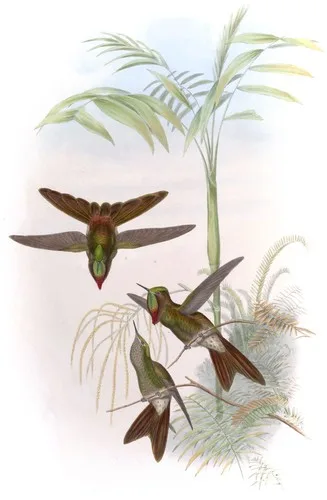
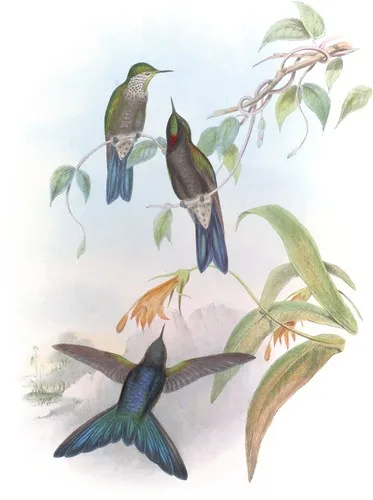
The adult male has the head, all the upper surface and wing-coverts rich dark shining purple; wings very dark purplish brown; tail velvety black; on the throat a large gorget of the most luminous metallic yellowish green; under surface bronzy green; across the vent an irregular band of buff; under tail-coverts dull bronzy green, edged with buff; bill black; feet dark brown.
The female has the whole of the upper surface bronzy green; the throat white with a spot of bronzy green at the tip of each feather; the remainder of the under surface white, washed with bronzy green on the flanks; vent deep buff; under tail-coverts similar to, but darker than those of the male; tail purplish bronzy black, the two lateral feathers on each side tipped with white; a white mark in the centre of the back in some instances.
It is not yet, I believe, clearly ascertained if the adult female ever has the gorget; in all probability she has not, or at all events not until after her capability for reproduction has ceased.
In some specimens we find the purple of the upper surface mottled with shining green; the throat-mark only partially developed, the lower part of the abdomen, and the margins of the under tail-coverts white, and the outer tail-feather only tipped with that colour: the birds in this state, I believe, are males of the second year assuming the adult plumage.
The Plate represents two adult males, a female, and a young bird of the year, on a species of Mimosa of the country, a plant very generally resorted to by the Trochihdæ.
References
- Ornismya microrhyncha, Boiss. in Rey. Zool. 1839, p. 354.—Ib. Mag. de Zool. 1840, Ois. pl. 16.
- Trochilus brachyrhynchus, Fras. in Proc. of Zool. Soc., part viii. p. 16.
- Mellisuga microrhyncha, Gray and Mitch. Gen. of Birds, vol. i. p. 112, Mellisuga, sp. 32.
- Ramphonucron microrhyncha, Bonap. Consp. Gen. Av., p. 79, Ramphomicron, sp. 1.