Urosticte Benjamini
Urosticte Benjamini
White-tip
- 学名
- Urosticte Benjamini
- 合集
- 古尔德蜂鸟图谱
- 绘者
- John Gould(约翰·古尔德)
- 年代
- 1852
- 图版号
- Pl. 190, Vol. III
- 原书页码
- p.190
- 授权
- CC0 1.0 Universal (Public domain)
关于本图版
这幅图版出自《古尔德蜂鸟图谱》(Gould's Hummingbirds),由约翰·古尔德绘制,1849—1887 年间出版。原书题作“Urosticte Benjamini”,归入蜂鸟科(Trochilidae)。
全编共收录 421 幅图版,本图是其中一幅,原书将其列为 Pl. 190, Vol. III,见第 190 页,版式为纵幅。图像由公有领域原件扫描修复而来,细节在放大视图中仍清晰可辨。
原书文字(英文 / 法文)
Ecuador
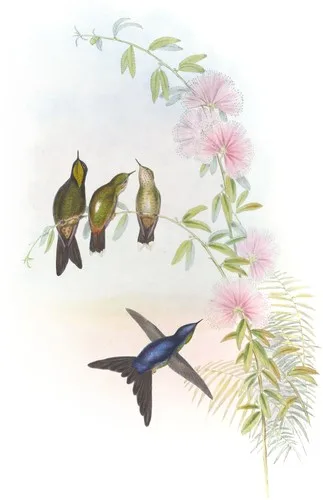
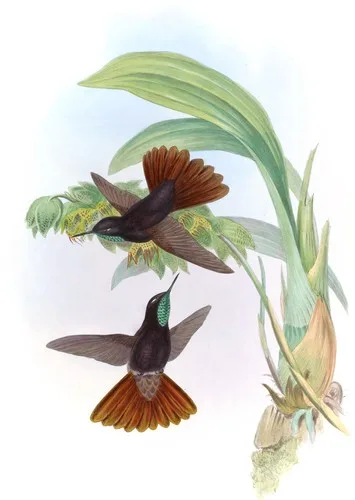
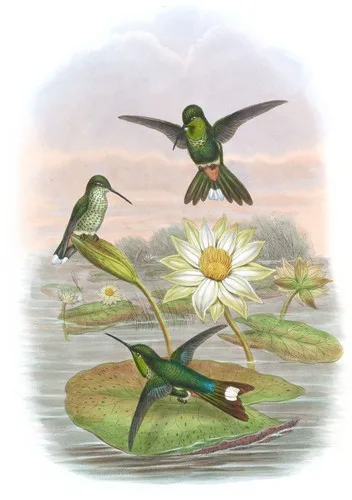
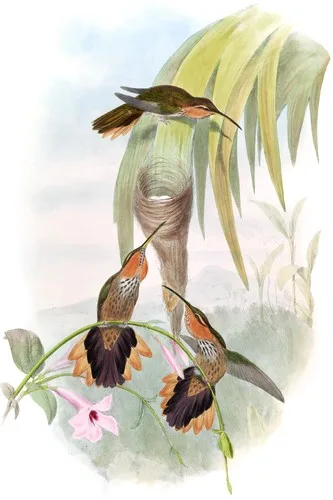
This beautiful species, one of the late discoveries in this lovely tribe of birds, differs in so many particulars from every other member of the family, that I have been constrained to give it a new generic title, and have selected that of Urosticte as indicative of the conspicuous white terminations of the four central tail-feathers; in nearly every other instance it is the outer feathers that are thus marked, and not the central ones, and it is the circumstance of the latter being thus decorated in the present bird which renders it so remarkable.
For a knowledge of this fine bird we are indebted to M. Bourcier, who discovered it during his residence in Ecuador as the French Consul General for that Republic; and who has named it Benjamin, after the eldest son of Mr. Leadbeater, a name so well known to all naturalists. M. Bourcier states that it inhabits the warm regions in the environs of Gualea; and I have received several examples from Quito, through the hands of Professor Jameson, who procured them on the western side of Pichincha.
The sexes offer a marked difference, as will be seen by the following descriptions:—
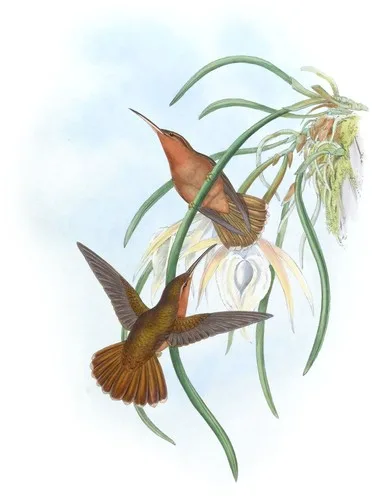
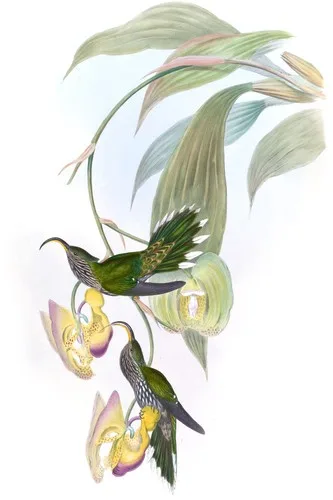
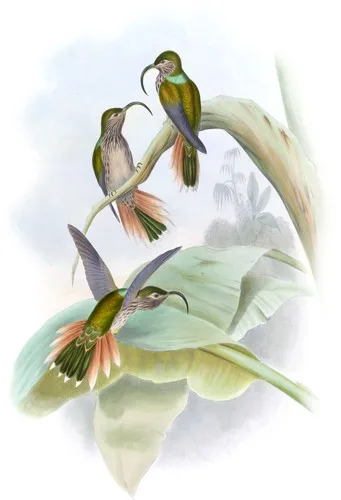
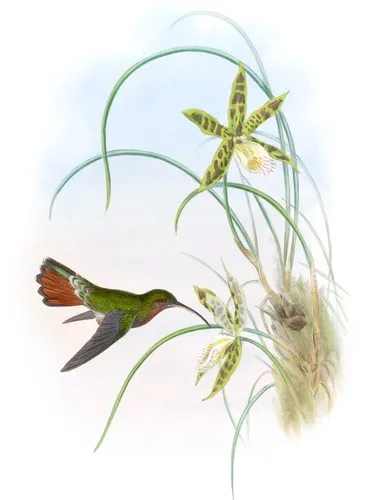
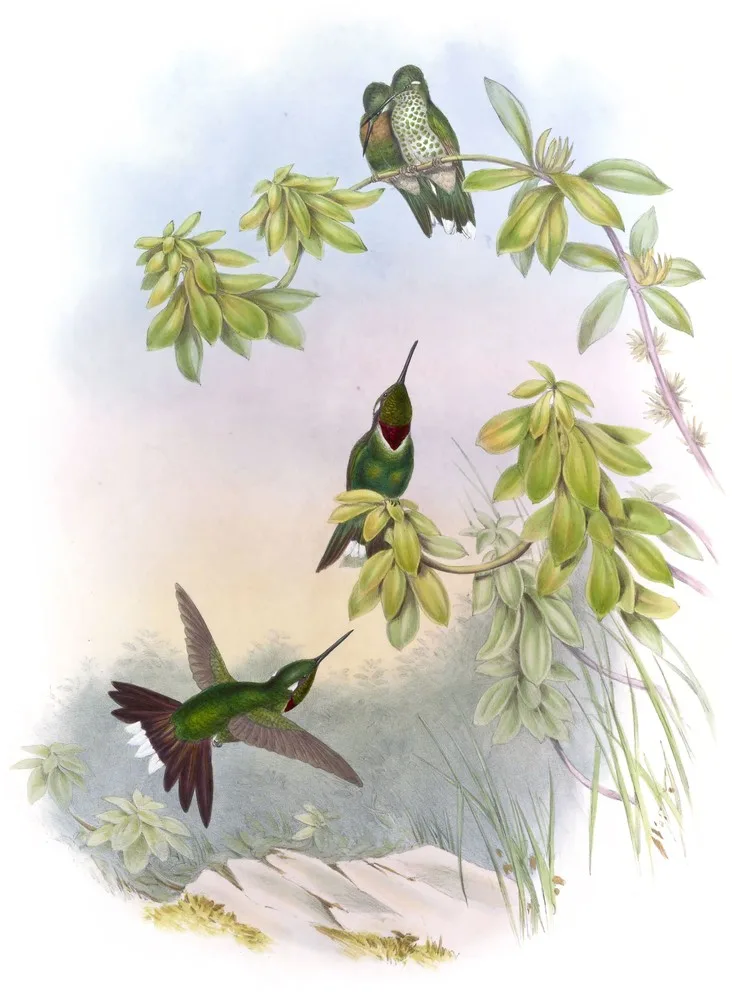
The male has the general plumage of the body, both on the upper and under surfaces, green; behind the eye a conspicuous projecting tuft of white; throat luminous green, below which is a gorget-shaped mark of deep reddish violet; wings dark purplish brown; tail bronzy purple, the four central feathers largely tipped with white; bill black; feet brown.
The female has the upper surface green, inclining to bronze on the head; the white tufts behind the eye less conspicuous; all but the two central tail-feathers tipped with white, and the throat and abdomen white, with a spangle of shining green at the tip of each feather.
The young male is dark bronzy green above, dark green below; has the throat rufous, and the four central feathers with an oblong patch of white near the tip.
The Plate represents two males, a young male and a female of the natural size, on a species of Sedum, grown by Sir William Jardine, Bart., at Jardine Hall, from seeds sent to him by Professor Jameson of Quito.
References
- Trochilus Benjamini, Bourc. Compt. Rend. de l’Acad. des Sci., tom. xxxii. p. 187.