Selasphorus Heloisæ
Selasphorus Heloisæ
Heloisa’s Flame-bearer
- 合集
- 古尔德蜂鸟图谱
- 绘者
- John Gould(约翰·古尔德)
- 年代
- 1852
- 图版号
- Pl. 141, Vol. III
- 原书页码
- p.141
- 授权
- CC0 1.0 Universal (Public domain)
关于本图版
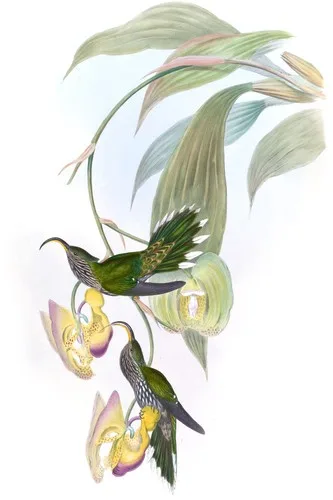
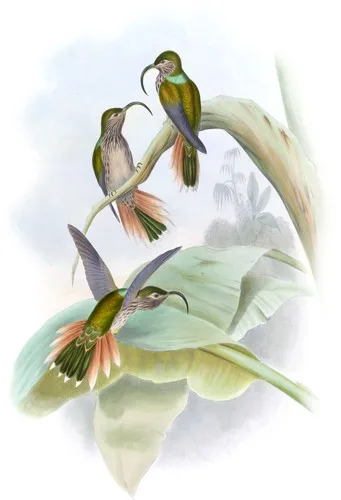
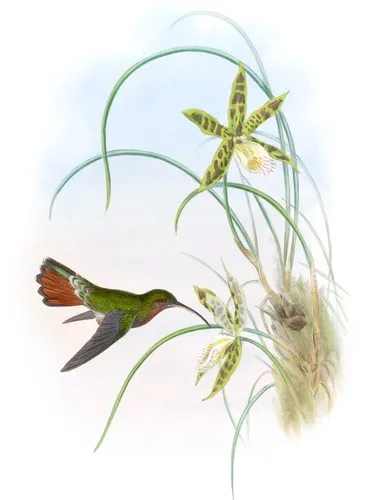
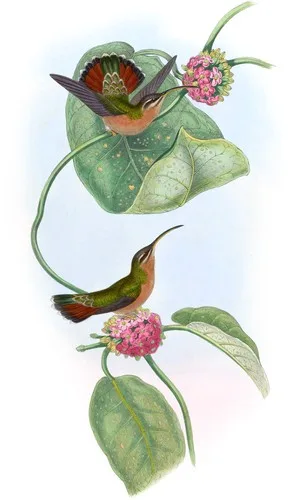
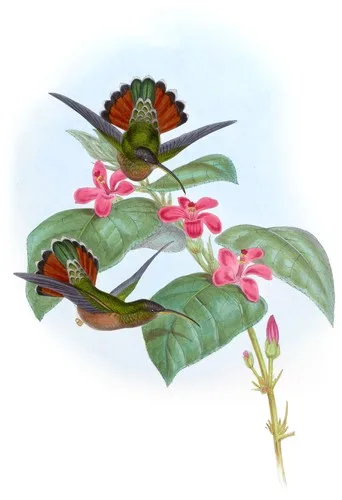
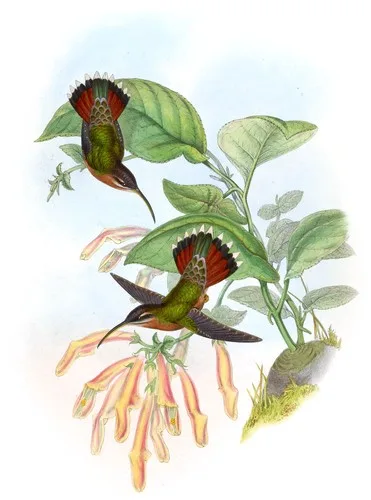
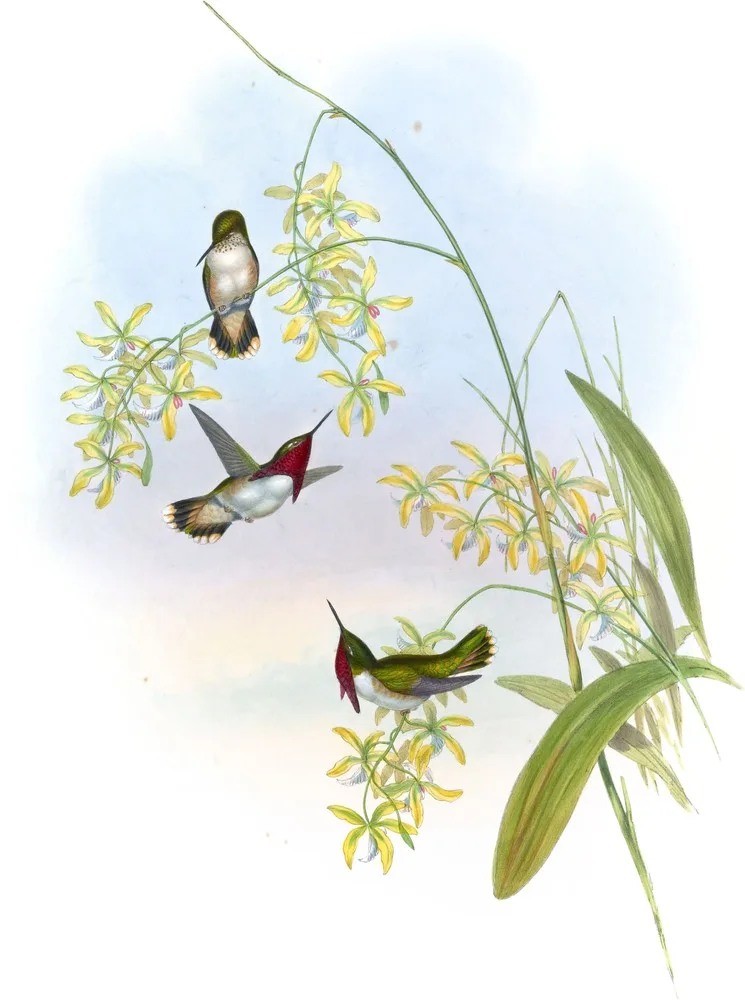
此图原刊于《古尔德蜂鸟图谱》(Gould's Hummingbirds),绘者为约翰·古尔德,成书于 1849—1887 年间。原书题作“Selasphorus Heloisæ”,归入蜂鸟科(Trochilidae)。
全编共收录 421 幅图版,本图是其中一幅,原书将其列为 Pl. 141, Vol. III,见第 141 页,版式为纵幅。扫描件取自公有领域原件,经高分辨率修复与色彩校正,可按原大放大查看线条与设色。
原书文字(英文 / 法文)
Central America and Southern Mexico
This beautiful species is so directly intermediate, both in form and colouring, between the members of the genera Calothorax and Selasphorus, that it is extremely difficult to determine with which of them it should be placed; in its size and in its glittering gorget it offers a close affinity to the former, and in the form of its tail to the latter; under these circumstances, some naturalists would make it the type of a new genus, and should other species possessing similar characters be discovered, it may be necessary so to do, but for the present I content myself with placing it in the genus Selasphorus, with a mark of doubt as to that being its proper place.
The Selasphorus? Heloisæ is a native of the temperate regions of Mexico. M. De Lattre, to whom we are indebted for its discovery, states that the examples he procured were found between Jalapa and Quatepu; that the male rises very early, does not search for food after nine o’clock in the morning, seldom leaves the female and young, and confines himself to the forests, but does not disdain field flowers.
The sexes differ considerably in their plumage, the male alone being adorned with a rich gorget.
I am indebted to the late M. Damiano Floresi d’Areais for fine examples of this bird collected during his last sojourn in Mexico.
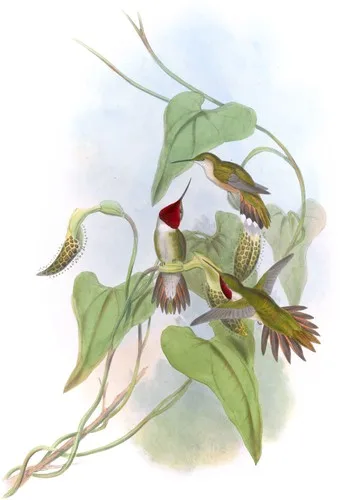
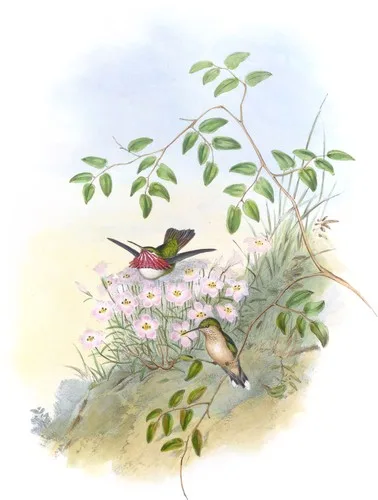
The male has the head, wing-coverts and upper surface rich golden green; wings purplish brown; central tail-feathers greenish bronze, the remainder cinnamon-red at the base, to which succeeds a large oblique mark of black, and a nearly round spot of white at the tip; throat glittering lilaceous red, the feathers short and scale-like in the centre, but lengthening on each side into prominent tufts; below this a band of greyish white terminating in a point on each side of the neck; flanks deep buff; centre of the abdomen and under tail-coverts buffy white.
The female is very similar to the male, but in lieu of the rich gorget has the throat spotted with brown on a white ground.
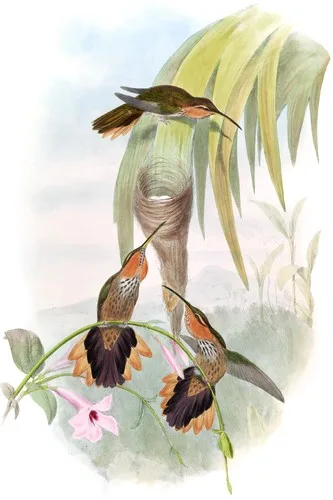
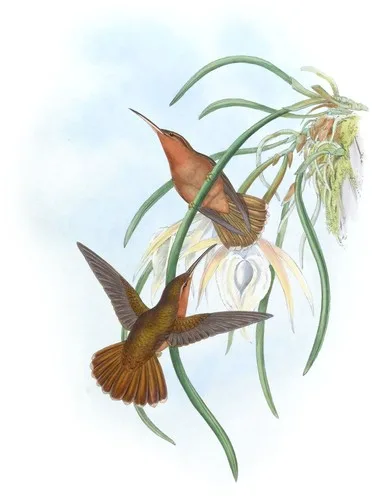
The figures represent both sexes of the natural size, on a Mexican orchid.
References
- Ornysmia Heloisa, Less. et De Latt. Rev. Zool. 1839, p. 15.
- Mellisuga Heloisa, Gray and Mitch. Gen. of Birds, vol. i. p. 1138, Melhisuga, sp. 62.
- Tryphena heloisa, Bonap. Consp. Troch. in Rey. et Mag. de Zool. 1854, p. 257.
十二观
- 纵幅 1.34∶1
- 1852 年刊
- 图版 141, Vol. III
这不是词条,是一条看画的次序:先站定看整体,再看名字与形色、构图与刀工,然后问它几时开、从哪里来、经了谁的手;最后是中国诗文——同一朵花,中国古人是怎么看的。十二观读完,这幅图就打开了。
-
第一眼
江馆清秋,晨起看竹,烟光日影露气,皆浮动于疏枝密叶之间。
—— 清·郑板桥《题画竹》
郑板桥说他画竹,是先看见“烟光日影露气”在枝叶间浮动,才动手。看画时找这一层空气,比记住花的名字更要紧。这一幅是竖的:眼睛从下往上走,落点在中段那只鸟身上。先别急着看羽毛,让姿态先立起来。第二步凑近一寸:看线与色的交界,色有没有压住线,线有没有断。第三步,把视线放到最深的那一小块:整幅的用色秩序,都是从那里排开的。
-
名与实
图上只标属名 Selasphorus,未定种;这一时期的图谱常以一属数种合绘,种名要等后来的专著补齐。此幅尚无通行中文名,姑以学名相称;在没有本地名字的地方,学名就是它唯一的身份证。
-
形与色
翼小而振频极高,能悬停、能倒飞;羽色非颜料所致,是羽枝结构折射的光,随角度而变。此幅未作色相归档,只能就形制论。看羽:先看覆羽的层次,再看飞羽的排列,最后才看颜色——颜色是最后才被注意到的部分。
-
构图与呼吸
画幅高而窄,鸟栖在枝的中段,上下留白多——十九世纪鸟谱的标准版式,留给它飞走的余地。(高宽比约 1.34∶1)全幅只画一只,不作解剖附图——这类图更近于“观赏”,而非“鉴定”。试着用拇指遮住空白处——画面立刻变闷;放开,它才重新“喘上气”。留白,是给主体让出的气口。
-
一刀一色
十九世纪后半叶,石版与彩色石印渐成主流:颜色可以直接印出,不再依赖手工,线条反倒退居其次。图像的“准确”提高了,手性却淡了。拿放大镜(或手机微距)看三处:喙缘、覆羽、题名。线若连续不断,是刻的;色若越过轮廓半毫米,是手涂的。
-
时序
热带美洲几乎全年可见,花期即其季节;温带种类的蜂鸟则随花北迁,一年往返数千公里。图上所记的 1852 年是刊行之年,不是采到那只鸟的年份;真正的观察记录通常比出版早一两年。看这一类图最好的时候,是它的花期:文字说不清的“开得正盛”,在树下站三分钟就懂了。
-
故土
仅产美洲,自阿拉斯加南部至火地岛,以安第斯山最为繁盛。中土无蜂鸟,汉籍不载,晚清海外游记始见其名。产地写在图上的,往往是“据说来自”;真正的野外记录,要等采集人回来才敢落笔。
-
书与人
《古尔德蜂鸟图谱》(Gould's Hummingbirds)由约翰·古尔德绘,成于1849-1887。此幅为其中图版 141, Vol. III,见原书第 141 页。一本书的“作者”常常是主编;真正决定这幅图好不好看的,是没留下名字的刻工与上色人。
-
诗境
穿花蛱蝶深深见,点水蜻蜓款款飞。
—— 唐·杜甫《曲江二首》
中土无蜂鸟,然“穿花”之态,杜甫早已写过:贴着花心走,是采蜜者的共同姿态。古人写到这一层,已不只是赏花,是借花说人;画面则只负责把那朵花留住。
-
文心
竖划三寸,当千仞之高;横墨数尺,体百里之迥。
—— 南朝宋·宗炳《画山水序》
三寸的竖线可当千仞高山,几尺横墨能容百里之远。一只蜂鸟只有拇指大,画家却要在几厘米里放下整片花丛——尺度从来不是障碍。古尔德《蜂鸟图谱》(1849—1887)以石版手工上色,金箔衬底,使羽色在纸上仍有金属光;这套图册本身就是十九世纪印刷与收藏狂热合流的产物。中外的分别不在谁高明,而在问的问题不同:欧洲问它是什么,中国问它像谁。两个问题都答了,一幅图才算读完。
-
花语
阿兹特克以蜂鸟为战神与太阳的化身;欧洲维多利亚时代则以蜂鸟为收藏与装饰的极致,百万只羽毛被做成胸饰。中国旧籍无此鸟,故无象征——这空白本身,就是一部博物学交流史。在图谱里,它首先是一个物种,其次才是一种象征——这个次序值得记住。
-
带走一双眼睛
下次看鸟,别急着认名:先看它停的姿态,再看羽色在哪一段最深,最后才翻图鉴——顺序一换,看鸟就从“对答案”变成了“看画”。1852 年的那只鸟早已化作尘土,它留在纸上的样子,却比任何一只活着的同类都长寿。