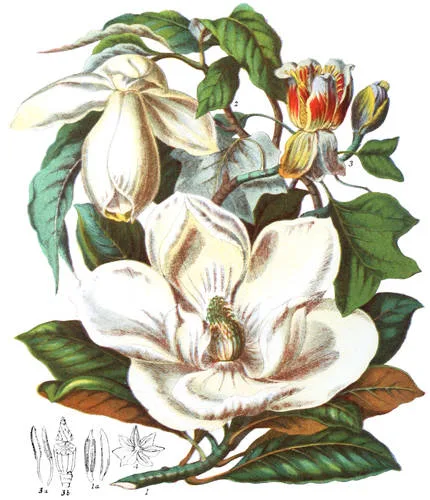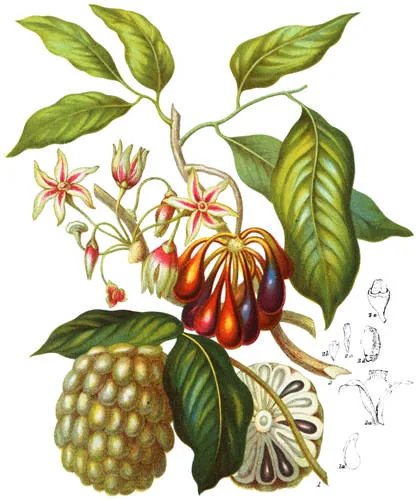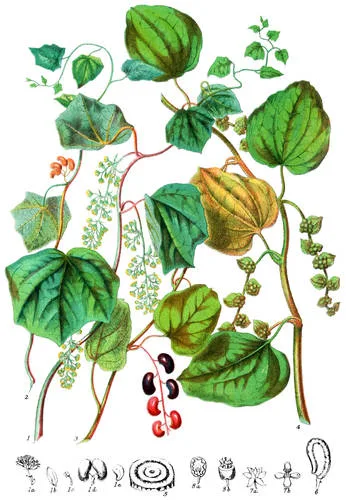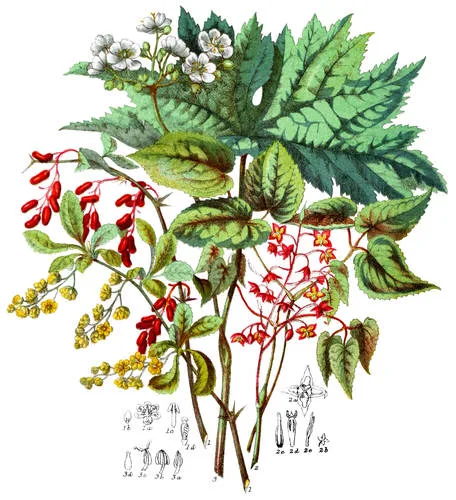
Nympheaceæ
Nympheaceæ
The Water-Lily Tribe
- 合集
- 植物自然目
- 绘者
- Elizabeth Twining(伊丽莎白·特温宁)
- 年代
- 1868
- 图版号
- Order 8
- 原书页码
- p.8
- 主色
- 黄
- 授权
- CC BY-SA 4.0
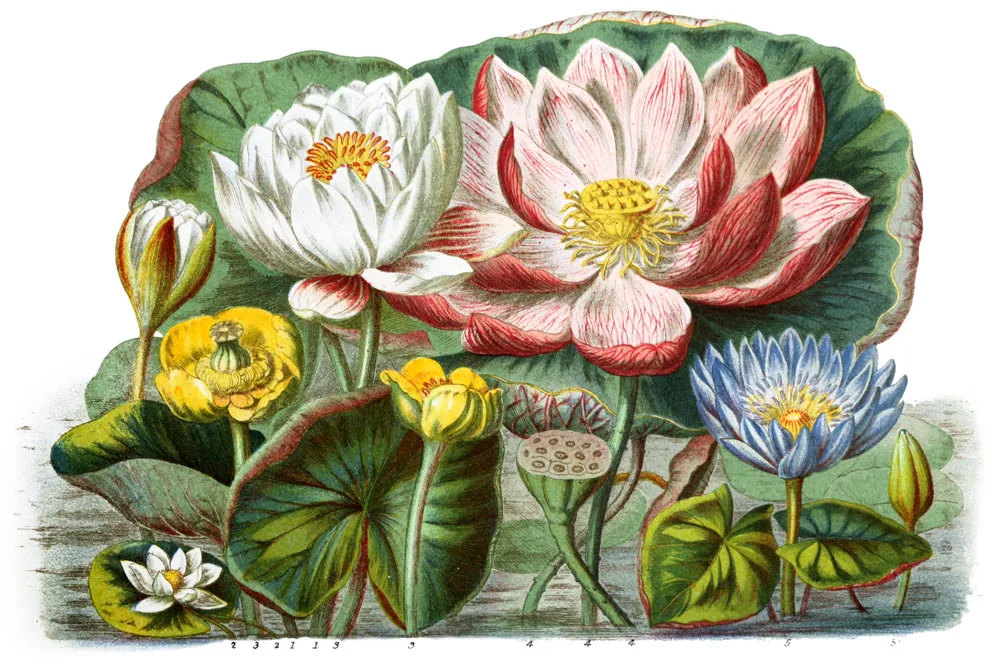
图中植物与部位
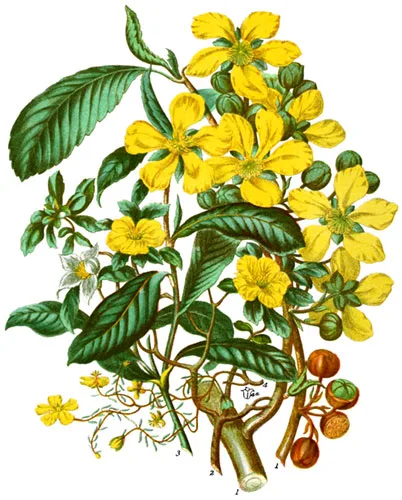
- 1. Nymhea alba , White Water-lily England
- 2. Nymphea pygmea , Pigmy Water-lily China
- 3. Nuphar luteum , Yellow Water-lily England
- 4. Nelumbium speciosum , Sacred Bean India
- 5. Nymphea cærulea , Blue Water-lily Cape of Good Hope
-
- bg.
关于本图版
本图选自伊丽莎白·特温宁的《植物自然目》(Natural Orders of plants),原书 1849 年出版。原书题作“Nympheaceæ”。原书为这一物种留下了成幅的彩色图像记录。
该合集全编共 160 幅图版,此图为其中之一,图版编号 Order 8,对应原书第 8 页,版式为横幅,画面以黄为主色。图像自原件扫描修复,构图与设色未经改动,授权方式见页面下方。
原书文字(英文 / 法文)
Key characteristics
All herbaceous plants, growing from a prostrate stem in quiet waters, having leaves of a thick substance, either heart-shaped or of a peltate form, attached to the leaf-stalk by the centre. The young leaves are usually rolled inwards; when fully grown they lie perfectly flat on the surface of the water, or else rise up above it. The flowers are composed of four or five sepals, and numerous petals, some of which pass gradually into stamens: both petals and stamens are inserted into the large fleshy disk which surrounds the ovary, except in Nelumbium, where they are placed in several rows at the base of the disk. The filaments of the stamens are of a petal-like form; the anthers burst inwardly by a double longitudinal cleft. The ovary contains many cells and numerous seeds, sumounted by the radiating stigmas. In Nelumbium the ovary is very large, and rises high in the centre of the flower, having on its summit several short styles and simple stigmas. The nuts, containing one, rarely two seeds each, lie half-buried in the hollow cells until they are ripe, when they become loose, and fall out. The seeds of Nymphea and Euryale are enveloped in an arillus.
The radiating stigmas on the summit of the enlarged seed-vessel, and a narcotic milky juice, are connecting links with the Poppy tribe; the dilated disk of some kinds of Peony resembles partly that of Water-lilies, thus forming a link with the Crowfoot tribe.
Select plants in this order
Not all plants listed are illustrated and not all plants illustrated are listed.
- Nymphea alba (1) is the most beautiful of British water-plants; the flower, rising above the water among the flat green leaves, opens in the morning and closes in the afternoon. The roots or creeping stem are used for dyeing grey in Ireland and the Highlands of Scotland; they are also useful in tanning leather.
- Nuphar luteum (3) grows in America, as well as in several countries of Europe: in Turkey a cooling beverage is prepared from the flowers. The stems contain a great portion of starch, and, if well washed, afford wholesome food. The seeds are also eatable, and are used by the poor peasants of some countries in times of scarceness.
- Nelumbium speciosum (4) is the once celebrated Lotus of Egypt, which was considered sacred, and employed as an emblematical ornament in the paintings of their temples. It is also frequently found on the ancient monuments of India, where it abounds in almost every part of the country, covering the waters with its magnificent flowers and large leaves, on which the aquatic birds walk. The long stalks are cooked and eaten in Japan; the rotos and seeds are esteemed food in China, being eaten fresh in summer, and preserved in salt and vinegar for winter use.
- Nymphea lotus, a pink species abut the size of our white Water-lily, still grows abundantly in Lower Egypt.
- The leaf and flower-stalks of several kinds of Nelumbium and Nymphea contain spiral vessels, out of which the Hindoos make wicks for the sacred lamps in their temples.
- Euryale ferox grows in China and India,—very plentifully in the lakes of Chittagong, eastward of Calcutta, where it is called by the natives Makannah; it bears flowers a great part of the year, but they are small, of a pale purple colour, and not nearly so ornamental as those of the tribe usually are. The stalks, calyx, and under-surface of the leaves are beset with strong prickles: the nuts are farinaceous; after being heated in sand they become light and spongy, and fit for food. The tubers and seeds of several kinds of Nymphea are roasted and eaten by the negroes of Senegal.
- Victoria regina, the most gigantic and eautiful of water-plants, belongs to the rivers of Guiana, where it was discovered by Robert H. Schomburgk in 1837, in great profusion. The leaf is from five to six feet in diameter, green above and red on the lower surface, having a broad rim around it. The flower measures fifteen inches across, and is composed of numerous petals of a deep rose colour in the centre, gradually becoming a pure white towards the exterior; the stalks and calyx are, like those of Euryale, covered with strong prickles: the seeds are eaten by the native Indians.
Locations
India is the principal station of this Order, all except Nuphar being found there. Nelumbium is the most abundant genus of the East Indies. Some inhabit the still waters of the temperate and tropical regions of the whole northern hemisphere, both of the Old and the New World; a few grow in the southern hemisphere, at the Cape of Good Hope and elsewhere. Victoria is the representative of the Order in South America.
Legend
- Nymphea alba, White Water-lily. England.
- Nymphea pygmea, Pigmy Water-lily. China.
- Nuphar lutem, Yellow Water-lily. England.
- Nelumbium speciosum, Sacred Bean. India.
- Nymphea cærulea, Blue Water-lily. Cape of Good Hope.
本图涉及的植物
- Nymphea alba
- Nymphea pygmea
- Nuphar lutea
- Nelumbium speciosum
- Nymphea cærulea
属索引
- Euryale
- Nelumbium
- Nuphar
- Nymphæa
- Victoria