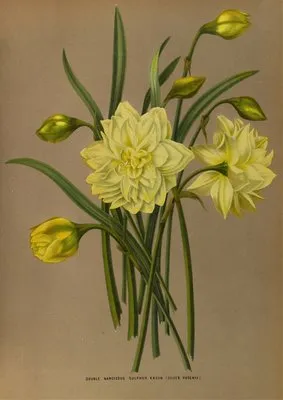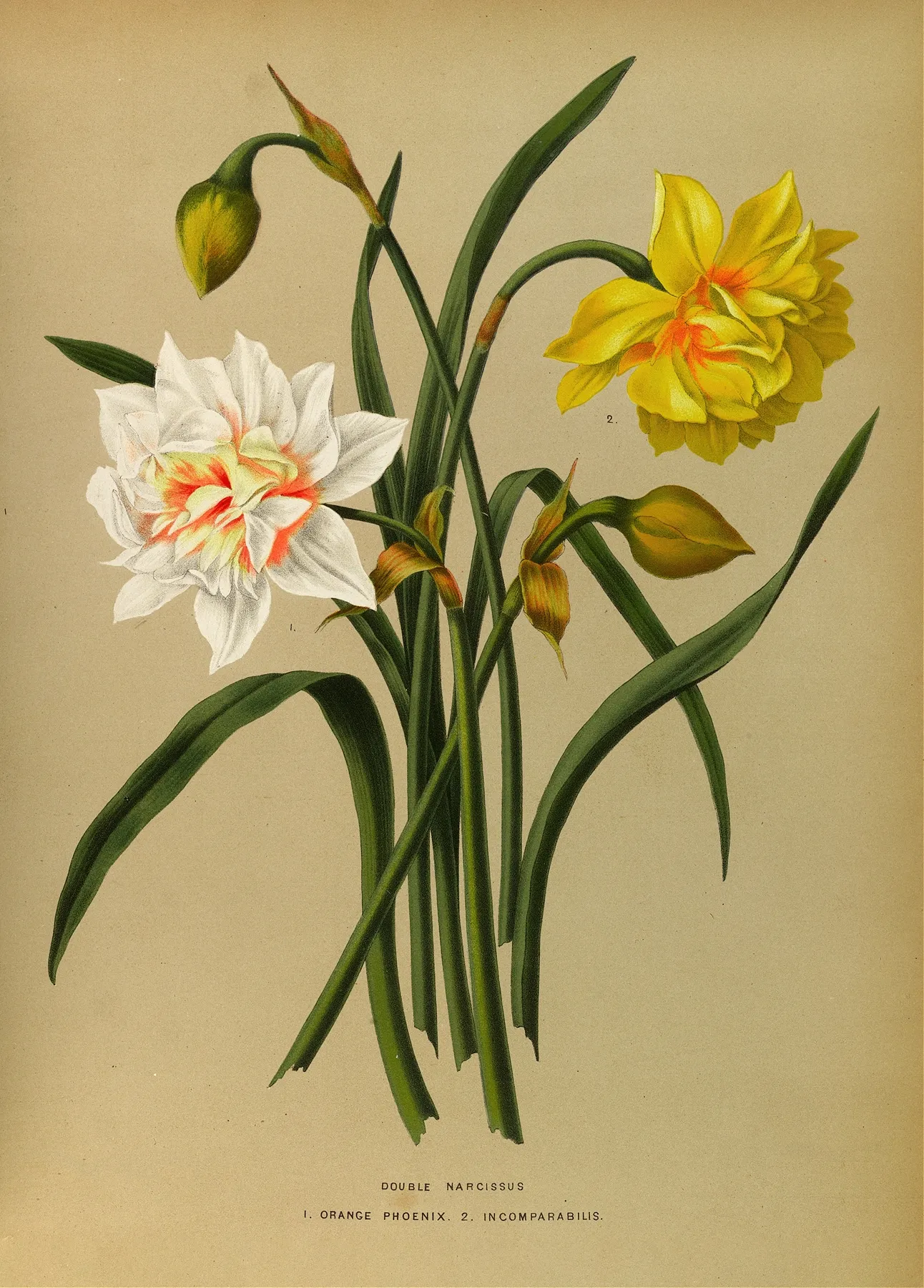
Double Narcissus 1.Orange Phoenix. 2. Incomparabilis
Double Narcissus 1.Orange Phoenix. 2. Incomparabilis
Double Narcissus 1.Orange Phoenix. 2. Incomparabilis
About this plate
Double Narcissus 1.Orange Phoenix. 2. Incomparabilis is plate 20, from Haarlem's Flora, drawn by Arentine H. Arendsen. This public-domain plate is reproduced at high resolution, free to view and download. Publication: Haarlem : 1872-1881..
Twelve ways of seeing
One plate, read twelve times over: its name, its colour, the burin and the brush, the shape of the sheet, the season, the soil it came from, the book it belongs to, its language of flowers, the poem it answers to, the lore behind it, how to look, and what remains.
-
The Name
The plate is titled “Double Narcissus 1.Orange Phoenix. 2. Incomparabilis”, numbered Plate 20. The plate gives only the genus, Narcissus; species-level names came later. No established Chinese name exists for this plate, so it is cited by its binomial alone.
-
Form and Colour
A layered bulb, upright strap leaves, six white tepals and a small golden cup — the Chinese name is 'silver terrace with a golden cup'. Filed under yellow — a honey-yellow. The colour is built in washes: a pale ground first, then deepening at the petal base and in shadow. Three things fix the habit: leaf arrangement, tepal count, and how the flower is borne.
-
Line and Colour
In the later nineteenth century chromolithography took over: colour printed rather than painted, line demoted. Images grew more accurate and less personal. Look closely at the line and the colour: an unbroken line means engraving, colour crossing the outline by half a millimetre means hand-colouring. Craft leaves franker evidence than inscriptions.
-
Composition
Tall and narrow, the plant rising in one movement with generous margins above and below — the upright format of most floras. (about 1.39 : 1). No details are appended: this is a plate for looking, not for keying out.
-
Season
Late winter into early spring: forced in water in the twelfth month, blooming at the New Year. The year 1872 on the plate is the year of publication, not of flowering — the gathering came a year or two earlier.
-
Provenance
Native to the Mediterranean, reaching China by sea in the late Tang; Zhangzhou in Fujian has grown it since Ming times. The volume was made in 1872-1881, when most of this knowledge came from living plants under glass rather than from the wild.
-
The Book
“Haarlem's Flora” was drawn by Arentine H. Arendsen and published 1872-1881. This plate is Plate 20. The image is in the public domain; the hand-colouring on the paper is still one person's hand, two centuries ago.
-
Symbolism
In China it is the New Year's offering — clear, fragrant, a little otherworldly; in Europe, because of Narcissus, it means self-love and the gaze turned inward. This plate leans yellow, which in flower language adds one more degree of feeling. In a flora it is a species first and a symbol second; the order is worth keeping.
-
Poetic Resonance
含香体素欲倾城,山矾是弟梅是兄。
—— 宋·黄庭坚《王充道送水仙花五十枝》
Fragrant, white-bodied, all but city-toppling; the snowbell is its younger brother, the plum its elder.
The poem gives the mood first and the picture supplies the form; set the line beside the plate and the yellow the corolla becomes its resting point.
-
Classical Lore
Song poets made it famous — Huang Tingjian wrote that southern gardeners grew it widely; Qing manuals describe the Zhangzhou practice of raising it in sand and water, still used today. Chinese flower books ranked plants by character; European floras described them by form and name. This plate belongs to the second tradition, yet bears reading by the first. Printed in 1872, at the moment the two traditions began to see each other.
-
How to Look
Note the depth of the corona — a long trumpet or a shallow cup — and whether the tepals reflex; the more they curl back, the stronger the scent. Follow the yellow: deepest at the petal base, palest at the tip, with the whole transition in between.
-
Afterword
A flora exists to be consulted; look long enough and you forget to consult — someone in 1872 gave a whole day to a single flower.