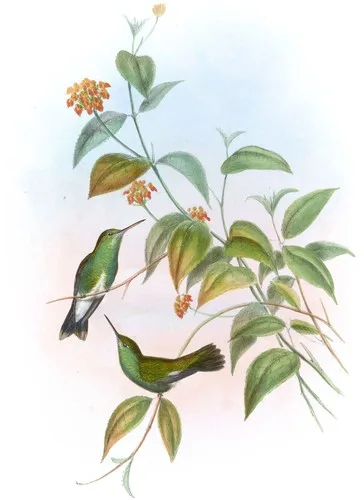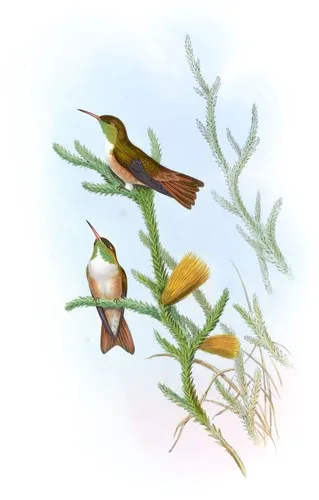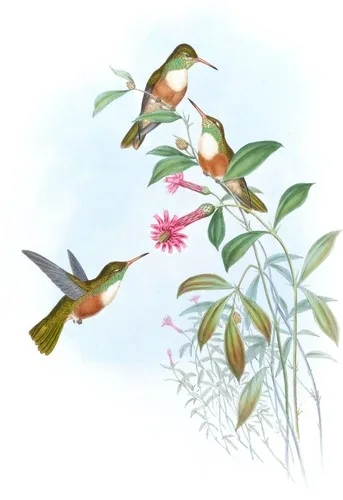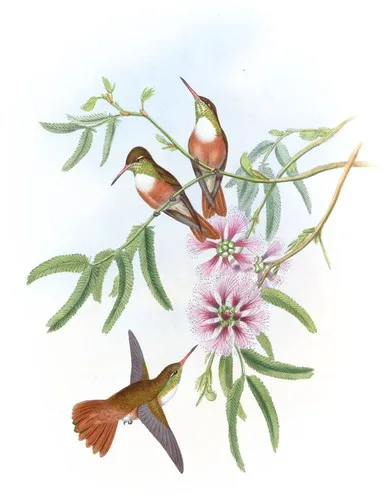
Amazilia pristina
美洲蜂鸟属
Amazilia pristina
Amazili
About this plate
The neighbourhood of Lima in Peru
In his description of this species, Lesson says, “Peru, like Brazil, possesses Humming-birds peculiarly its own,” and adds, “the name given to this bird will not only recall to our imagination one of the heroines celebrated by Marmontel in his ‘Incas,’ but also the country in which it lives.”
It is, indeed, peculiar to Peru, and is exceedingly common in the neighbourhood of the far-famed city of the Sun—Lima. It is one of the largest and most powerful species of the genus Amazilia, and may be regarded as the type of a form to which no less than six generic appellations have been assigned. The specific name of latirostris applied to this bird by Prince Charles L. Bonaparte and Dr. Reichenbach cannot be retained, as the latirostris of Swainson, which they have imagined to be the same, is a bird of a totally different form.
I possess numerous examples of this species, none of which present sufficient differences to suggest any positive determination of their sex.
“Elle n’est point rare,” says M. Lesson, “dans les buissons du littoral du Perou, qu’elle frequente le soir et le matin. Comme tous l’oiseaux-mouches, l’Amazili est toujours en mouvement, et vole de fleurs en fleurs en bourdonnant.”
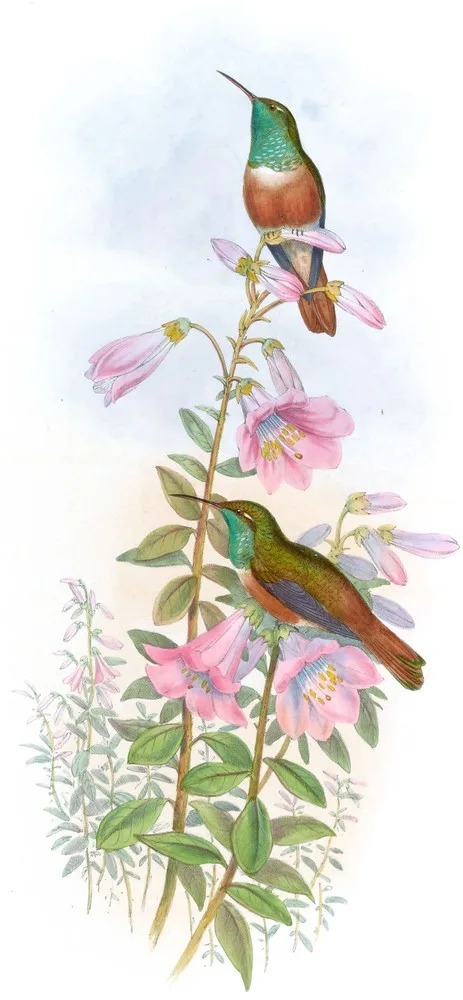
Crown of the head and upper surface greenish-bronze, changing into bronzy-red on the lower part of the back and upper tail-coverts; wings purplish-brown, glossed with bronze; tail chestnut-red, glossed on the central feathers with bronze; throat and chest white, with a crescent of glittering green at the tip of each feather; centre of the breast white; under surface sandy-red; vent and under tail-coverts white, the former washed with rufous.
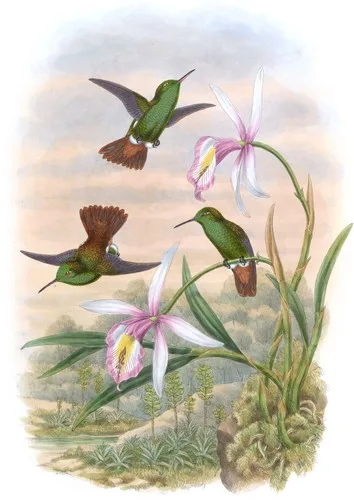
The figures are of the natural size. The plant is the Befaria estuans.
References
- Orthorhynchus Amazili, Less. Voy. de la Coq., Ois., pl. 31. fig. 3.
- Ormsmya amazili, Less. Hist. Nat. des Ois. Mou., pp. xxvii, 67. pls. 12, 13.—Ib. Traité d’Orn., p. 280.—Ib. Man. d’Orn., tom. ii. p. 81.—Ib. Ind. Gen. et Syn. des Ois. du gen. Trochilus, p. xxvii.
- Polytmus Amazili, Gray and Mitch. Gen. of Birds, vol. i. p. 108, Polytmus, sp. 70.
- Trochilus Amazilia, Tschudi, Consp. Av., no. 206.—Ib. Faun. Peruana, p. 39.
- Amazilius latirostris, Bonap. Consp. Gen. Av., p. 77, Amazilius, sp. 1.—Ib. Rev. et Mag. de Zool. 1854, p. 254.
- Amazilia latirostris, Reich. Aufz. der Col., p. 10.
Ten ways of seeing
- upright 2.16 : 1
- published 1861
- Pl. 303, Vol. V
Not a catalogue entry but a way of looking: how to stand, what to notice, how the line was cut — then, halfway, a line of Chinese poetry: how the ancients saw this same flower. After it, the flower's language, its season and homeland, its book; and at the end one line of classical prose — and a pair of eyes to take away.
-
First Look
论画以形似,见与儿童邻。
—— 宋·苏轼《书鄢陵王主簿所画折枝》
To judge painting by likeness alone is the view of a child.
The sheet is vertical: the eye climbs and settles on the bird. Take the posture before the plumage. Then step in close: watch where colour meets line, and whether the line ever breaks. Third, find the darkest small patch: the whole tonal order is measured from there.
-
Name and Thing
The binomial is Amazilia pristina: the first word is the genus it belongs among, the second the epithet that sets it apart. Two words carry a whole provenance. The Chinese name 美洲蜂鸟属 is a modern rendering of the Latin, not an old garden name.
-
Form and Colour
The smallest of birds: a needle-fine bill, a forked tubular tongue, wings beating so fast the bird hovers and even flies backwards. Its colour is not pigment but structure — light bent by feather barbules, changing with the angle.No colour group is recorded. A single plant, laid out with nothing hidden.
-
Composition
Tall and narrow, the bird perched mid-branch with generous margins above and below. (about 2.16 : 1) No details are appended: a plate for looking, not for keying out. Cover the margins with your thumb and the plate suffocates; uncover them and the flower breathes again.
-
Line and Colour
In the later nineteenth century chromolithography took over: colour printed rather than painted, line demoted. Decide first whether it was printed or painted; only then discuss whether it is beautiful. If you mean to copy it: block in the broad shapes and colours first, detail last; lithographic softness comes from thin washes — two or three pale layers will get you close.
-
Poetic Resonance
夫列子御风而行,泠然善也,旬有五日而后反。
—— 《庄子·逍遥游》
Liezi rode the wind and came back after fifteen days, so light was his going.
The poem gives the mood first and the picture supplies the form; set the line beside the plate and the bird itself becomes its resting point.
-
Symbolism
For the Aztecs the hummingbird was warrior and sun; for Victorian Europe it was the ultimate ornament, millions killed for breast jewellery. China has no tradition here — and that blank is itself a history of exchange. Flower language was added later; the flower knows nothing of it, and that innocence is part of its power.
-
Season and Place
temperate hummingbirds follow the bloom north and back, thousands of kilometres a year. the name arrives with late-Qing travel writing. The year 1861 on the plate is that of publication, not of flowering — the gathering came a year or two earlier. Read the locality and the flowering season both with a discount: one is hearsay, the other a ten-day peak.
-
The Book and the Hand
“Gould's Hummingbirds” was drawn by John Gould and published 1849-1887. This plate is Pl. 303, Vol. V, book page 303. The image is public domain; the hand-colouring is still one person's hand.
-
The Written Tradition
竖划三寸,当千仞之高;横墨数尺,体百里之迥。
—— 南朝宋·宗炳《画山水序》
A vertical stroke of three inches stands for a cliff of a thousand fathoms; a few feet of ink holds a hundred li. Smallness of scale was never the obstacle.
Gould's Hummingbirds (1849–1887) used hand-coloured lithography over gold leaf so the iridescence survived on paper — a monument to Victorian printing and collecting alike. Keep the line; it will surface the next time you meet the same plant.
What to Take Away
Appreciation is not knowledge but habit — one more look each time. A flora exists to be consulted; look long enough and you forget to consult — someone in 1861 gave a whole day to a single flower.