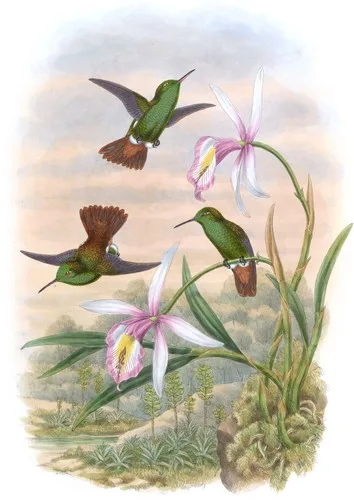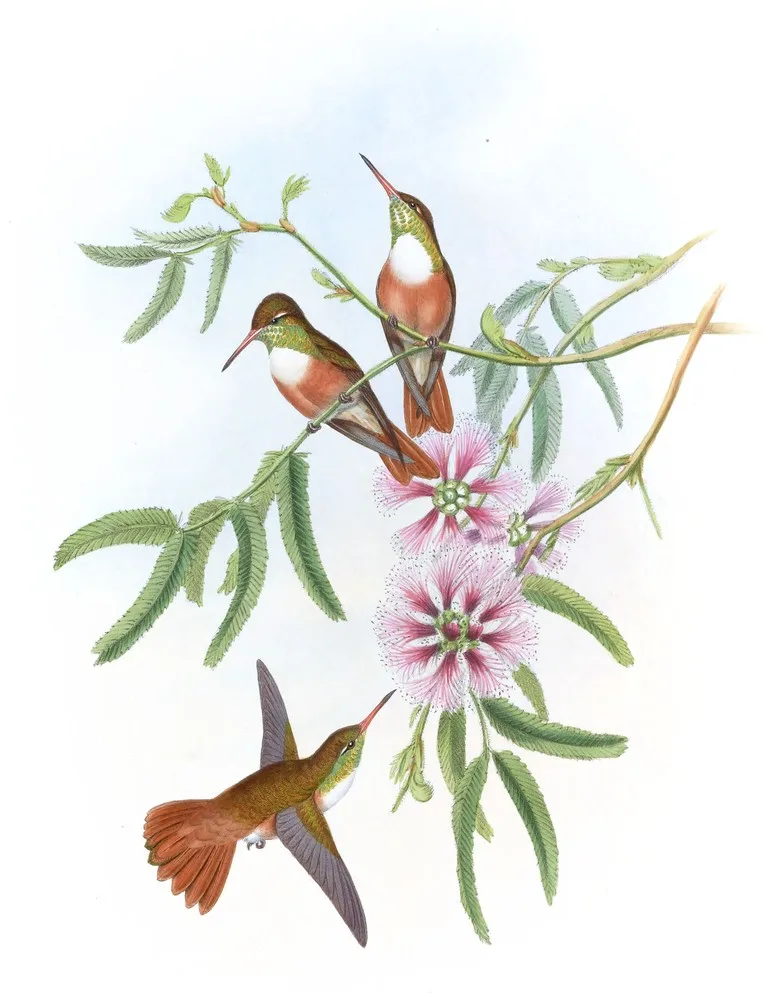
Amazilia leucophæa
Amazilia leucophæa
White-breasted Amazili
About this plate
Southern Peru. Collected in the vicinity of the Volcano of Arequipa by M. Warszewicz.
I am equally certain with regard to the identity of this species as I am with respect to the A. Dumerili, the specimens from which Dr. Reichenbach took his description of his A. leucophea and my own having come from the same source—M. Warszewicz, who collected them in the vicinity of the volcano of Arequipa in South Peru.
In size it closely resembles A. Dumeri; but it is smaller than A. pristina, from which it also differs in the colour of its mandibles, which are said to be either white or fleshy white. In the accompanying Plate I have figured this new species of the size of life; and it would have been a source of pleasure to me to have been able to give some account of its history; but such unfortunately is not the case, M. Warszewicz’s visit being so hurried a one that he had only time to snatch, as it were, the present and several other new birds from their native forests in passing. If several novelties could be thus obtained under very disadvantageous circumstances, surely we may regard their acquisition as an evidence that a careful investigation of the fine countries of Peru and Bolivia would well repay the researches of the traveller and the naturalist.
I am a little uncertain with respect to the female of this species. Dr. Reichenbach has, it is true, described it; but as I have never seen his specimen, and the three in my own collection are alike, I must defer giving a description of the female, to some future opportunity.
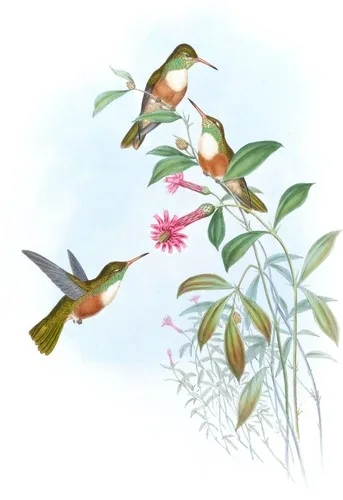
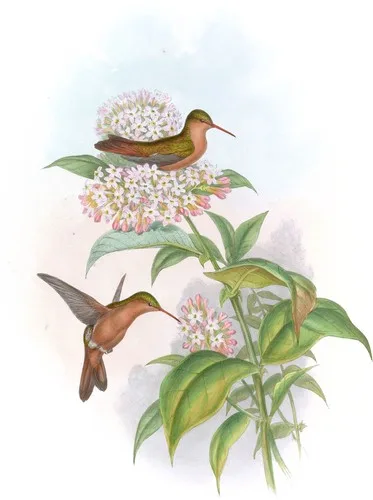
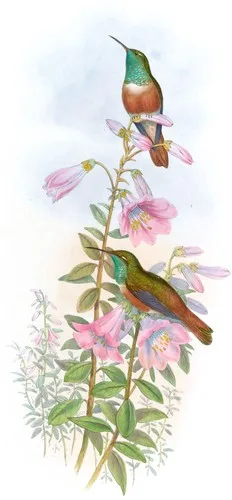
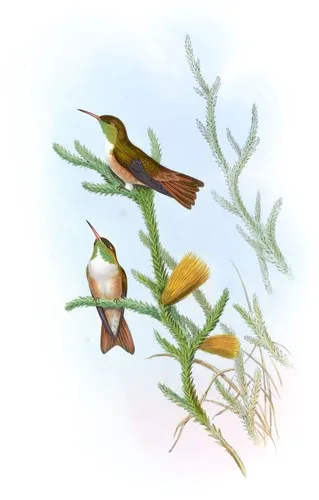
Crown of the head, all the upper surface and wing-coverts golden green, somewhat obscure on the head; upper tail-coverts and tail rufous, the two centre ones with a zone of greenish bronze near the tip; wings pale purplish brown; throat and sides of the neck glittering golden green; on the centre of the chest a patch of white; under surface rufous or sandy red; under tail-coverts very pale rufous fringed with white; bill fleshy white with a dark-coloured tip.
The figures are of the natural size. The plant is the Callandria Tweediei.
References
- Amazilia leucophea, Reich. Auf. der Col., p. 10.
- Amazilia leucophea, Ib., p. 24.
Twelve ways of seeing
- slightly upright 1.29 : 1
- published 1861
- Pl. 306, Vol. V
Not a catalogue entry but a way of looking: how to stand, what to notice, how the line was cut, when it flowers, where it came from, who made it — and then the poems and the classics that taught China to see the same flower. Read the twelve in order and the plate opens.
-
First Look
搜尽奇峰打草稿。
—— 清·石涛《苦瓜和尚画语录》
Exhaust the strange peaks, and then make the sketch.
Slightly taller than wide; the eye lands on the bird's head, a little above centre. Then step in close: watch where colour meets line, and whether the line ever breaks. Third, find the darkest small patch: the whole tonal order is measured from there.
-
Name and Thing
Only the genus Amazilia is given; species-level names came later. No established Chinese name exists, so it is cited by its binomial alone.
-
Form and Colour
The smallest of birds: a needle-fine bill, a forked tubular tongue, wings beating so fast the bird hovers and even flies backwards. Its colour is not pigment but structure — light bent by feather barbules, changing with the angle.No colour group is recorded. Three things fix the habit: leaf arrangement, tepal count, and how the flower is borne.
-
Composition
Slightly taller than wide, the bird set a little above centre, the eye landing at head and bill. (about 1.29 : 1) No details are appended: a plate for looking, not for keying out. Blank paper is not unfinished work: it is where the eye rests.
-
Line and Colour
In the later nineteenth century chromolithography took over: colour printed rather than painted, line demoted. Craft leaves franker evidence than inscriptions.
-
Season
In tropical America they are present all year, their season set by flowers; temperate hummingbirds follow the bloom north and back, thousands of kilometres a year. The year 1861 on the plate is that of publication, not of flowering — the gathering came a year or two earlier. The best time to read such a plate is its flowering season: three minutes under the tree explains what no text can.
-
Provenance
Americas only, from southern Alaska to Tierra del Fuego, richest in the Andes. China has no hummingbirds and no classical record of them; the name arrives with late-Qing travel writing. The localities on the plate are those of a century ago; plants travel and places change their names.
-
The Book and the Hand
“Gould's Hummingbirds” was drawn by John Gould and published 1849-1887. This plate is Pl. 306, Vol. V, book page 306. The image is public domain; the hand-colouring is still one person's hand.
-
Poetic Resonance
穿花蛱蝶深深见,点水蜻蜓款款飞。
—— 唐·杜甫《曲江二首》
Butterflies thread the flowers, seen deep within; dragonflies touch the water and fly on, slow and deliberate.
The poem gives the mood first and the picture supplies the form; set the line beside the plate and the bird itself becomes its resting point.
-
The Written Tradition
竖划三寸,当千仞之高;横墨数尺,体百里之迥。
—— 南朝宋·宗炳《画山水序》
A vertical stroke of three inches stands for a cliff of a thousand fathoms; a few feet of ink holds a hundred li. Smallness of scale was never the obstacle.
Gould's Hummingbirds (1849–1887) used hand-coloured lithography over gold leaf so the iridescence survived on paper — a monument to Victorian printing and collecting alike. You need not parse every word: take the line, and the flower acquires a second face.
-
Symbolism
For the Aztecs the hummingbird was warrior and sun; for Victorian Europe it was the ultimate ornament, millions killed for breast jewellery. China has no tradition here — and that blank is itself a history of exchange. In a flora it is a species first and a symbol second; the order is worth keeping.
-
What to Take Away
If you keep one line, keep Guo Xi's: from afar its momentum, up close its texture. The flower of that year is dust, yet its image on paper has outlived every living cousin.