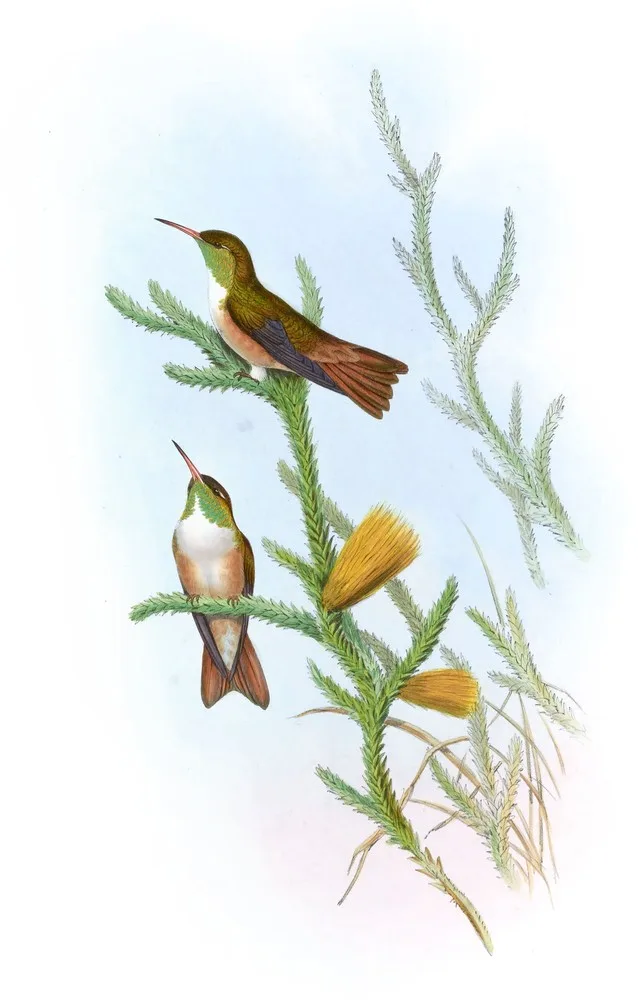
Amazilia alticola
美洲蜂鸟属
Amazilia alticola
Mountain Amazili
Ten ways of seeing
- upright 1.57 : 1
First Look
论画以形似,见与儿童邻。
—— 宋·苏轼《书鄢陵王主簿所画折枝》
To judge painting by likeness alone is the view of a child.
The sheet is vertical: the eye climbs and settles on the bird. Take the posture before the plumage. Then step in close: watch where colour meets line, and whether the line ever breaks. Third, find the darkest small patch: the whole tonal order is measured from there.
Name and Thing
The binomial is Amazilia alticola: the first word is the genus it belongs among, the second the epithet that sets it apart. Two words carry a whole provenance. The Chinese name 美洲蜂鸟属 is a modern rendering of the Latin, not an old garden name.
Form and Colour
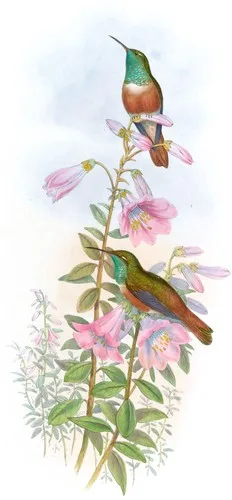
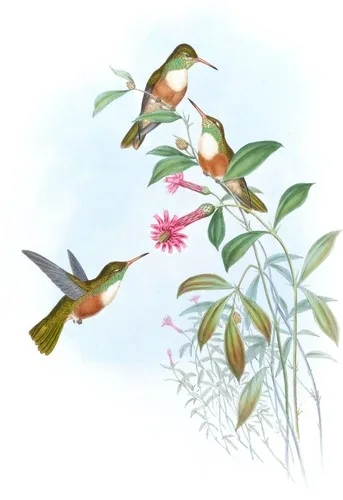
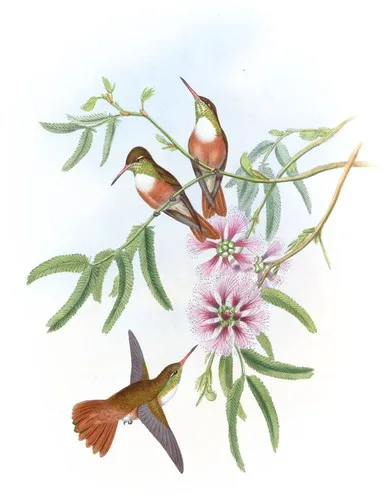
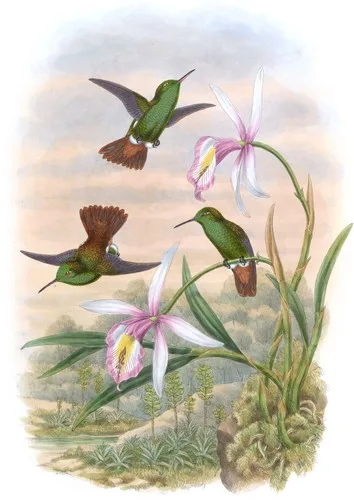
The smallest of birds: a needle-fine bill, a forked tubular tongue, wings beating so fast the bird hovers and even flies backwards. Its colour is not pigment but structure — light bent by feather barbules, changing with the angle.No colour group is recorded. A single plant, laid out with nothing hidden.
Composition
Tall and narrow, the bird perched mid-branch with generous margins above and below. No details are appended: a plate for looking, not for keying out. Cover the margins with your thumb and the plate suffocates; uncover them and the flower breathes again.
Line and Colour
In the later nineteenth century chromolithography took over: colour printed rather than painted, line demoted. There is evidence on the back too: the plate mark pressed into the paper, the slight relief of the pigment, lines worn shallow in a later printing. If you mean to copy it: block in the broad shapes and colours first, detail last; lithographic softness comes from thin washes — two or three pale layers will get you close.
Poetic Resonance
穿花蛱蝶深深见,点水蜻蜓款款飞。
—— 唐·杜甫《曲江二首》
Butterflies thread the flowers, seen deep within; dragonflies touch the water and fly on, slow and deliberate.
The poem gives the mood first and the picture supplies the form; set the line beside the plate and the bird itself becomes its resting point.
Symbolism
For the Aztecs the hummingbird was warrior and sun; for Victorian Europe it was the ultimate ornament, millions killed for breast jewellery. China has no tradition here — and that blank is itself a history of exchange. In a flora it is a species first and a symbol second; the order is worth keeping.
Season and Place
temperate hummingbirds follow the bloom north and back, thousands of kilometres a year. the name arrives with late-Qing travel writing. The year 1861 on the plate is that of publication, not of flowering — the gathering came a year or two earlier. Much of what that generation knew of such birds came from specimens and cages; read locality and season both as hearsay.
The Book and the Hand
“Gould's Hummingbirds” carries only John Gould's name. The image is public domain; the hand-colouring is still one person's hand.
What to Take Away
If you keep one line, keep Guo Xi's: from afar its momentum, up close its texture. Two centuries on, the plant may still flower in some garden; the one on this sheet stopped in the season of 1861.
About this plate
The high lands of Central Peru; the precise locality uncertain.
I am indebted to M. Bourcier, of Paris, for an example of this new species, which, he informs me, is from the Puna district in Peru.
In size it exceeds the Amazilia pristina, the A. Dumerili and the A. leucophea. In the general style of its colouring it is very similar to the latter; but, compared with that species, it is a giant in point of size, it has also a less amount of the glittering green on the cheeks and sides of the neck. It is to the present bird and the three species above mentioned that I would wish to restrict the generic term of Amazilia; for they form a very natural section, distinguished by their peculiar form and style of colouring. All are natives of Ecuador and Peru, to which countries they appear to be confined; while the other species, to which the generic term of Pyrrhophæna has been applied, are widely spread, and the greater number of them are natives of Mexico and Central America.
But little is known respecting the typical Amaziliæ, and less about the present bird than of any of the others. I believe, however, that there is no difference in the colouring of the sexes of any of them.
Crown of the head and back of the neck dark brown, with very slight reflexions of golden green; back of the neck, back, and rump golden or orange green; upper part of the throat, cheeks, and sides of the neck light golden green; lower part of the throat, chest, centre of the abdomen, thighs, and. the thickly clothed tarsi pure white; flanks rich bright buff; under tail-coverts white washed with buff; tail rich deep reddish buff, the two centre feathers washed with bronzy green, and the four outer ones, on each side, washed on their outer edges with bronzy green; wings purplish brown; bill black at the tip, the remainder white or flesh-colour.
The figures are of the natural size. The plant is the Chuquiraga insignis.
References
- Amazilia alticola, Gould in Proc. of Zool. Soc., part xxviii. p. 309.