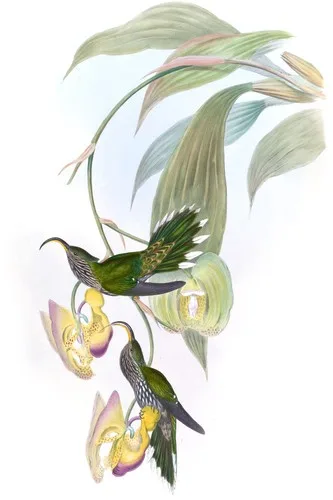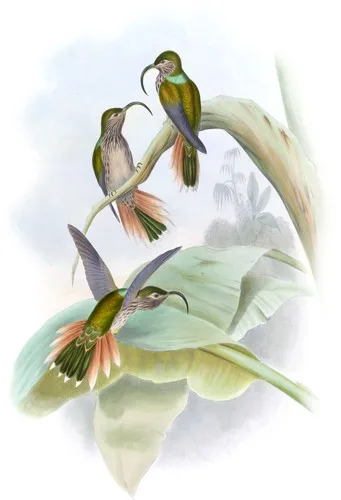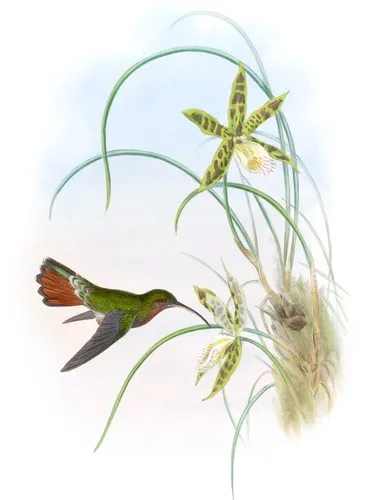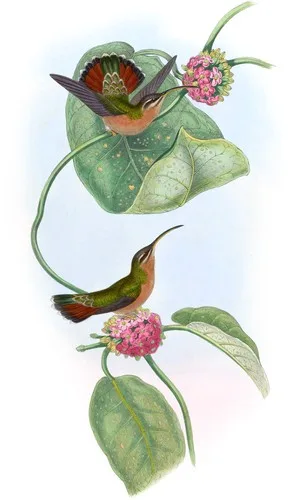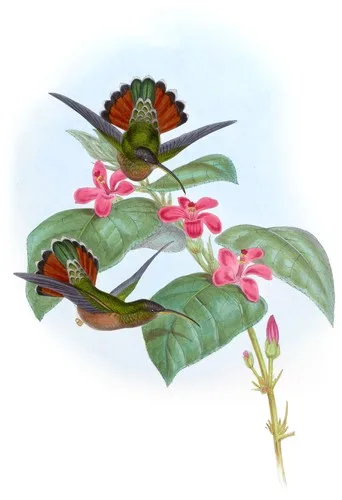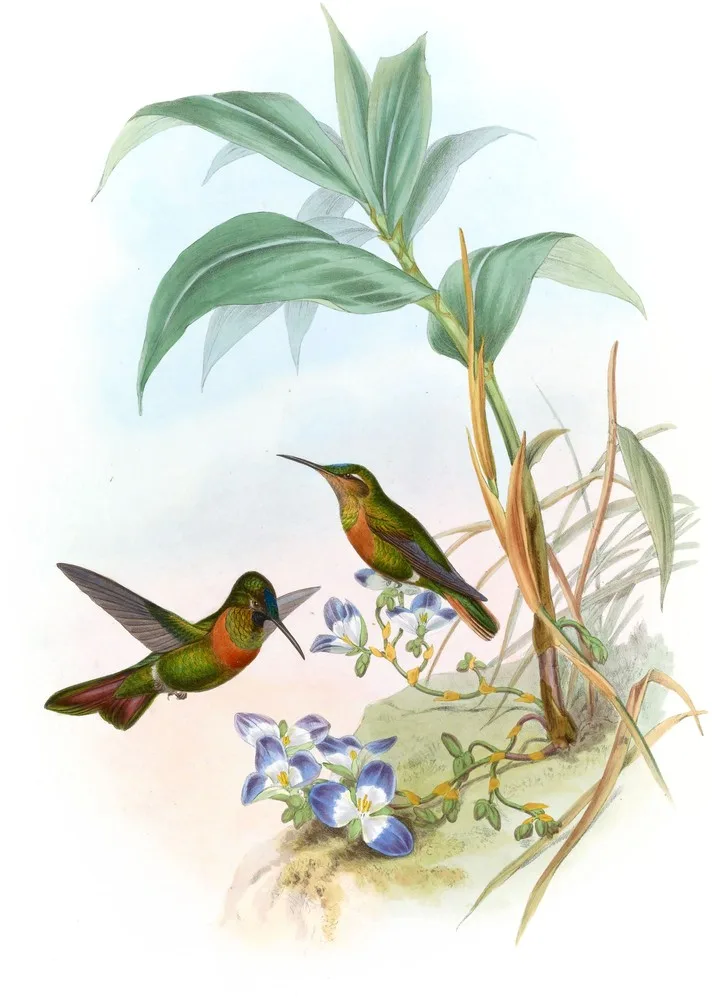
Clytolæma? aurescens
Clytolæma? aurescens
Banded Ruby
Ten ways of seeing
- upright 1.40 : 1
First Look
竖划三寸,当千仞之高;横墨数尺,体百里之迥。
—— 南朝宋·宗炳《画山水序》
A vertical stroke of three inches stands for a cliff of a thousand fathoms; a few feet of ink holds a hundred li.
The sheet is vertical: the eye climbs and settles on the bird. Take the posture before the plumage. Then step in close: watch where colour meets line, and whether the line ever breaks. Third, find the darkest small patch: the whole tonal order is measured from there.
Name and Thing
No reliable binomial survives, so the printed title must serve. Neither name nor binomial survives: the printed title must do.
Form and Colour
The smallest of birds: a needle-fine bill, a forked tubular tongue, wings beating so fast the bird hovers and even flies backwards. Its colour is not pigment but structure — light bent by feather barbules, changing with the angle.No colour group is recorded. Three things fix the habit: leaf arrangement, tepal count, and how the flower is borne.
Composition
Tall and narrow, the bird perched mid-branch with generous margins above and below. No details are appended: a plate for looking, not for keying out. Old plates set the plant slightly off centre, with unequal margins — that small imbalance is what keeps it alive.
Line and Colour
In the later nineteenth century chromolithography took over: colour printed rather than painted, line demoted. Craft leaves franker evidence than inscriptions. If you mean to copy it: block in the broad shapes and colours first, detail last; lithographic softness comes from thin washes — two or three pale layers will get you close.
Poetic Resonance
穿花蛱蝶深深见,点水蜻蜓款款飞。
—— 唐·杜甫《曲江二首》
Butterflies thread the flowers, seen deep within; dragonflies touch the water and fly on, slow and deliberate.
The poem gives the mood first and the picture supplies the form; set the line beside the plate and the bird itself becomes its resting point.
Symbolism
For the Aztecs the hummingbird was warrior and sun; for Victorian Europe it was the ultimate ornament, millions killed for breast jewellery. China has no tradition here — and that blank is itself a history of exchange. Flower language was added later; the flower knows nothing of it, and that innocence is part of its power.
Season and Place
temperate hummingbirds follow the bloom north and back, thousands of kilometres a year. Americas only, from southern Alaska to Tierra del Fuego, richest in the Andes. China has no hummingbirds and no classical record of them. The year 1854 on the plate is that of publication, not of flowering — the gathering came a year or two earlier. The bud and the ripe fruit on one branch tell the season; the name in the title often tells the journey.
The Book and the Hand
“Gould's Hummingbirds” carries only John Gould's name. A plate is collective work: drawer, engraver and colourist were different hands, and the unnamed ones decided how good it looks.
What to Take Away
Appreciation is not knowledge but habit — one more look each time. A flora exists to be consulted; look long enough and you forget to consult — someone in 1854 gave a whole day to a single flower.
About this plate
The forests bordering the Rivers Madeira, Upper Amazon, and Negro
There is a region in South America that has as yet been but superficially investigated, either by the persevering and forward-pressing collector, the scrutinizing man of science, or those pioneers of discovery, the devotees of religion.
This country, vast in extent, covered with great primeval forests, and watered by hundreds of the tributary streams which serve to form the great rivers of the inner sides of Columbia, Peru, and Bolivia, teems with animal life: by the inner side, I mean the eastern dip of the great Andean and Cordilleran ranges, or, to speak more pointedly, the sources and tributaries of the rivers Amazon, Madeira, and Negro. In this vast region, extending for at least six degrees of latitude on each side of the equator, there must be numerous species which are still unknown to us; for at present we have only skirted some of its forests, and ascended or descended, as the case may be, a few of its principal rivers. The part of America here alluded to is, if I mistake not, the native country of the beautiful bird figured on the accompanying Plate; at least it is from thence that most of the specimens I have seen have been procured. My late friend, John Natterer of Vienna, obtained, I believe, several examples on the banks of the Madeira; and Mr. Bates sent females or young males from the neighbourhood of Ega; I have also a specimen sent from Kcuador by Mr. Fraser, but said to have been obtained on the Napo.
In point of affinity, the Clytolæma aurescens is more nearly allied to the C. rubinea than to any other species; still it differs somewhat both in form and colouring, sufficiently, perhaps, to warrant its being made the type of a new genus; and, if so, one has already been proposed for it, as will be seen on reference to the synonyms, which are getting pretty numerous as to generic appellations; I trust, however, that, as I had the pleasure of naming the bird in the first instance, it may be allowed, after nearly twenty years, to remain in the genus in which I have now placed it.
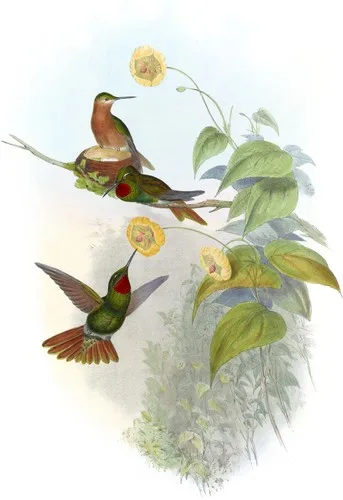
The male has the chin black; the throat rich luminous gold-colour; across the chest a broad band of deep rufous; on the forehead a longitudinal stripe of rich shining blue; all the upper surface, two central tailfeathers, upper and under wing-coverts and abdomen bronzy green; wings purplish brown; lateral tailfeathers chestnut-brown, tipped both above and beneath with a bronzy lustre; under tail-coverts deep fawncolour; bill black.
The female or young male of the year differs in having the chin greenish brown, and in the absence of the longitudinal blue stripe on the crown; the outer feather of the tail chestnut, the three next chestnut with a narrow edging of bronze along their outer margins.
This latter description probably applies to a young male; if so, the female is unknown.
The figures are of the natural size. The plant is the Dichorisandra leucophthalmos.
References
- Trochilus (Lampornis) aurescens, Gould in Proc. of Zool. Soc., part xiv. p. 88.
- Polytmus aurescens, Gray and Mitch. Gen. of Birds, vol. i. p. 108, Polytmus, sp. 23.
- Lampornis aurescens, Bonap. Consp. Gen. Av., tom. i. p. 72, Lampornis, sp. 12.
- Margarochrysis aurescens, Reich. Auf. der Col., p. 11.—Ib. Troch. Enum., p. 8.
- Campylopterus aurescens, Bonap. Rey. et Mag. de Zool. 1854, p. 250.