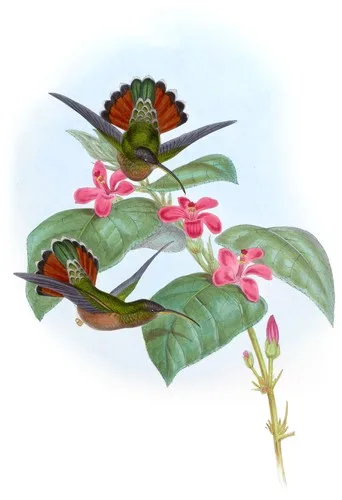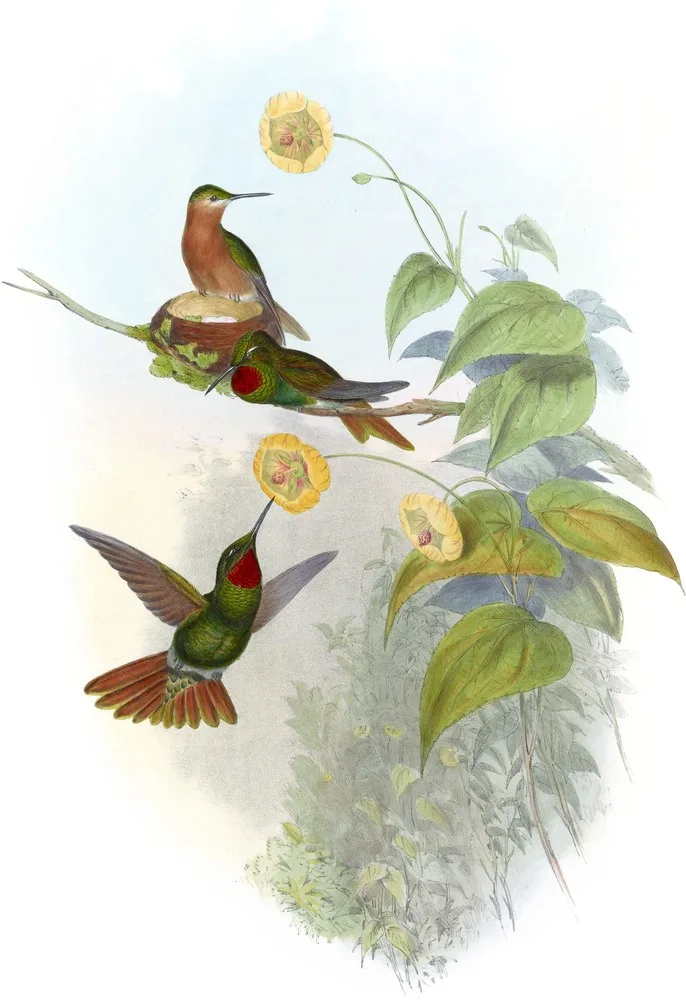
Clytolæma rubinea
Clytolæma rubinea
Brazilian Ruby
About this plate
The eastern portions of Brazil; common at Rio de Janeiro
I do not recollect that I have ever received examples of this bird from any other country than Southern Brazil, which I am therefore led to believe is its true habitat; it is one of the species most abundantly sent to Europe in all collections transmitted from Rio de Janeiro, and one of those most commonly called into requisition for the fabrication of the beautiful artificial feather flowers made by the nuns in the convents of that country.
That it undergoes a partial migration is shown by the remarks respecting it communicated to me by Mr. Reeves, in which he states that it arrives in the neighbourhood of Rio de Janeiro in May, and retires again to the virgin forests or other unexplored parts of the country about the end of September. For some time after its arrival it frequents the flowers of the Yuga, “Tamarinda de Serra;” in July, August and September, it resorts to the flowers of the Gua-chimba, and lastly, procures its food from those of the Mariana, a plant which seldom remains in bloom for more than fourteen days. It breeds during the months of June, July and August, the nest being placed among the branches of the loftiest trees of the forest. Thousands are killed every year for the fabrication of artificial flowers.
The circumstance of this species being so very abundant near Rio during the months above mentioned, has enabled Mr. Reeves to ascertain with certainty that it is subject to very great variation in the colouring of the plumage between youth and maturity, and moreover that the adult female is fully as brilliant as the male. I consider this a very important piece of information, as we may reasonably suppose that some other species undergo similar changes; and it tends to confirm an opinion I have long entertained, that very old females of other species are as brilliantly coloured as the males; I do not, however, believe that this state must be attained before the powers of reproduction are perfected, for I have no doubt that the brown birds so constantly sent with the males have been capable of breeding. Mr. Reeves adds, that “in the places much frequented by this species examples may be seen during the same month in every state of plumage they assume while in existence; and these changes are so numerous that I have in my Collection upwards of thirty specimens, no two of which are precisely alike.”
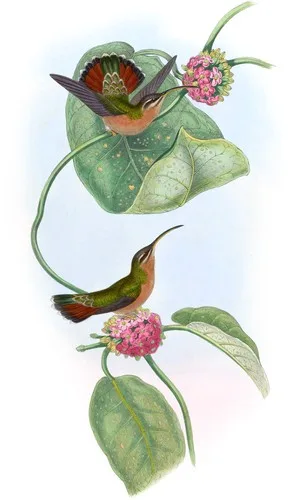
To give figures or minute descriptions of all these changes would not add to the value or the interest of the present work; they will be sufficiently illustrated by the accompanying figures of the two extremes.
Besides being one of the commonest birds in our collections, the Clytolæma rubinea is also one of the most beautiful members of its lovely family, and is rendered eminently conspicuous in the group by its rich ruby-coloured throat, surrounded with equally glittering green.
Mr. Reeves informs me that its local name is “Papa de Fogo,” and that the old bird utters a loud cry resembling the syllables Tirr-tirr-tirr, the cry of the young bird being the same, but fainter and uttered more slowly.
The nest sent to me by this gentleman is of a round, cup-shaped, but shallow form, placed horizontally on the tri-forked extremity of a small branch, composed of fine, dark brown, glossy, hair-like materials closely woven together, and decorated with small pieces of buff-coloured lichen, and lined with the pale buff flossy seed crowns of Asclepiadeæ, within which is another lining of a pale rufous wool-like substance, upon which the two white eggs are deposited: they are half an inch in length and three-eighths of an inch in width.
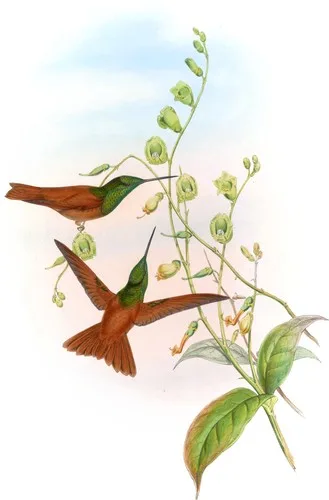
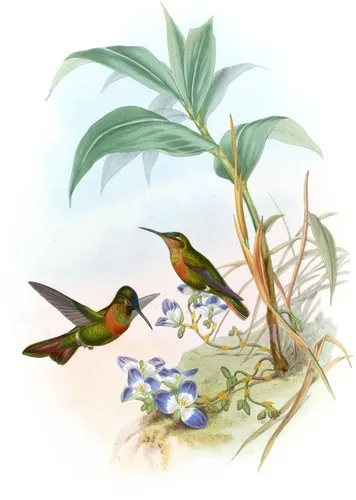
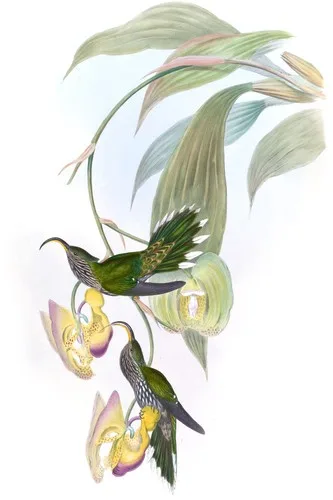
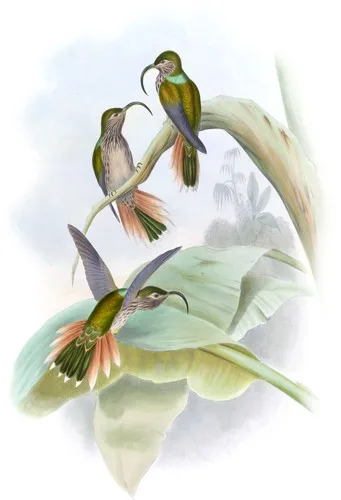
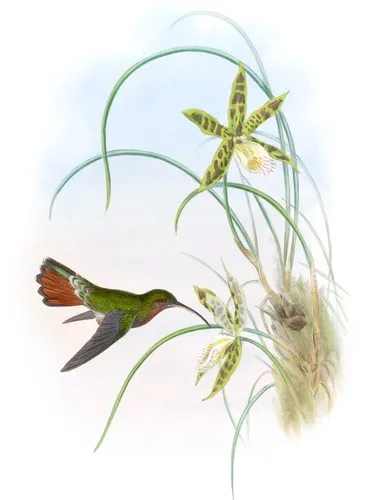
Forehead rich luminons metallic green, proceeding backwards to a point on the centre of the crown; throat rich luminous puce-red, surrounded by a broad pectoral crescent of rich luminous metallic green; sides of the crown and occiput greenish bronze, passing into the golden rufous of the back, wing- and tailcoverts; wings rich purple-brown; the bases of the secondaries rufous, showing conspicuously on their under surface; tail rich golden brown, slightly edged with dark brown, and tipped with bronzy green; abdomen and flanks dull green, each feather slightly luminous at the tip; a bar of downy white feathers across the vent; under tail-coverts green, edged with rufous; bill black; feet fleshy brown.
In the young male or the female the head and upper surface is green; the lateral tail-feather on each side is rufous; the three next are rufous down the central portion of their bases, with bronzy margins and apices; and the two central ones are wholly bronze; the throat and breast are rufous, and the flanks green.
In the subsequent stages the rich gorget and the full hues of maturity are gradually assumed.
The figures are of the natural size.
References
- Mellisuga Brasiliensis gutture rubro, Briss. Orn., tom. iii. p. 720. pl. 37. fig. 4.
- Oiseau mouche à rouge, Buff. Pl. Enl. 276. fig. 4.
- Le Rubis Emeraude, Buff. Hist. des Ois., tom. vi. p. 31.—Vieill. Ois. dor., tom. i. p. 114.
- Le Grand Rubis, Vieill. Ois. dor., tom. i. p. 60. pl. 27.
- Trochilus rubineus, Lath. Ind. Orn., tom. i. p. 312.—Vieill. Eney. Méth. Orn., part u. p. 563.
- Ornismya rubinea, Less. Hist. Nat. des Ois. Mou., p. 146. pls. 44, 45, 46.—Ib. Traité d’Orn., p. 278.
- Mellisuga rubinea, Gray and Mitch. Gen. of Birds, vol. i. p. 112, Mellisuga, sp. 22.
- Heliomaster rubineus, Bonap. Consp. Gen. Av., p. 70, Heliomaster, sp. 4.
- Ruby-throated Humming-bird, Lath. Gen. Syn., tom. ii. p. 768.—Shaw, Gen. Zool., vol. viii. pp. 340, 341.—Lath. Gen. Hist., vol. iv. p. 342.
- L’oiseau-mouche brun-gris, Vieill. Ois. dor., tom. i. p. 61. pl. 28?
Twelve ways of seeing
- upright 1.46 : 1
- published 1854
- Pl. 249, Vol. IV
Not a catalogue entry but a way of looking: how to stand, what to notice, how the line was cut, when it flowers, where it came from, who made it — and then the poems and the classics that taught China to see the same flower. Read the twelve in order and the plate opens.
-
First Look
搜尽奇峰打草稿。
—— 清·石涛《苦瓜和尚画语录》
Exhaust the strange peaks, and then make the sketch.
The sheet is vertical: the eye climbs and settles on the bird. Take the posture before the plumage. Then step in close: watch where colour meets line, and whether the line ever breaks. Third, find the darkest small patch: the whole tonal order is measured from there.
-
Name and Thing
No reliable binomial survives, so the printed title must serve. Neither name nor binomial survives: the printed title must do.
-
Form and Colour
The smallest of birds: a needle-fine bill, a forked tubular tongue, wings beating so fast the bird hovers and even flies backwards. Its colour is not pigment but structure — light bent by feather barbules, changing with the angle.No colour group is recorded. Read the outline, then the colour layers, then the brush.
-
Composition
Tall and narrow, the bird perched mid-branch with generous margins above and below. (about 1.46 : 1) No details are appended: a plate for looking, not for keying out. Blank paper is not unfinished work: it is where the eye rests.
-
Line and Colour
In the later nineteenth century chromolithography took over: colour printed rather than painted, line demoted. Craft leaves franker evidence than inscriptions.
-
Season
In tropical America they are present all year, their season set by flowers; temperate hummingbirds follow the bloom north and back, thousands of kilometres a year. The year 1854 on the plate is that of publication, not of flowering — the gathering came a year or two earlier. Note the season. Phenology is the most practical tool of appreciation.
-
Provenance
Americas only, from southern Alaska to Tierra del Fuego, richest in the Andes. China has no hummingbirds and no classical record of them; the name arrives with late-Qing travel writing. The localities on the plate are those of a century ago; plants travel and places change their names.
-
The Book and the Hand
“Gould's Hummingbirds” was drawn by John Gould and published 1849-1887. This plate is Pl. 249, Vol. IV, book page 249. The image is public domain; the hand-colouring is still one person's hand.
-
Poetic Resonance
夫列子御风而行,泠然善也,旬有五日而后反。
—— 《庄子·逍遥游》
Liezi rode the wind and came back after fifteen days, so light was his going.
The poem gives the mood first and the picture supplies the form; set the line beside the plate and the bird itself becomes its resting point.
-
The Written Tradition
竖划三寸,当千仞之高;横墨数尺,体百里之迥。
—— 南朝宋·宗炳《画山水序》
A vertical stroke of three inches stands for a cliff of a thousand fathoms; a few feet of ink holds a hundred li. Smallness of scale was never the obstacle.
Gould's Hummingbirds (1849–1887) used hand-coloured lithography over gold leaf so the iridescence survived on paper — a monument to Victorian printing and collecting alike. The difference is not of quality but of question: Europe asks what it is, China asks whom it resembles.
-
Symbolism
For the Aztecs the hummingbird was warrior and sun; for Victorian Europe it was the ultimate ornament, millions killed for breast jewellery. China has no tradition here — and that blank is itself a history of exchange. Meanings change their tune: the same flower can say opposite things within a century.
-
What to Take Away
Appreciation is not knowledge but habit — one more look each time. The flower of that year is dust, yet its image on paper has outlived every living cousin.