Clytolæma rubinea
Clytolæma rubinea
Brazilian Ruby
- 合集
- 古尔德蜂鸟图谱
- 绘者
- John Gould(约翰·古尔德)
- 年代
- 1854
- 图版号
- Pl. 249, Vol. IV
- 原书页码
- p.249
- 授权
- CC0 1.0 Universal (Public domain)
十观
- 纵幅 1.46∶1
第一眼
搜尽奇峰打草稿。
—— 清·石涛《苦瓜和尚画语录》
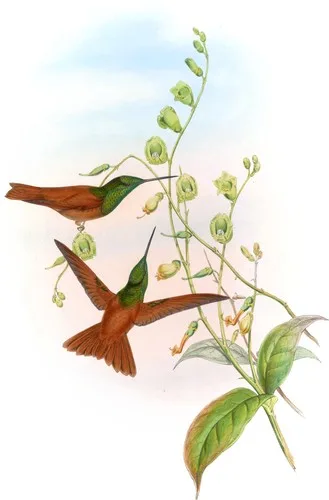
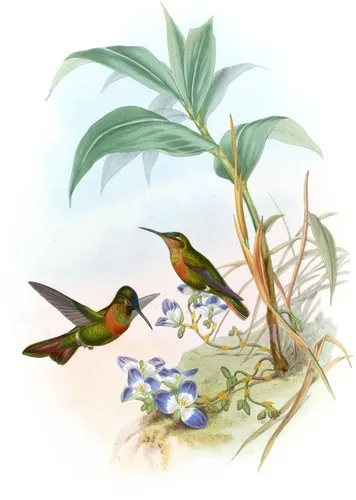
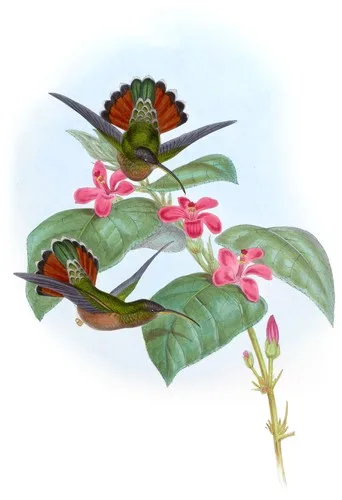
走遍山川,才有资格落笔。博物画的画家也一样:先在温室与山野里看够了活的花,纸上那一朵才不虚。这一幅是竖的:眼睛从下往上走,落点在中段那只鸟身上。先别急着看羽毛,让姿态先立起来。第二步凑近一寸:看线与色的交界,色有没有压住线,线有没有断。第三步,把视线放到最深的那一小块:整幅的用色秩序,都是从那里排开的。
名与实
没有学名可依,就看题名:题名里往往藏着产地、赠者或一句形容。此幅既无通行中文名,学名也不可靠,只能以原书题名相称——图谱里总有几幅这样的图,只能靠画面本身说话。
形与色
翼小而振频极高,能悬停、能倒飞;羽色非颜料所致,是羽枝结构折射的光,随角度而变。此幅未作色相归档,只能就形制论。颜色不是平涂的:最浅处近乎纸色,最深处在花瓣重叠的缝里。把这两处找到,画面的呼吸就出来了。
构图与呼吸
画幅高而窄,鸟栖在枝的中段,上下留白多——十九世纪鸟谱的标准版式,留给它飞走的余地。全幅只画一只,不作解剖附图——这类图更近于“观赏”,而非“鉴定”。试着用拇指遮住空白处——画面立刻变闷;放开,它才重新“喘上气”。留白,是给主体让出的气口。
一刀一色
十九世纪后半叶,石版与彩色石印渐成主流:颜色可以直接印出,不再依赖手工,线条反倒退居其次。图像的“准确”提高了,手性却淡了。先判断它是“印”的还是“画”的,再谈好不好看——这是看老版画最实用的一条规矩。想动笔临它的人记住一句:先铺大块的形与色,干后再收细部;石印的柔和层次来自薄涂与网点,水彩分两三遍淡铺即可逼近。
诗境
穿花蛱蝶深深见,点水蜻蜓款款飞。
—— 唐·杜甫《曲江二首》
中土无蜂鸟,然“穿花”之态,杜甫早已写过:贴着花心走,是采蜜者的共同姿态。诗以气行,画以形立;两种“看”叠在一起,才是看画的意思。
花语
阿兹特克以蜂鸟为战神与太阳的化身;欧洲维多利亚时代则以蜂鸟为收藏与装饰的极致,百万只羽毛被做成胸饰。中国旧籍无此鸟,故无象征——这空白本身,就是一部博物学交流史。在图谱里,它首先是一个物种,其次才是一种象征——这个次序值得记住。
时与地
热带美洲几乎全年可见,花期即其季节。仅产美洲,自阿拉斯加南部至火地岛,以安第斯山最为繁盛。中土无蜂鸟,汉籍不载,晚清海外游记始见其名。图上所记的 1854 年是刊行之年,不是采到那只鸟的年份;真正的观察记录通常比出版早一两年。看叶的老嫩、花与果是否同在枝上,季节便八九不离十;看题名里藏着的地名,来路也猜得出七分。
书与人
《古尔德蜂鸟图谱》只署了约翰·古尔德一个人的名字。从画稿到成图要过好几双手:转刻的人求准,上色的人求快——快与准之间,就是各幅之间深浅不一的来历。
带走一双眼睛
把这三件事带走:先整体后细节;先线后色;先看画再翻书。任何一张老图版,都可以用这三条读。图谱的用意是“以备查考”,看久了却会忘记查考:1854 年的一个人,为一只鸟花了整整一天。
关于本图版
《古尔德蜂鸟图谱》(Gould's Hummingbirds)由约翰·古尔德绘制,1849—1887 年间印行,本图即其中一幅。画面主体为 Clytolæma rubinea,在分类体系中列于蜂鸟科(Trochilidae)。
该合集全编共 421 幅图版,此图为其中之一,图版编号 Pl. 249, Vol. IV,对应原书第 249 页,版式为纵幅。图为公有领域原件的修复扫描,构图与设色未经改动。
原书文字(英文 / 法文)
The eastern portions of Brazil; common at Rio de Janeiro
I do not recollect that I have ever received examples of this bird from any other country than Southern Brazil, which I am therefore led to believe is its true habitat; it is one of the species most abundantly sent to Europe in all collections transmitted from Rio de Janeiro, and one of those most commonly called into requisition for the fabrication of the beautiful artificial feather flowers made by the nuns in the convents of that country.
That it undergoes a partial migration is shown by the remarks respecting it communicated to me by Mr. Reeves, in which he states that it arrives in the neighbourhood of Rio de Janeiro in May, and retires again to the virgin forests or other unexplored parts of the country about the end of September. For some time after its arrival it frequents the flowers of the Yuga, “Tamarinda de Serra;” in July, August and September, it resorts to the flowers of the Gua-chimba, and lastly, procures its food from those of the Mariana, a plant which seldom remains in bloom for more than fourteen days. It breeds during the months of June, July and August, the nest being placed among the branches of the loftiest trees of the forest. Thousands are killed every year for the fabrication of artificial flowers.
The circumstance of this species being so very abundant near Rio during the months above mentioned, has enabled Mr. Reeves to ascertain with certainty that it is subject to very great variation in the colouring of the plumage between youth and maturity, and moreover that the adult female is fully as brilliant as the male. I consider this a very important piece of information, as we may reasonably suppose that some other species undergo similar changes; and it tends to confirm an opinion I have long entertained, that very old females of other species are as brilliantly coloured as the males; I do not, however, believe that this state must be attained before the powers of reproduction are perfected, for I have no doubt that the brown birds so constantly sent with the males have been capable of breeding. Mr. Reeves adds, that “in the places much frequented by this species examples may be seen during the same month in every state of plumage they assume while in existence; and these changes are so numerous that I have in my Collection upwards of thirty specimens, no two of which are precisely alike.”
To give figures or minute descriptions of all these changes would not add to the value or the interest of the present work; they will be sufficiently illustrated by the accompanying figures of the two extremes.
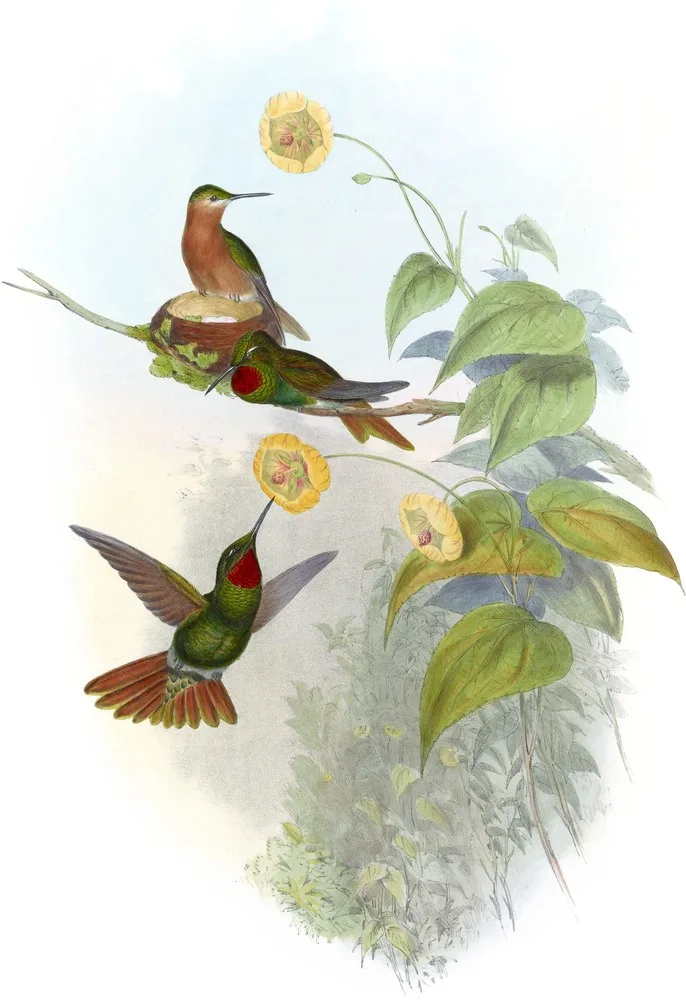
Besides being one of the commonest birds in our collections, the Clytolæma rubinea is also one of the most beautiful members of its lovely family, and is rendered eminently conspicuous in the group by its rich ruby-coloured throat, surrounded with equally glittering green.
Mr. Reeves informs me that its local name is “Papa de Fogo,” and that the old bird utters a loud cry resembling the syllables Tirr-tirr-tirr, the cry of the young bird being the same, but fainter and uttered more slowly.
The nest sent to me by this gentleman is of a round, cup-shaped, but shallow form, placed horizontally on the tri-forked extremity of a small branch, composed of fine, dark brown, glossy, hair-like materials closely woven together, and decorated with small pieces of buff-coloured lichen, and lined with the pale buff flossy seed crowns of Asclepiadeæ, within which is another lining of a pale rufous wool-like substance, upon which the two white eggs are deposited: they are half an inch in length and three-eighths of an inch in width.
Forehead rich luminons metallic green, proceeding backwards to a point on the centre of the crown; throat rich luminous puce-red, surrounded by a broad pectoral crescent of rich luminous metallic green; sides of the crown and occiput greenish bronze, passing into the golden rufous of the back, wing- and tailcoverts; wings rich purple-brown; the bases of the secondaries rufous, showing conspicuously on their under surface; tail rich golden brown, slightly edged with dark brown, and tipped with bronzy green; abdomen and flanks dull green, each feather slightly luminous at the tip; a bar of downy white feathers across the vent; under tail-coverts green, edged with rufous; bill black; feet fleshy brown.
In the young male or the female the head and upper surface is green; the lateral tail-feather on each side is rufous; the three next are rufous down the central portion of their bases, with bronzy margins and apices; and the two central ones are wholly bronze; the throat and breast are rufous, and the flanks green.
In the subsequent stages the rich gorget and the full hues of maturity are gradually assumed.
The figures are of the natural size.
References
- Mellisuga Brasiliensis gutture rubro, Briss. Orn., tom. iii. p. 720. pl. 37. fig. 4.
- Oiseau mouche à rouge, Buff. Pl. Enl. 276. fig. 4.
- Le Rubis Emeraude, Buff. Hist. des Ois., tom. vi. p. 31.—Vieill. Ois. dor., tom. i. p. 114.
- Le Grand Rubis, Vieill. Ois. dor., tom. i. p. 60. pl. 27.
- Trochilus rubineus, Lath. Ind. Orn., tom. i. p. 312.—Vieill. Eney. Méth. Orn., part u. p. 563.
- Ornismya rubinea, Less. Hist. Nat. des Ois. Mou., p. 146. pls. 44, 45, 46.—Ib. Traité d’Orn., p. 278.
- Mellisuga rubinea, Gray and Mitch. Gen. of Birds, vol. i. p. 112, Mellisuga, sp. 22.
- Heliomaster rubineus, Bonap. Consp. Gen. Av., p. 70, Heliomaster, sp. 4.
- Ruby-throated Humming-bird, Lath. Gen. Syn., tom. ii. p. 768.—Shaw, Gen. Zool., vol. viii. pp. 340, 341.—Lath. Gen. Hist., vol. iv. p. 342.
- L’oiseau-mouche brun-gris, Vieill. Ois. dor., tom. i. p. 61. pl. 28?