Cynanthus smaragdicaudus
阔嘴蜂鸟属
Cynanthus smaragdicaudus
Green-tailed Sylph
Ten ways of seeing
- upright 1.55 : 1
First Look
竖划三寸,当千仞之高;横墨数尺,体百里之迥。
—— 南朝宋·宗炳《画山水序》
A vertical stroke of three inches stands for a cliff of a thousand fathoms; a few feet of ink holds a hundred li.
The sheet is vertical: the eye climbs and settles on the bird. Take the posture before the plumage. Then step in close: watch where colour meets line, and whether the line ever breaks. Third, find the darkest small patch: the whole tonal order is measured from there.
Name and Thing
The binomial is Cynanthus smaragdicaudus: the first word is the genus it belongs among, the second the epithet that sets it apart. Two words carry a whole provenance. The Chinese name 阔嘴蜂鸟属 is a modern rendering of the Latin, not an old garden name.
Form and Colour
The smallest of birds: a needle-fine bill, a forked tubular tongue, wings beating so fast the bird hovers and even flies backwards. Its colour is not pigment but structure — light bent by feather barbules, changing with the angle.No colour group is recorded. A single plant, laid out with nothing hidden.
Composition
Tall and narrow, the bird perched mid-branch with generous margins above and below. No details are appended: a plate for looking, not for keying out. Cover the margins with your thumb and the plate suffocates; uncover them and the flower breathes again.
Line and Colour
In the later nineteenth century chromolithography took over: colour printed rather than painted, line demoted. There is evidence on the back too: the plate mark pressed into the paper, the slight relief of the pigment, lines worn shallow in a later printing. If you mean to copy it: block in the broad shapes and colours first, detail last; lithographic softness comes from thin washes — two or three pale layers will get you close.
Poetic Resonance
夫列子御风而行,泠然善也,旬有五日而后反。
—— 《庄子·逍遥游》
Liezi rode the wind and came back after fifteen days, so light was his going.
The poem gives the mood first and the picture supplies the form; set the line beside the plate and the bird itself becomes its resting point.
Symbolism
For the Aztecs the hummingbird was warrior and sun; for Victorian Europe it was the ultimate ornament, millions killed for breast jewellery. China has no tradition here — and that blank is itself a history of exchange. In a flora it is a species first and a symbol second; the order is worth keeping.
Season and Place
temperate hummingbirds follow the bloom north and back, thousands of kilometres a year. Americas only, from southern Alaska to Tierra del Fuego, richest in the Andes. China has no hummingbirds and no classical record of them. The year 1852 on the plate is that of publication, not of flowering — the gathering came a year or two earlier. The bud and the ripe fruit on one branch tell the season; the name in the title often tells the journey.
The Book and the Hand
“Gould's Hummingbirds” carries only John Gould's name. A plate is collective work: drawer, engraver and colourist were different hands, and the unnamed ones decided how good it looks.
What to Take Away
Appreciation is not knowledge but habit — one more look each time. A flora exists to be consulted; look long enough and you forget to consult — someone in 1852 gave a whole day to a single flower.
About this plate
Peru and Bolivia
In general structure this beautiful species is most closely allied to the Blue-tailed Sylph (Cynanthus cyanurus) 5 it is, however, of rather smaller size, and may at all times be distinguished by its resplendent metallic green tail: unfortunately nothing whatever is known of its habits and economy, but they are doubtless as similar to those of its ally, as the two birds are in form and structure.
The first specimen that came under my own observation, was received more than thirty years ago direct from Popayan; M. De Lattre killed it at Mocoa, “an ancient capital of the Indians, the environs of which are inundated for five or six months of the year, which is situated on the borders of the Anthropophagous nations, the Huitotos and Mesalles, and rarely visited by Europeans.” Mr. Bridges found it in tolerable abundance in Bolivia, whence he brought numerous examples to this country. I regret to say that this is all that is at present known respecting it; but from this meagre information I infer that the true habitat of the species lies to the southward of the equator; its range probably extending over the whole of the eastern dip of the Peruvian Andes, a portion of the country but rarely explored by naturalists.
In retaining my own name of smaragdicaudus for this species, I am not actuated by any desire to displace that of Mocoa given to it by M. Bourcier, who has contributed so largely to our knowledge of this lovely group of birds; but have simply given it the preference because it so justly expresses the trivial name of Green-tail commonly applied to it: I may remark, moreover, that I believe it has slightly the priority in the date of publication.
The changes of plumage from youth to maturity, and the difference between the sexes, are precisely similar to those of the Blue-tail. The young males, as might be expected, assume the green tint on the tail at a very early period, but are far less brilliant than the adult; in this state of plumage, specimens were brought both by M. De Lattre and Mr. Bridges: in many of them a white mark occurred down the centre of the back, similar to that observable in examples of the Blue-tail of the same age, but in every instance the gorget of blue was absent.
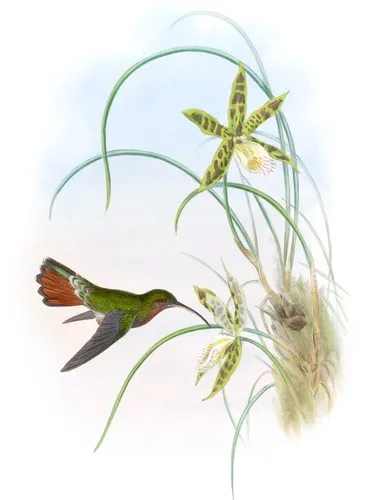
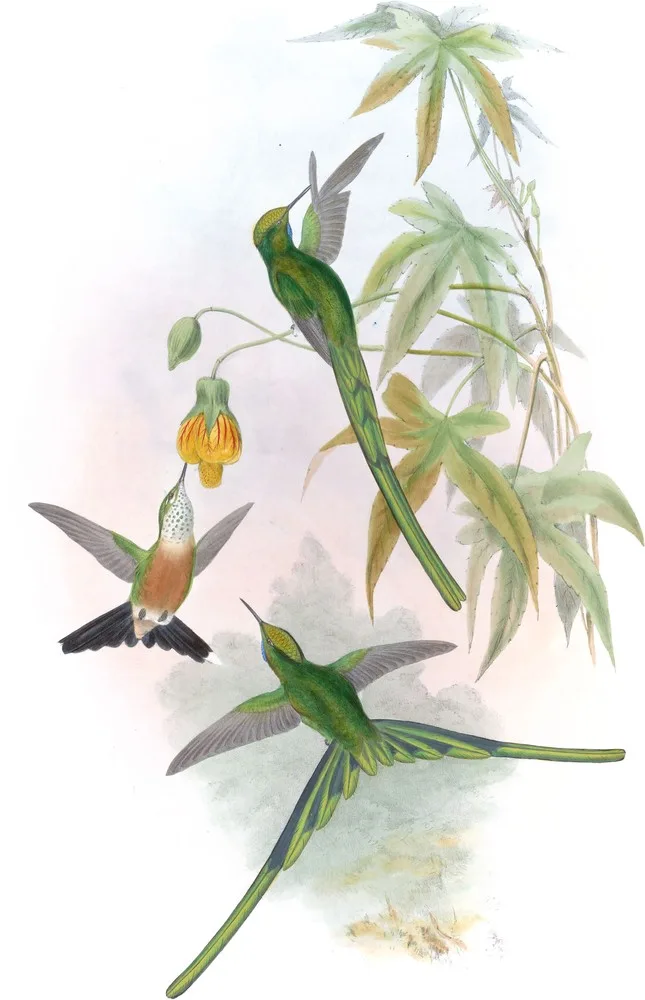
The male has the crown of the head rich shining yellowish metallic green; on the throat a small gorget of beautiful shining purplish blue; plumage of the body bronzy green, becoming of a browner hue on the under surface; wing-coverts and tips of the spurious wing-feathers shining green; the remainder of the wings purple-brown; tail rich shining metallic green, with the exception of the basal half of the feather, which is black; a few white feathers stretch across the abdomen; under tail-coverts green; above and behind the eye a very minute mark of white.
The young male resembles the adult, but has the whole of the colouring, especially that of the crown, far less brilliant; is entirely destitute of the gorget on the throat, and has the lateral tail-feathers much less developed.
The female has the upper surface and wing-coverts golden bronze, a small mark of white behind the eye, and a small streak of the same hue beneath it; the under surface rufous, marked with bronzy green on the flanks; central tail-feathers shining green, changing to purple towards the tip; lateral feathers black glossed with deep blue, and tipped with white; all the tail-feathers purplish black on their under surface; throat greyish white, with a round spot of dull green near the tip of each feather.
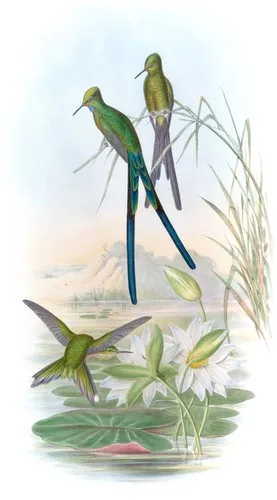
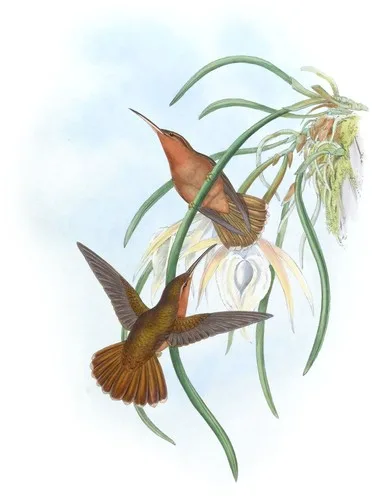
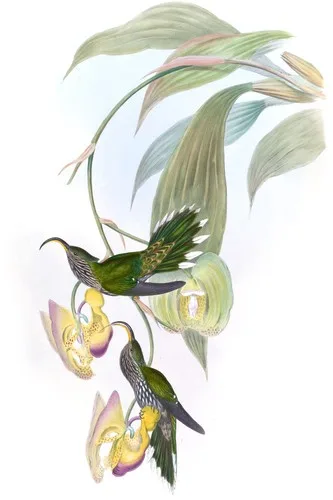
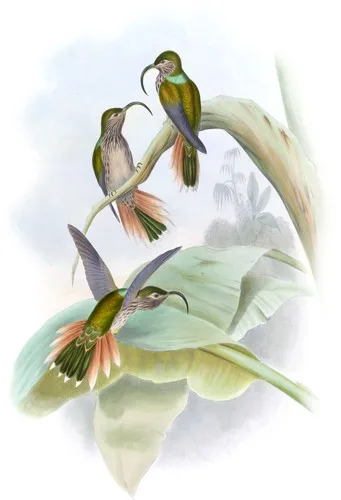
The Plate represents two males and a female of the natural size on one of the common plants of Peru.
References
- Trochilus (Lesbia) smaragdinus, Gould in Proc. of Zool. Soc., Part XIV. p. 85.
- Trochilus Mocoa, De Latt. et Boure. in Rev. Zool., 1846, p. 311.
- Mellisuga smaragdinis, Gray and Mitch. Gen. of Birds, vol. i. p. 118, Mellisuga, sp. 52.
- Cynanthus mocoa, Bonap. Consp. Gen. Av., p. 81, Cynanthus, sp. 3.