阔嘴蜂鸟属
Cynanthus smaragdicaudus
Cynanthus smaragdicaudus
Green-tailed Sylph
- 中文名
- 阔嘴蜂鸟属
- 学名
- Cynanthus smaragdicaudus
- 合集
- 古尔德蜂鸟图谱
- 绘者
- John Gould(约翰·古尔德)
- 年代
- 1852
- 图版号
- Pl. 173, Vol. III
- 原书页码
- p.173
- 授权
- CC0 1.0 Universal (Public domain)
十观
- 纵幅 1.55∶1
第一眼
竖划三寸,当千仞之高;横墨数尺,体百里之迥。
—— 南朝宋·宗炳《画山水序》
三寸的竖线可当千仞高山,几尺横墨能容百里之远。尺幅从来不是障碍,取舍才是本事。这一幅是竖的:眼睛从下往上走,落点在中段那只鸟身上。先别急着看羽毛,让姿态先立起来。第二步凑近一寸:看线与色的交界,色有没有压住线,线有没有断。第三步,把视线放到最深的那一小块:整幅的用色秩序,都是从那里排开的。
名与实
学名 Cynanthus smaragdicaudus:前一词是属,管它归在哪一类;后一词是种加词,管它在这一类里凭什么与众不同。双名制的好处是唯一:全世界叫这个名字的,只能是这一种。中文名“阔嘴蜂鸟属”是后人据学名回译的通行叫法,与古书里的旧名未必对得上——名与物之间,总隔着一层翻译。
形与色
蜂鸟为美洲最小之鸟,喙细长如针,舌分叉成管,可伸入花心吸蜜;翼小而振频极高,能悬停、能倒飞。此幅未作色相归档,只能就形制论。看形制不必求全:记住喙形、翼式与栖姿,这一类的骨架就立住了。
构图与呼吸
画幅高而窄,鸟栖在枝的中段,上下留白多——十九世纪鸟谱的标准版式,留给它飞走的余地。全幅只画一只,不作解剖附图——这类图更近于“观赏”,而非“鉴定”。空白不是没画完,是给眼睛留的落脚处:一张图若四边都塞满,花反而会闷。
一刀一色
十九世纪后半叶,石版与彩色石印渐成主流:颜色可以直接印出,不再依赖手工,线条反倒退居其次。图像的“准确”提高了,手性却淡了。拿放大镜(或手机微距)看三处:喙缘、覆羽、题名。线若连续不断,是刻的;色若越过轮廓半毫米,是手涂的。想动笔临它的人记住一句:先铺大块的形与色,干后再收细部;石印的柔和层次来自薄涂与网点,水彩分两三遍淡铺即可逼近。
诗境
夫列子御风而行,泠然善也,旬有五日而后反。
—— 《庄子·逍遥游》
蜂鸟悬停于空,不落不飞,最近于“御风”。庄子说的是一种自由的姿态,蜂鸟把它做成了生理事实。古人写到这一层,已不只是赏花,是借花说人;画面则只负责把那朵花留住。
花语
阿兹特克以蜂鸟为战神与太阳的化身;欧洲维多利亚时代则以蜂鸟为收藏与装饰的极致,百万只羽毛被做成胸饰。中国旧籍无此鸟,故无象征——这空白本身,就是一部博物学交流史。象征多半来自形状与气味:像杯的、像泪的、香的、臭的——先有形状,后有意义。
时与地
温带种类的蜂鸟则随花北迁,一年往返数千公里。仅产美洲,自阿拉斯加南部至火地岛,以安第斯山最为繁盛。中土无蜂鸟,汉籍不载,晚清海外游记始见其名。图上所记的 1852 年是刊行之年,不是采到那只鸟的年份;真正的观察记录通常比出版早一两年。那一代人对这类鸟的知识,多半来自标本与笼养。看这一类图,不妨把产地和季节都当“据说”来读。
书与人
《古尔德蜂鸟图谱》只署了约翰·古尔德一个人的名字。版画是集体工程:绘图、刻版、上色各有其人,真正决定这幅图好不好看的,常是没留下名字的刻工与上色师。
带走一双眼睛
下次看鸟,别急着认名:先看它停的姿态,再看羽色在哪一段最深,最后才翻图鉴——顺序一换,看鸟就从“对答案”变成了“看画”。图谱的用意是“以备查考”,看久了却会忘记查考:1852 年的一个人,为一只鸟花了整整一天。
关于本图版
此图原刊于《古尔德蜂鸟图谱》(Gould's Hummingbirds),绘者为约翰·古尔德,成书于 1849—1887 年间。画面主体是阔嘴蜂鸟(Cynanthus smaragdicaudus),归入蜂鸟科(Trochilidae)。
全编共收录 421 幅图版,本图是其中一幅,原书将其列为 Pl. 173, Vol. III,见第 173 页,版式为纵幅。图为公有领域原件的修复扫描,构图与设色未经改动。
原书文字(英文 / 法文)
Peru and Bolivia
In general structure this beautiful species is most closely allied to the Blue-tailed Sylph (Cynanthus cyanurus) 5 it is, however, of rather smaller size, and may at all times be distinguished by its resplendent metallic green tail: unfortunately nothing whatever is known of its habits and economy, but they are doubtless as similar to those of its ally, as the two birds are in form and structure.
The first specimen that came under my own observation, was received more than thirty years ago direct from Popayan; M. De Lattre killed it at Mocoa, “an ancient capital of the Indians, the environs of which are inundated for five or six months of the year, which is situated on the borders of the Anthropophagous nations, the Huitotos and Mesalles, and rarely visited by Europeans.” Mr. Bridges found it in tolerable abundance in Bolivia, whence he brought numerous examples to this country. I regret to say that this is all that is at present known respecting it; but from this meagre information I infer that the true habitat of the species lies to the southward of the equator; its range probably extending over the whole of the eastern dip of the Peruvian Andes, a portion of the country but rarely explored by naturalists.
In retaining my own name of smaragdicaudus for this species, I am not actuated by any desire to displace that of Mocoa given to it by M. Bourcier, who has contributed so largely to our knowledge of this lovely group of birds; but have simply given it the preference because it so justly expresses the trivial name of Green-tail commonly applied to it: I may remark, moreover, that I believe it has slightly the priority in the date of publication.
The changes of plumage from youth to maturity, and the difference between the sexes, are precisely similar to those of the Blue-tail. The young males, as might be expected, assume the green tint on the tail at a very early period, but are far less brilliant than the adult; in this state of plumage, specimens were brought both by M. De Lattre and Mr. Bridges: in many of them a white mark occurred down the centre of the back, similar to that observable in examples of the Blue-tail of the same age, but in every instance the gorget of blue was absent.
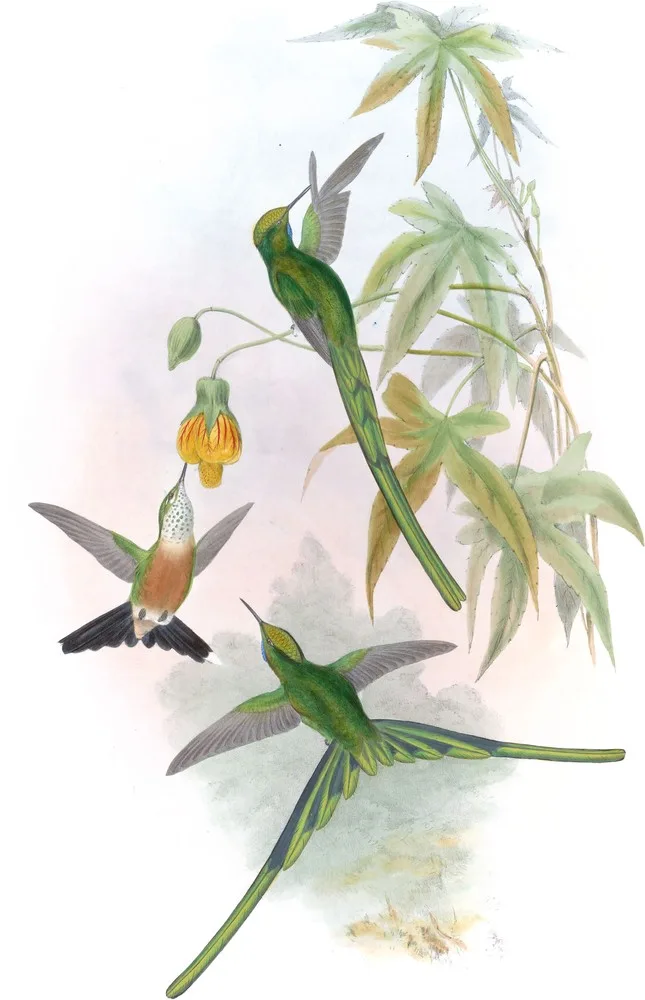
The male has the crown of the head rich shining yellowish metallic green; on the throat a small gorget of beautiful shining purplish blue; plumage of the body bronzy green, becoming of a browner hue on the under surface; wing-coverts and tips of the spurious wing-feathers shining green; the remainder of the wings purple-brown; tail rich shining metallic green, with the exception of the basal half of the feather, which is black; a few white feathers stretch across the abdomen; under tail-coverts green; above and behind the eye a very minute mark of white.
The young male resembles the adult, but has the whole of the colouring, especially that of the crown, far less brilliant; is entirely destitute of the gorget on the throat, and has the lateral tail-feathers much less developed.
The female has the upper surface and wing-coverts golden bronze, a small mark of white behind the eye, and a small streak of the same hue beneath it; the under surface rufous, marked with bronzy green on the flanks; central tail-feathers shining green, changing to purple towards the tip; lateral feathers black glossed with deep blue, and tipped with white; all the tail-feathers purplish black on their under surface; throat greyish white, with a round spot of dull green near the tip of each feather.
The Plate represents two males and a female of the natural size on one of the common plants of Peru.
References
- Trochilus (Lesbia) smaragdinus, Gould in Proc. of Zool. Soc., Part XIV. p. 85.
- Trochilus Mocoa, De Latt. et Boure. in Rev. Zool., 1846, p. 311.
- Mellisuga smaragdinis, Gray and Mitch. Gen. of Birds, vol. i. p. 118, Mellisuga, sp. 52.
- Cynanthus mocoa, Bonap. Consp. Gen. Av., p. 81, Cynanthus, sp. 3.