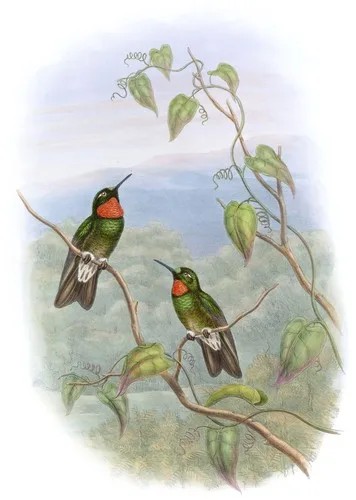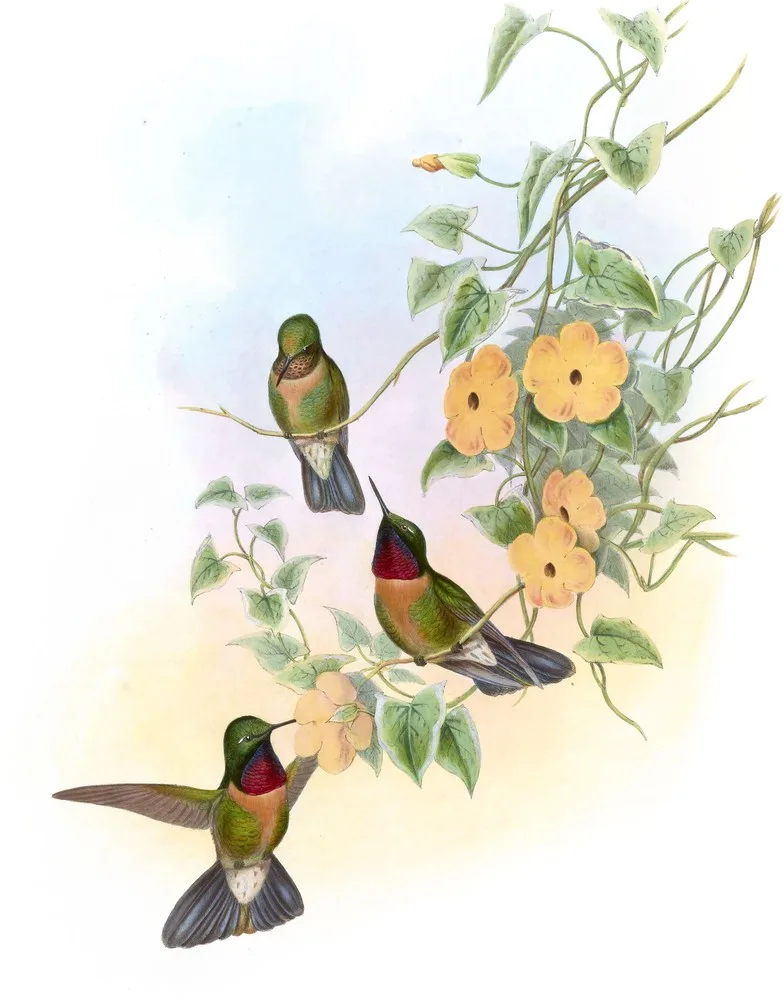
辉喉领蜂鸟
Heliangelus amethysticollis
Heliangelus amethysticollis
Amethystine Sun Angel
- 中文名
- 辉喉领蜂鸟
- 学名
- Heliangelus amethysticollis
- 合集
- 古尔德蜂鸟图谱
- 绘者
- John Gould(约翰·古尔德)
- 年代
- 1854
- 图版号
- Pl. 245, Vol. IV
- 原书页码
- p.245
- 授权
- CC0 1.0 Universal (Public domain)
十观
- 略纵 1.28∶1
第一眼
搜尽奇峰打草稿。
—— 清·石涛《苦瓜和尚画语录》
走遍山川,才有资格落笔。博物画的画家也一样:先在温室与山野里看够了活的花,纸上那一朵才不虚。这一幅略高于宽,落点在中央偏上。第二步凑近一寸:看线与色的交界,色有没有压住线,线有没有断。第三步,把视线放到最深的那一小块:整幅的用色秩序,都是从那里排开的。
名与实
学名 Heliangelus amethysticollis:前一词是属,管它归在哪一类;后一词是种加词,管它在这一类里凭什么与众不同。一百多年前的命名者,把一种植物的来历压进了两个词。中文名“辉喉领蜂鸟”是后人据学名回译的通行叫法,与古书里的旧名未必对得上——名与物之间,总隔着一层翻译。
形与色
鳞茎由多数肉质鳞片抱合而成,故名“百合”;茎直立,叶披针或轮生,花被六片,盛开时向外反卷,雄蕊六枚,花药长大如丁字。此幅未作色相归档,只能就形制论。画幅略高,形与色的关系因此看得格外清楚:先读轮廓,再读色层,最后才看笔触。
构图与呼吸
画幅略高于宽,主株居中偏上,视线自然落在花冠。全幅只画一株,不作解剖附图——这类图更近于“观赏”,而非“鉴定”。空白不是没画完,是给眼睛留的落脚处:一张图若四边都塞满,花反而会闷。
一刀一色
十九世纪后半叶,石版与彩色石印渐成主流:颜色可以直接印出,不再依赖手工,线条反倒退居其次。图像的“准确”提高了,手性却淡了。拿放大镜(或手机微距)看三处:花瓣边缘、叶脉、题名。线若连续不断,是刻的;色若越过轮廓半毫米,是手涂的。想动笔临它的人记住一句:先铺大块的形与色,干后再收细部;石印的柔和层次来自薄涂与网点,水彩分两三遍淡铺即可逼近。
诗境
更乞两丛香百合,老翁七十尚童心。
—— 宋·陆游《窗前作小土山蓻兰及玉簪最后得香百合并种之戏作》
“更乞两丛香百合”——诗以气行,画以形立;两种“看”叠在一起,才是看画的意思。
花语
西方以白百合为圣母之洁,天使报喜时手持者即是;中国取其“百年好合”之谐音,婚仪用之,是世俗的祝福而非宗教的纯洁。象征会随世道改口:同一株植物,在一个世纪里可以说完全相反的话。
时与地
初夏至盛夏,六七月间开。百合花期短,三五日即谢,故画者多取初开之态。北半球温带,中国、日本与欧洲山地皆有。中国百合入药已久,十九世纪欧洲又从东亚引去数十种,一时百合育种大盛。图上所记的 1854 年是刊行之年,不是花期;真正的花藏在原书的采集记录里,通常比出版早一两年。同一株植物,春秋两季像两种东西;同一座山,一百年前与今天叫两个名字。图把这两样都冻结在了纸上。
书与人
《古尔德蜂鸟图谱》只署了约翰·古尔德一个人的名字。从画稿到成图要过好几双手:转刻的人求准,上色的人求快——快与准之间,就是各幅之间深浅不一的来历。
带走一双眼睛
鉴赏力不是知识,是习惯:每次多看一眼,十年之后你看什么都和别人不一样。1854 年的那朵花早已化作尘土,它留在纸上的样子,却比任何一株活着的同类都长寿。
关于本图版
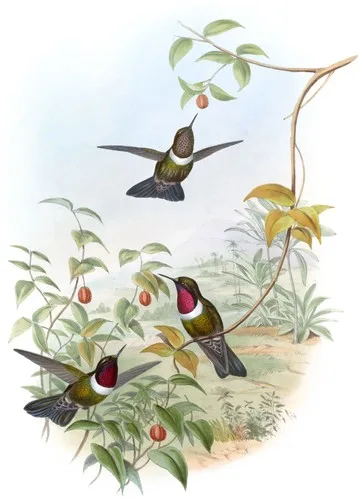
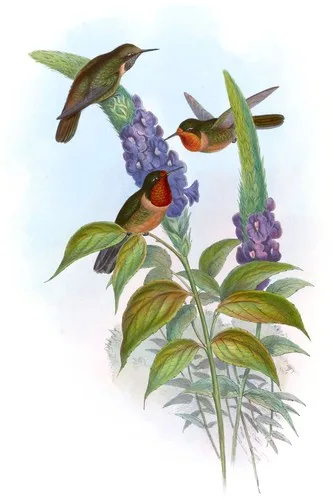
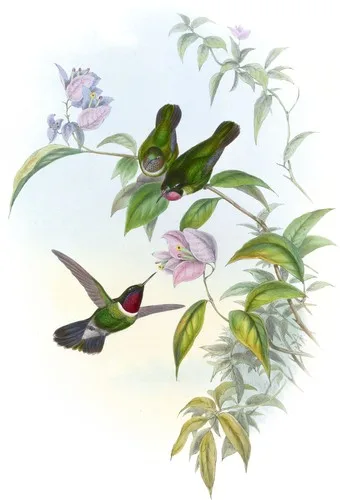
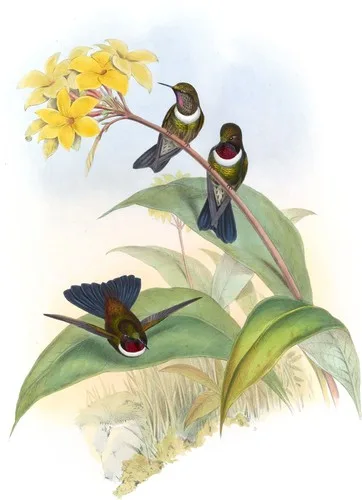
《古尔德蜂鸟图谱》(Gould's Hummingbirds)由约翰·古尔德绘制,1849—1887 年间印行,本图即其中一幅。画面主体是辉喉领蜂鸟(Heliangelus amethysticollis),在分类体系中列于蜂鸟科(Trochilidae)。
该合集全编共 421 幅图版,此图为其中之一,图版编号 Pl. 245, Vol. IV,对应原书第 245 页,版式为纵幅。扫描件取自公有领域原件,经高分辨率修复与色彩校正,可按原大放大查看线条与设色。
原书文字(英文 / 法文)
Peru
This beautiful Humming Bird was first made known to science by M. D’Orbigny, who procured a single example of it during his journey into Bolivia.
It was subsequently found by Mr. Bridges in the same country, and it is from that source that the specimens in my own collection were obtained; I also’received a single example from M. Warszewicz, who killed it in Northern Peru. Peru and Bolivia, then, evidently constitute the true habitat of this species, which may be regarded as the southern representative of the well-defined genus to which the appellation of Heliangelus has been given. In size and in the semi-rounded form of its tail it assimilates to H. Clarissæ; but it differs from that, as well as from every other member of the genus, in the buff colouring of its gorget, in the central line of the abdomen being’ buff, and in the under tail-coverts being of a darker hue; a marked difference from all its congeners is also presented in the greater size of the glittering green spot on the forehead, which, instead of being confined to the front, extends towards the crown. The female offers the usual difference in the colouring of the plumage, but preserves the buff band across the breast so characteristic of the male.
The specimen of this bird procured by M. D’Orbigny was obtained on the eastern slope of the Cordilleras in the country of the Yuracares near Cochabamba, at the upper limit of the woody vegetation. Its stomach contained numerous grubs and the larve of hemipterous insects.
The male has a large mark of luminous green on the forehead; chin black; throat rich luminous violetred or puce colour, the blue or violaceous hue prevailing on the upper and lateral margins; below this a wide gorget of buff, succeeded by a series of green feathers, very narrow in the centre, broad on the sides, and blending with the bronzy green of the flanks; head, upper surface and wing-coverts bronzy green; the head, however, when viewed in front, appears black; lores and sides of the neck velvety black, separating the colours of the upper and under surface of the head and neck; immediately behind the eye a very small spot of buffy white; wings chocolate-brown; two central tail-feathers bronzy green; lateral tailfeathers dull black, the three outermost on each side tipped with brownish grey; abdomen mottled buff and bronzy green; under tail-coverts greyish white; bill black; feet brown.
The female has a faint indication of the luminous green on the forehead; head, upper surface and central tail-feathers bronzy green; lateral tail-feathers black; throat mottled buff and black; the buff gorget not so decided, and the luminous green feathers*below far less conspicuous than in the male.
The figures are of the natural size.
References
- Orthorhynchus amethysticollis, D’Orb. et LaFres. Syn. Av., p. 31.—D’Orb. Voy. dans l’Amér. Mér., tom. iv. p. 576, tom. viii. pl. 60. fig. 2.
- Mellisuga amethysticollis, Gray and Mitch. Gen. of Birds, vol. i. p. 112, Mellisuga, sp. 40.
- Trochilus amethysticollis, Tschudi, Consp. Av., no. 207.
- Lampornis amethysticollis, Tschudi, Faun. Per., p. 246.
- Heliangelus amethysticollis, Bonap. Consp. Gen. Av., p. 76, Heliangelus, sp. 6.—Ib. Rey. et Mag. de Zool. 1854, p. 252.
- Anactoria amethysticollis, Reichenb. Aufz. der Colibris, p. 12.