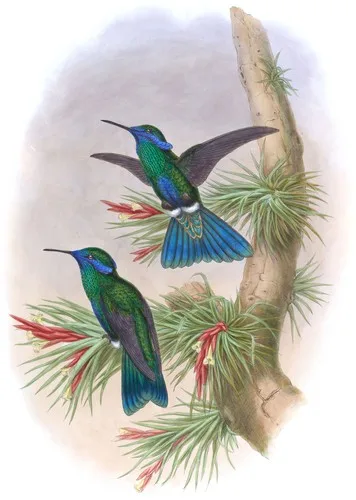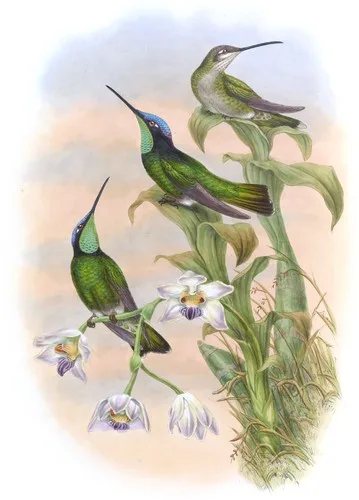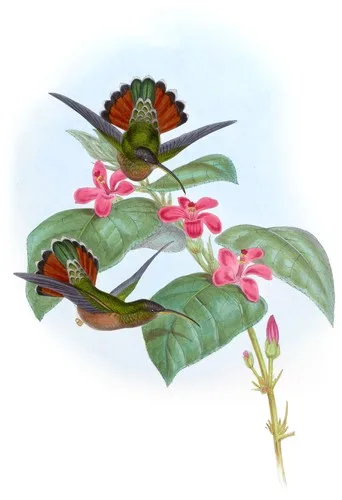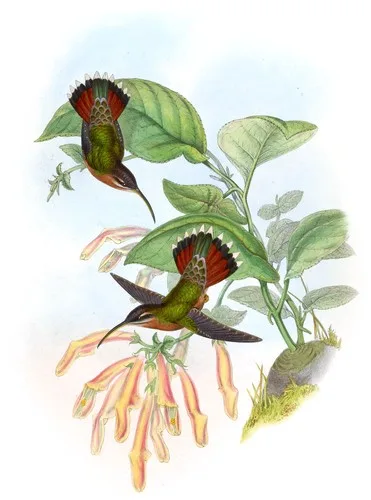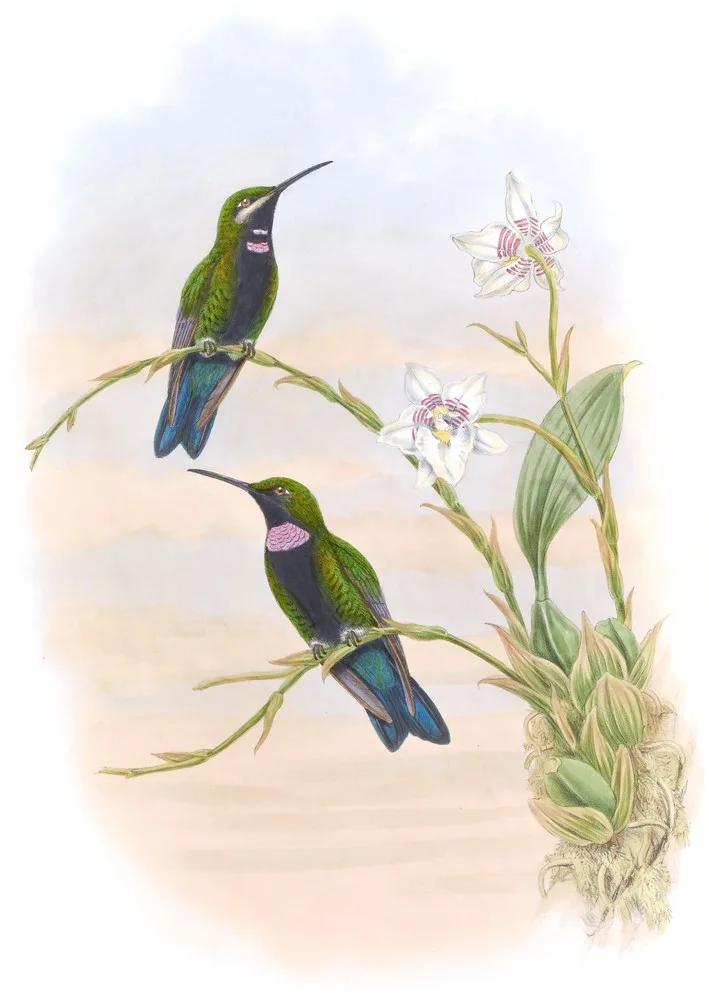
Ionolæma whitleyana
Ionolæma whitleyana
Whitely’s Humming-bird
Ten ways of seeing
- upright 1.41 : 1
First Look
真山水之川谷,远望之以取其势,近看之以取其质。
—— 宋·郭熙《林泉高致·山水训》
Mountains and valleys: from afar take their momentum, up close take their texture — the two distances from which any picture is read.
The sheet is vertical: the eye climbs and settles on the bird. Take the posture before the plumage. Then step in close: watch where colour meets line, and whether the line ever breaks. Third, find the darkest small patch: the whole tonal order is measured from there.
Name and Thing
No reliable binomial survives, so the printed title must serve. Neither name nor binomial survives: the printed title must do.
Form and Colour
The smallest of birds: a needle-fine bill, a forked tubular tongue, wings beating so fast the bird hovers and even flies backwards. Its colour is not pigment but structure — light bent by feather barbules, changing with the angle.No colour group is recorded. A single plant, laid out with nothing hidden.
Composition
Tall and narrow, the bird perched mid-branch with generous margins above and below. No details are appended: a plate for looking, not for keying out. Old plates set the plant slightly off centre, with unequal margins — that small imbalance is what keeps it alive.
Line and Colour
In the later nineteenth century chromolithography took over: colour printed rather than painted, line demoted. Craft leaves franker evidence than inscriptions. If you mean to copy it: block in the broad shapes and colours first, detail last; lithographic softness comes from thin washes — two or three pale layers will get you close.
Poetic Resonance
穿花蛱蝶深深见,点水蜻蜓款款飞。
—— 唐·杜甫《曲江二首》
Butterflies thread the flowers, seen deep within; dragonflies touch the water and fly on, slow and deliberate.
The poem gives the mood first and the picture supplies the form; set the line beside the plate and the bird itself becomes its resting point.
Symbolism
For the Aztecs the hummingbird was warrior and sun; for Victorian Europe it was the ultimate ornament, millions killed for breast jewellery. China has no tradition here — and that blank is itself a history of exchange. Flower language was added later; the flower knows nothing of it, and that innocence is part of its power.
Season and Place
In tropical America they are present all year, their season set by flowers. Americas only, from southern Alaska to Tierra del Fuego, richest in the Andes. China has no hummingbirds and no classical record of them. The year 1887 on the plate is that of publication, not of flowering — the gathering came a year or two earlier. The bud and the ripe fruit on one branch tell the season; the name in the title often tells the journey.
The Book and the Hand
“Gould's Hummingbirds” carries only John Gould's name. The image is public domain; the hand-colouring is still one person's hand.
What to Take Away
Carry three rules away: whole before detail; line before colour; picture before book. A flora exists to be consulted; look long enough and you forget to consult — someone in 1887 gave a whole day to a single flower.
About this plate
Four species of the genus Ionolæma are now known, two of them having a brilliant metallic spot on the forehead, viz. I. frontalis and I. whitelyana, and two which have no bright spot, I. luminosa and I. schreibersi.
The present bird differs from I. frontalis in having the breast green instead of black: it was discovered by Mr. Henry Whitely at Cosnipata in the province of Cuzco, Peru, in August 1871, at an elevation of 2300 feet above the level of the sea.
Mr. Whitely states that he found the bird very rare, having only met with a male in August, and a female on the 21st of May, 1871. He states that it “frequents flowering plants at the tops of the loftiest trees in the depths of the forest, at nearly all times out of range of gun-shot. Very powerful in flight, and darts from flower to flower with extraordinary rapidity.”
The following description was given by me in the volume of the ‘Annals’ mentioned above:—
Male. Crown, all the upper surface and flanks deep grass-green; an obscure glittering mark on the forehead; chin, chest, and centre of the abdomen jet-black with a broad gorget of beautiful violet on the throat; the bill, which is stout and straight, is black, as are also the legs and toes; the tail and under tailcoverts steel-black; primaries and secondaries purplish brown, the external edge of the outer primary reddish brown. Total length 5
inches, bill 1 , wing 3, tail 2 .
Mr. Whitely gives the soft parts as follows: “Bill black; eye dark hazel; legs, toes, and claws black.”
The specimens figured in the Plate are the original ones procured by Mr. Whitely, and now in my collection.
References
- Iolæma whiteleyana, Gould, Ann. & Mag. Nat. Hist. (4) x. p. 452 (1872).—Sclater & Salvin, Nomencl. Av. Neotrop. p. 82 (1872).—Whitely, Proc. Zool. Soc. 18738, p. 188. —Muls. Hist. Nat. Oiseaux-Mouches, ii. p. 141 (1876).
- Ionolæma whitelyana, Elliot, Synopsis of the Humming-Birds, p. 59 (1878).
- Ionolaima whitelyana, Eudes-Deslongchamps, Annuaire Mus. d’Hist. Nat. Caen, i. p. 276 (1880).