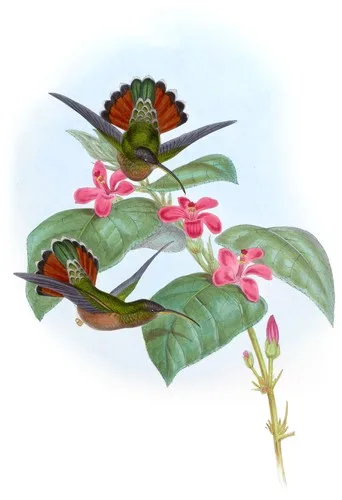
Lafresnaya flavicaudata
绒胸蜂鸟属
Lafresnaya flavicaudata
Buff-tailed Velvet-breast
Ten ways of seeing
- slightly upright 1.12 : 1
First Look
凡画山水,意在笔先。
—— 唐·王维《山水论》
In painting, the intention precedes the brush.
Slightly taller than wide; the eye lands on the bird's head, a little above centre. Then step in close: watch where colour meets line, and whether the line ever breaks. Third, find the darkest small patch: the whole tonal order is measured from there.
Name and Thing
The binomial is Lafresnaya flavicaudata: the first word is the genus it belongs among, the second the epithet that sets it apart. Two words carry a whole provenance. The Chinese name 绒胸蜂鸟属 is a modern rendering of the Latin, not an old garden name.
Form and Colour
The smallest of birds: a needle-fine bill, a forked tubular tongue, wings beating so fast the bird hovers and even flies backwards. Its colour is not pigment but structure — light bent by feather barbules, changing with the angle.No colour group is recorded. A single plant, laid out with nothing hidden.
Composition
Slightly taller than wide, the bird set a little above centre, the eye landing at head and bill. No details are appended: a plate for looking, not for keying out. Blank paper is not unfinished work: it is where the eye rests.
Line and Colour
In the later nineteenth century chromolithography took over: colour printed rather than painted, line demoted. Decide first whether it was printed or painted; only then discuss whether it is beautiful. If you mean to copy it: block in the broad shapes and colours first, detail last; lithographic softness comes from thin washes — two or three pale layers will get you close.
Poetic Resonance
穿花蛱蝶深深见,点水蜻蜓款款飞。
—— 唐·杜甫《曲江二首》
Butterflies thread the flowers, seen deep within; dragonflies touch the water and fly on, slow and deliberate.
The poem gives the mood first and the picture supplies the form; set the line beside the plate and the bird itself becomes its resting point.
Symbolism
For the Aztecs the hummingbird was warrior and sun; for Victorian Europe it was the ultimate ornament, millions killed for breast jewellery. China has no tradition here — and that blank is itself a history of exchange. Flower language was added later; the flower knows nothing of it, and that innocence is part of its power.
Season and Place
temperate hummingbirds follow the bloom north and back, thousands of kilometres a year. Americas only, from southern Alaska to Tierra del Fuego, richest in the Andes. China has no hummingbirds and no classical record of them. The year 1850 on the plate is that of publication, not of flowering — the gathering came a year or two earlier. Read the locality and the flowering season both with a discount: one is hearsay, the other a ten-day peak.
The Book and the Hand
“Gould's Hummingbirds” carries only John Gould's name. A plate is collective work: drawer, engraver and colourist were different hands, and the unnamed ones decided how good it looks.
What to Take Away
If you keep one line, keep Guo Xi's: from afar its momentum, up close its texture. A flora exists to be consulted; look long enough and you forget to consult — someone in 1850 gave a whole day to a single flower.
About this plate
The high lands of New Granada. Common at Bogota and Popayan; and probably in the northern parts of Ecuador.
Not only are the Columbian Andes most fertile in species of Humming-birds, but, in many instances, forms there occur which do not exist elsewhere; and the genus Lafresnaya may be cited as one of such genera, of which two, if not three, well-defined species have been discovered, and which are true Andean birds.
Although the extent of the range enjoyed by the present species has not been accurately ascertained, we know that it plays a conspicuous part in bird-life in the neighbourhood of Bogota and other parts of Columbia. I have not, however, seen specimens from Popayan, Quito, or Ecuador, yet M. Warszewicz collected examples in Peru, a country still farther south.
It will be seen that the present bird has been twice described, and it is to be regretted that the name of Lafresnayi cannot be retained as its specific appellation, as no one is more worthy of having a beautiful bird dedicated to him than the worthy and amiable Baron de la Fresnaye: his name will, however, in spite of this contretemps, be handed down to posterity not only as the author of many valuable papers on Ornithology, but as the individual in honour of whom the present genus has been entitled Lafresnaya.
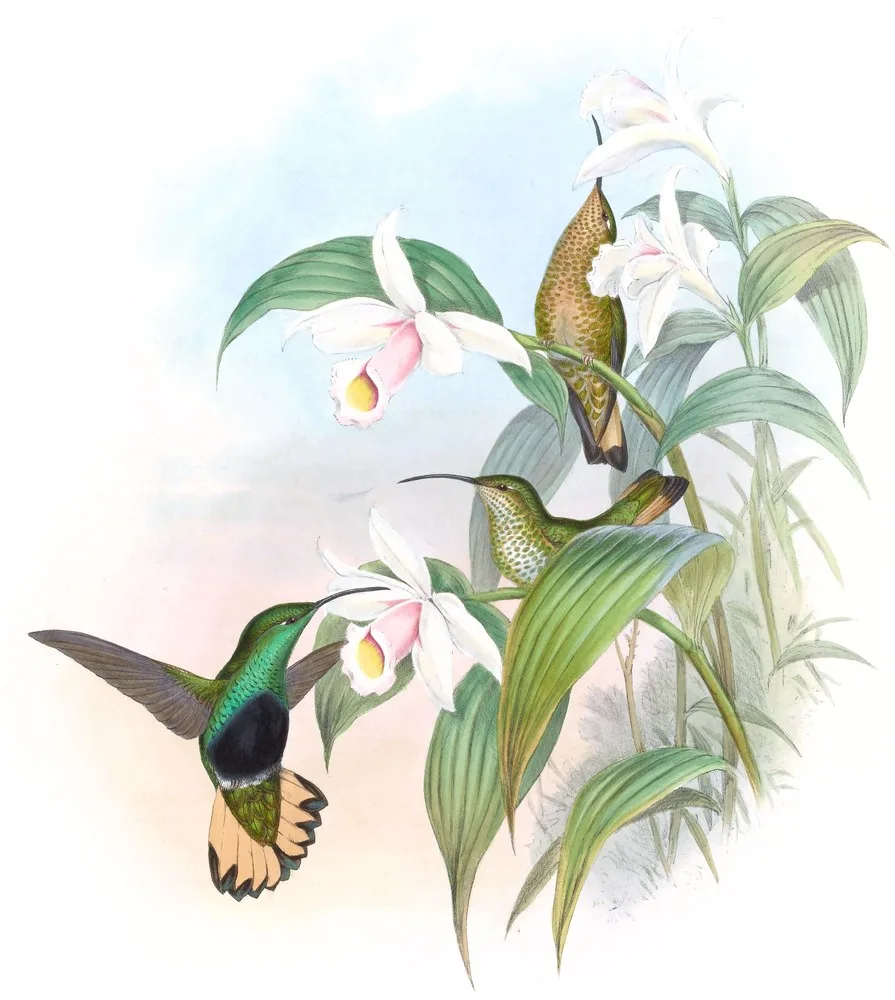
The females, and especially the young males, of this species present a beautifully spangled character of markings, which become most glittering and attractive when the breasts of the birds are so placed as to receive the direct rays of light, and contrast strongly when compared with the green throat and velvety breast of the male.
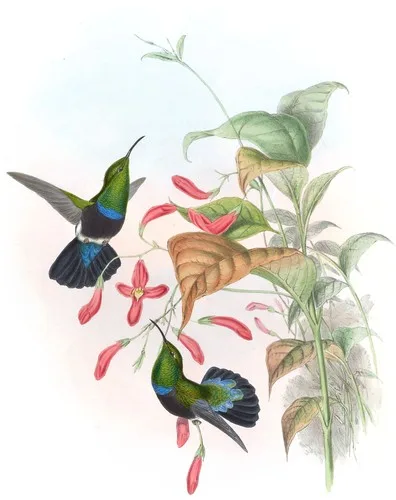
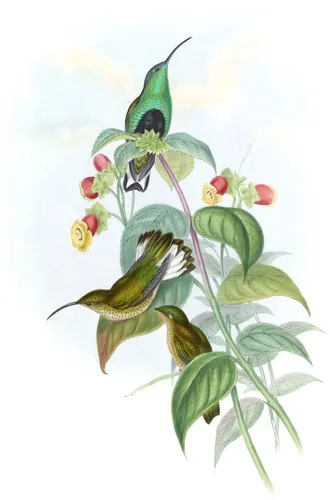
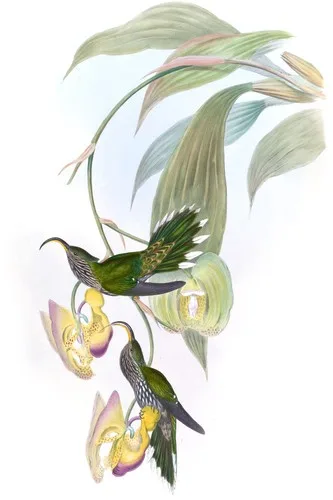
The male has the crown of the head, all the upper surface, wing- and upper tail-coverts dark green; wings rich purplish-brown; throat, breast, upper part of the abdomen and flanks very dark shining grass-green; lower part of the abdomen velvety-black; two central tail-feathers of a bronzy hue, the remainder yellowishbuff; the apical two-thirds of the outer web, and the tip of the inner web, of the external feather purplishbrown; the remainder with an arrow-shaped mark of bronzy-brown at the tip, broadest on the external web, and lessening in extent as the feathers approach the centre; under tail-coverts bronzy-green, with white bases; bill blackish-brown, the under mandible somewhat lighter.
In the young males, and in the females, the bronze tipping to the tail-feathers is much more extensive, and the buff is of a somewhat deeper tint; the under surface is white, or buffy-white, with a spangle of glittering green at the tip of each feather.
Both sexes are figured on the accompanying Plate, on the Sodratia sessilis.
References
- Trochilus flavicaudatus, Fras. in Proc. of Zool. Soe., part viii. p. 18.
- Trochilus Lafresnayi, Boiss. Rev. Zool. 1848, p. 8.
- Calothorax Lafresnayi, Gray and Mitch. Gen. of Birds, vol. i. p. 110, Calothorax, sp. 1.
- Lafresnaya flavicaudatus, Bonap. Consp. Gen. Av., p. 68, Lafresnaya, sp. 1.
- Lafresnaya flavicaudata, Reich. Aufz. der Col., p.11.—Bonap. Rev. et Mag. de Zool. 1854, p. 252.