Lafresnaya Gayi
绒胸蜂鸟属·Lafresnaya Gayi
Lafresnaya Gayi
White-tailed Velvet-breast
Ten ways of seeing
- upright 1.51 : 1
First Look
江馆清秋,晨起看竹,烟光日影露气,皆浮动于疏枝密叶之间。
—— 清·郑板桥《题画竹》
On an autumn morning at the river lodge I looked at the bamboo: mist, sunlight, dew, all drifting among the sparse and dense leaves.
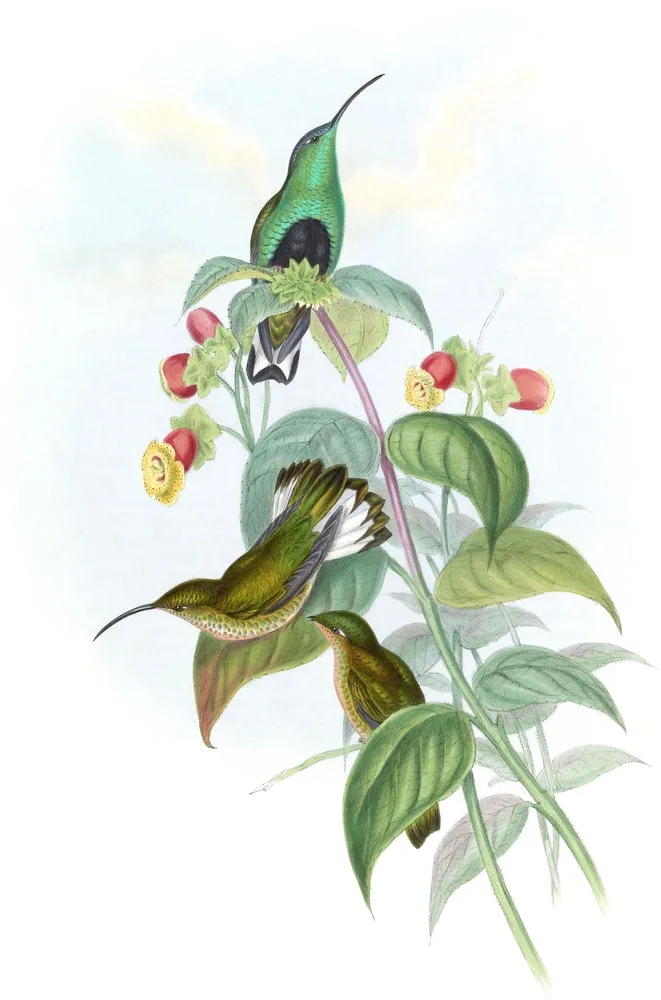
The sheet is vertical: the eye climbs and settles on the bird. Take the posture before the plumage. Then step in close: watch where colour meets line, and whether the line ever breaks. Third, find the darkest small patch: the whole tonal order is measured from there.
Name and Thing
The binomial is Lafresnaya gayi: the first word is the genus it belongs among, the second the epithet that sets it apart. Two words carry a whole provenance. No established Chinese name exists, so it is cited by its binomial alone.
Form and Colour
The smallest of birds: a needle-fine bill, a forked tubular tongue, wings beating so fast the bird hovers and even flies backwards. Its colour is not pigment but structure — light bent by feather barbules, changing with the angle.No colour group is recorded. Three things fix the habit: leaf arrangement, tepal count, and how the flower is borne.
Composition
Tall and narrow, the bird perched mid-branch with generous margins above and below. No details are appended: a plate for looking, not for keying out. Cover the margins with your thumb and the plate suffocates; uncover them and the flower breathes again.
Line and Colour
In the later nineteenth century chromolithography took over: colour printed rather than painted, line demoted. There is evidence on the back too: the plate mark pressed into the paper, the slight relief of the pigment, lines worn shallow in a later printing. If you mean to copy it: block in the broad shapes and colours first, detail last; lithographic softness comes from thin washes — two or three pale layers will get you close.
Poetic Resonance
穿花蛱蝶深深见,点水蜻蜓款款飞。
—— 唐·杜甫《曲江二首》
Butterflies thread the flowers, seen deep within; dragonflies touch the water and fly on, slow and deliberate.
The poem gives the mood first and the picture supplies the form; set the line beside the plate and the bird itself becomes its resting point.
Symbolism
For the Aztecs the hummingbird was warrior and sun; for Victorian Europe it was the ultimate ornament, millions killed for breast jewellery. China has no tradition here — and that blank is itself a history of exchange. Flower language was added later; the flower knows nothing of it, and that innocence is part of its power.
Season and Place
temperate hummingbirds follow the bloom north and back, thousands of kilometres a year. Americas only, from southern Alaska to Tierra del Fuego, richest in the Andes. China has no hummingbirds and no classical record of them. The year 1850 on the plate is that of publication, not of flowering — the gathering came a year or two earlier. The bud and the ripe fruit on one branch tell the season; the name in the title often tells the journey.
The Book and the Hand
“Gould's Hummingbirds” carries only John Gould's name. A plate is collective work: drawer, engraver and colourist were different hands, and the unnamed ones decided how good it looks.
What to Take Away
Carry three rules away: whole before detail; line before colour; picture before book. Two centuries on, the plant may still flower in some garden; the one on this sheet stopped in the season of 1850.
About this plate
Ecuador and Peru
The present is a somewhat larger species than the Lafresnaya flavicaudata, and, if I mistake not, will be considered even more beautiful in its colouring, its pure white tail-feathers offering a greater contrast to the velvety-black of the abdomen, and the green colouring of the breast being still more resplendent.
In my account of L. flavicaudata, stated that that bird was a native of Columbia, while Ecuador and Peru lay claim to the bird here represented—L. Gayi. It was in Quito that the greater number of the specimens in my collection were procured; the remainder are from Peru.
It will be observed that, like the L. flavicaudata, this species has been honoured with two specific appellations—Gayi and Saulæ, both of which were applied to it by M. Bourcier. I have, however, looked in vain for any character in his descriptions by which the opinion that they apply to two distinct birds can be substantiated. When describing Saulæ, M. Bourcier stated that it was somewhat larger than the Gayi, but I believe he now admits that both terms have reference to the same bird; however, should a further accession of examples induce a contrary conclusion, I shall be happy to rectify the error.
The present species, which has been dedicated to Dr. Gay, so well known for his scientific explorations in Chili, is much more rare than the L. flavicaudata. Of its habits and actions, which I suspect are rather peculiar, nothing whatever is known.
The term Saulæ was given as a compliment to the daughter of Mr. Saul, the conchologist.
The male has the head, all the upper surface, wing- and tail-coverts golden-green; wings rich purplebrown; throat, chest and flanks shining deep grass-green; abdomen velvety-black; under tail-coverts bronzy-green, with white bases; two centre tail-feathers greenish-bronze; lateral tail-feathers white, with an arrowhead-shaped mark at the tip of each, broadest on the outer web, largest and most conspicuous on the external feather, and gradually lessening towards the central ones.
In the young male the tipping of the tail-feathers is much more extensive, and, except on the outer feather, is bronzy instead of purplish-brown, and the under surface is white, with a spangle of glittering green at the tip of each feather.
The female has the upper surface of a more bronzy hue, and the under surface white, spangled with bronze instead of green.
The Plate represents the birds of the natural size. The plant is the Scodacalyx Warszewiczii.
References
- Trochilus Gayi, Boure. et Muls. Ann. de la Soe. Sci. de Lyon, tom. ix. 1846, p. 325.
- Trochilus Saule, Bourc. Rev. Zool. 1846, p. 309.
- Calothorax Gayi, Gray and Mitch. Gen. of Birds, vol. i. p. 110, Calothorax, sp. 2.
- Calothorax Saulii, Gray and Mitch. Gen. of Birds, vol. i. p. 110, Calothorax, sp. 3.
- Lafresnaya gayi, Bonap. Consp. Gen. Av., p. 68, Lafresnaya, sp. 2.—Reich. Aufz. der Col., p. 11.—Bonap. Rev. et Mag. de Zool. 1854, p. 252.
- Lafresnaya Saulæ, Bonap. Consp. Gen. Av., p. 68, Lafresnaya, sp. 3.
- Lafresnaya Saul, Reich. Aufz. der Gol., p. 11.