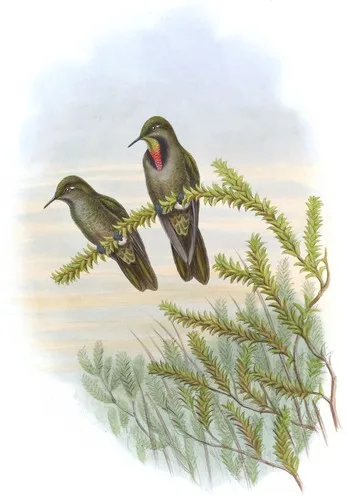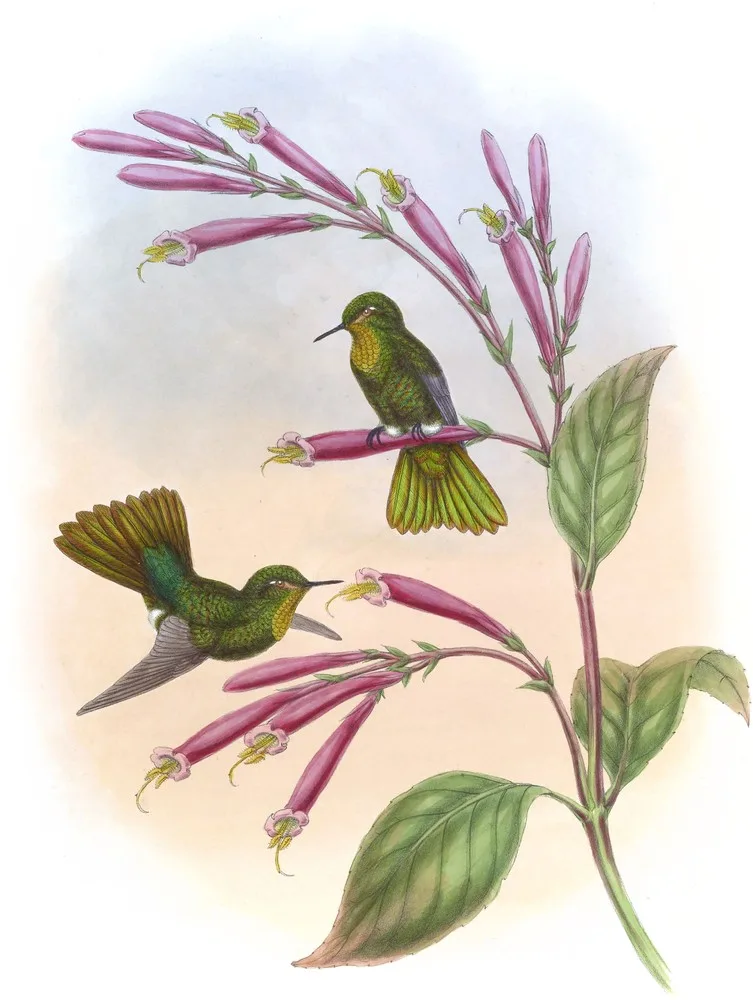
Metallura jelskii / heterocerca
辉尾蜂鸟属
Metallura jelskii / heterocerca
Jelski’s Copper-tail
Ten ways of seeing
- upright 1.33 : 1
First Look
凡画山水,意在笔先。
—— 唐·王维《山水论》
In painting, the intention precedes the brush.
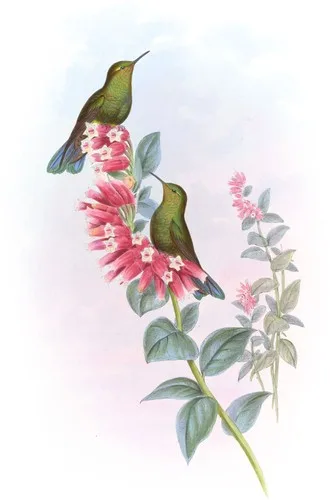
The sheet is vertical: the eye climbs and settles on the bird. Take the posture before the plumage. Then step in close: watch where colour meets line, and whether the line ever breaks. Third, find the darkest small patch: the whole tonal order is measured from there.
Name and Thing
Only the genus Metallura is given; species-level names came later. The Chinese name 辉尾蜂鸟属 is a modern rendering of the Latin, not an old garden name.
Form and Colour
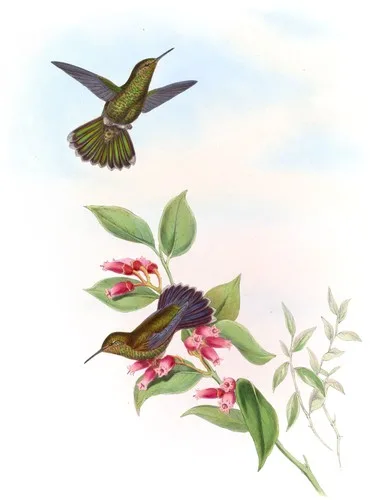
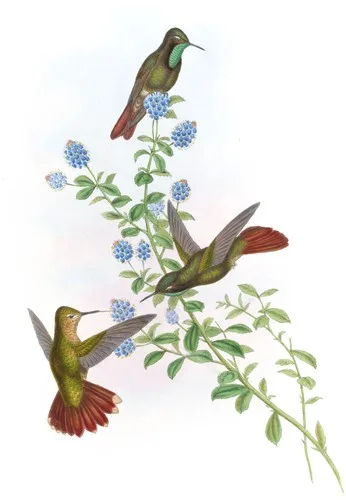
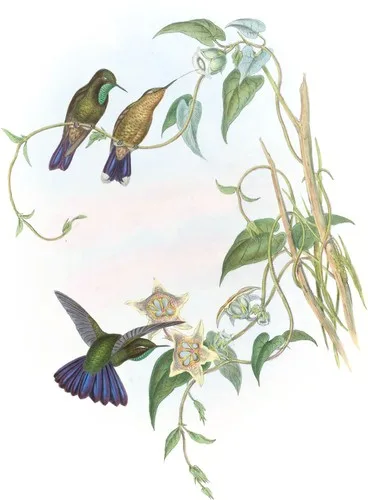
The smallest of birds: a needle-fine bill, a forked tubular tongue, wings beating so fast the bird hovers and even flies backwards. Its colour is not pigment but structure — light bent by feather barbules, changing with the angle.No colour group is recorded. A single plant, laid out with nothing hidden.
Composition
Tall and narrow, the bird perched mid-branch with generous margins above and below. No details are appended: a plate for looking, not for keying out. Blank paper is not unfinished work: it is where the eye rests.
Line and Colour
In the later nineteenth century chromolithography took over: colour printed rather than painted, line demoted. Take a loupe to three places: petal edge, leaf vein, caption. An unbroken line means engraving; colour crossing the outline means a hand. If you mean to copy it: block in the broad shapes and colours first, detail last; lithographic softness comes from thin washes — two or three pale layers will get you close.
Poetic Resonance
夫列子御风而行,泠然善也,旬有五日而后反。
—— 《庄子·逍遥游》
Liezi rode the wind and came back after fifteen days, so light was his going.
The poem gives the mood first and the picture supplies the form; set the line beside the plate and the bird itself becomes its resting point.
Symbolism
For the Aztecs the hummingbird was warrior and sun; for Victorian Europe it was the ultimate ornament, millions killed for breast jewellery. China has no tradition here — and that blank is itself a history of exchange. Flower language was added later; the flower knows nothing of it, and that innocence is part of its power.
Season and Place
In tropical America they are present all year, their season set by flowers. Americas only, from southern Alaska to Tierra del Fuego, richest in the Andes. China has no hummingbirds and no classical record of them. The year 1887 on the plate is that of publication, not of flowering — the gathering came a year or two earlier. Read the locality and the flowering season both with a discount: one is hearsay, the other a ten-day peak.
The Book and the Hand
“Gould's Hummingbirds” carries only John Gould's name. From drawing to plate the sheet passed through several hands — the engraver aimed at accuracy, the colourist at speed, and between them lies each plate's unevenness.
What to Take Away
Next time you watch a bird: posture first, then where the plumage is deepest, and only then the field guide. A flora exists to be consulted; look long enough and you forget to consult — someone in 1887 gave a whole day to a single flower.
About this plate
This species was discovered in Peru by the celebrated Polish traveller whose name it bears, and by whom it was met with in the high mountains near Lake Junin, between Cucas and Paleamayo.
Mr. Elliot places the species in the section of the genus Metallura with bluish-green throats and blackishpurple general coloration. It is allied to M. opaca and M. chloropogon, but is distinguished by the colour of the tail, which, according to Mr. Elliot, is luminous vinous purple. Nothing bas been recorded of its habits.
The following description is translated from Dr. Taczanowski’s work on the Birds of Peru:—
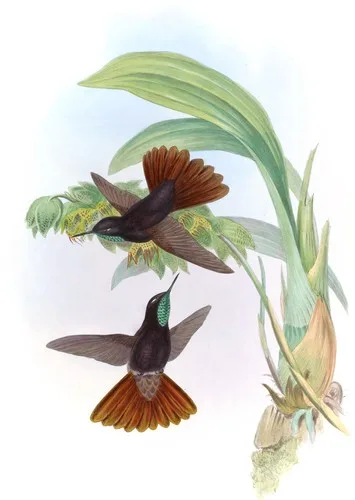
Adult male. The entire plumage is black of a dull silky texture, presenting under certain lights, especially when seen frontways from behind, a slight lustre of bluish or reddish violet, according to the direction of the light; tail-coverts brownish black, glossed with bronzy or reddish copper; fore part of the throat ornamented with scaly plumes of a dark and brilliant emerald-green; anal region downy and white; under tail-coverts bronzy, with a violet reflection and bordered with pale reddish; wing-coverts dull coppery bronze, taking under certain lights a lustre of reddish yiolet similar to that of the general plumage; quills brown, glossed with bronzy olive and violet in their terminal parts; tail slightly emarginate, the tail-feathers broad, the middle ones slightly rounded, the others rather pointed at the extremity, of a dark coppery bronze, taking a lustre of more reddish or violet colour according to the direction of the light, and changing to a fine greenish-blue but very brilliant lustre when looked at from behind forwards; lower part of the tail coppery red or violet, more brilliant than the upper surface. Bill straight, black, much longer than the head, a little less than half the body; feet black, with the tarsus almost entirely bare.
Adult female. Dusky black above, brownish below, with the same violet lustre as the male; forehead pale brownish grey, gradually passing into a darker shade on the hind neck; feathers of the breast and abdomen narrowly fringed with buff, more distinctly in the middle of the belly; tail-coverts dull bronze; fore neck ornamented with scaly feathers, of a blue colour broadly edged with violet, the lustre less strongly developed than in the male; tail not so long, somewhat truncated, similar in colour to the male, but in general less red and more coppery, with the greenish blue not so brilliant.
[R. B. S.]
References
- Metallura jelskii, Cab. Journ. fiir Orn. 1874, p. 99.—Mulsant, Hist. Nat. Oiseaux-Mouches, ui. p. 109 cum fig. (1877).—Elliot, Synopsis of the Humming-Birds, p. 164 (1878).—Tacz. Orn. du Pérou, i. p. 354 (1884).
- Metallura cupreicauda, Tacz. Proc. Zool. Soc. 1874, p. 544 (nec Gould).