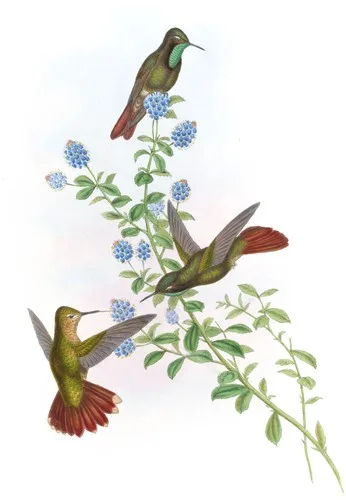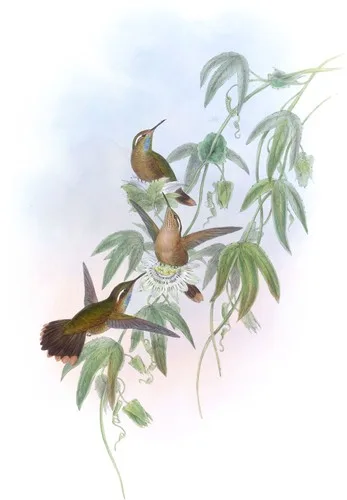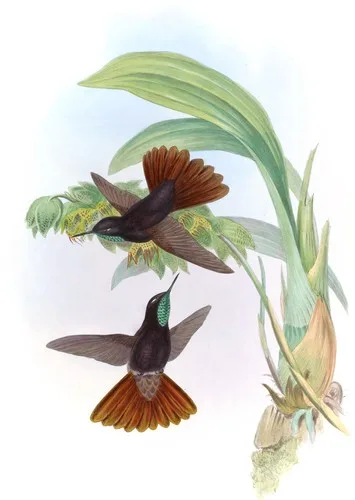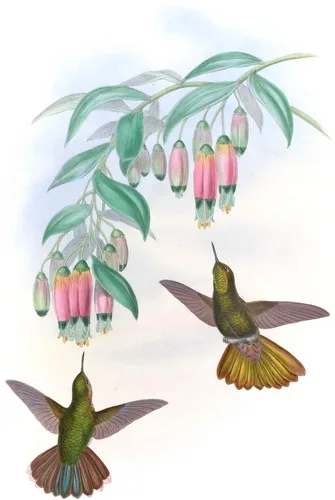
Metallura smaragdinicollis
辉尾蜂鸟属
Metallura smaragdinicollis
Violet-Tail
Ten ways of seeing
- upright 1.36 : 1
First Look
搜尽奇峰打草稿。
—— 清·石涛《苦瓜和尚画语录》
Exhaust the strange peaks, and then make the sketch.
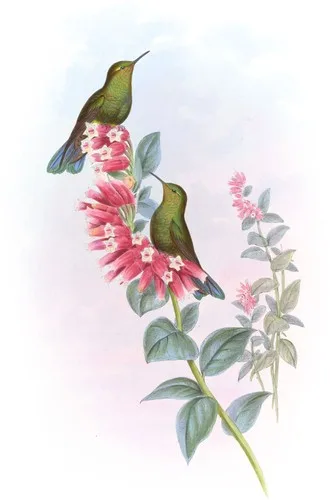
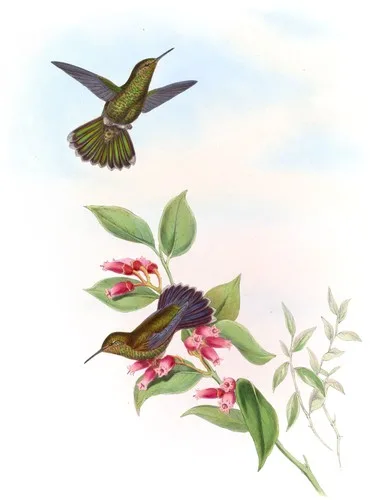
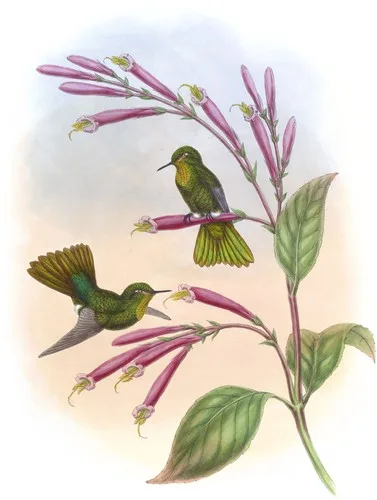
The sheet is vertical: the eye climbs and settles on the bird. Take the posture before the plumage. Then step in close: watch where colour meets line, and whether the line ever breaks. Third, find the darkest small patch: the whole tonal order is measured from there.
Name and Thing
The binomial is Metallura smaragdinicollis: the first word is the genus it belongs among, the second the epithet that sets it apart. Two words carry a whole provenance. The Chinese name 辉尾蜂鸟属 is a modern rendering of the Latin, not an old garden name.
Form and Colour
The smallest of birds: a needle-fine bill, a forked tubular tongue, wings beating so fast the bird hovers and even flies backwards. Its colour is not pigment but structure — light bent by feather barbules, changing with the angle.No colour group is recorded. A single plant, laid out with nothing hidden.
Composition
Tall and narrow, the bird perched mid-branch with generous margins above and below. No details are appended: a plate for looking, not for keying out. Blank paper is not unfinished work: it is where the eye rests.
Line and Colour
In the later nineteenth century chromolithography took over: colour printed rather than painted, line demoted. Craft leaves franker evidence than inscriptions. If you mean to copy it: block in the broad shapes and colours first, detail last; lithographic softness comes from thin washes — two or three pale layers will get you close.
Poetic Resonance
夫列子御风而行,泠然善也,旬有五日而后反。
—— 《庄子·逍遥游》
Liezi rode the wind and came back after fifteen days, so light was his going.
The poem gives the mood first and the picture supplies the form; set the line beside the plate and the bird itself becomes its resting point.
Symbolism
For the Aztecs the hummingbird was warrior and sun; for Victorian Europe it was the ultimate ornament, millions killed for breast jewellery. China has no tradition here — and that blank is itself a history of exchange. Meanings change their tune: the same flower can say opposite things within a century.
Season and Place
In tropical America they are present all year, their season set by flowers. the name arrives with late-Qing travel writing. The year 1852 on the plate is that of publication, not of flowering — the gathering came a year or two earlier. Much of what that generation knew of such birds came from specimens and cages; read locality and season both as hearsay.
The Book and the Hand
“Gould's Hummingbirds” carries only John Gould's name. A plate is collective work: drawer, engraver and colourist were different hands, and the unnamed ones decided how good it looks.
What to Take Away
Appreciation is not knowledge but habit — one more look each time. Two centuries on, the plant may still flower in some garden; the one on this sheet stopped in the season of 1852.
About this plate
Peru and Bolivia
At a first glance this species has a close resemblance to the M. tyrianthina; but on a further examination it is found to be more beautiful, and it certainly is very much more rare in the collections of Europe; the two species are in fact representatives of each other on either side of the equator, the present bird being found solely in Peru and Bolivia, while the M. tyrianthina is as exclusively an inhabitant of the high ranges north of the line.
The beautiful violaceous tail of the present spécies will at all times distinguish it from its northern representative, this feature occurs in both sexes; in other respects their colouring is very similar. The discovery of this fine bird is due to the researches of M. D’Orbigny, who has published the following short note respecting its habitat, habits, &c.:—
This species inhabits the woody and rather warm mountains of the eastern dip of the Cordilleras, from the 17th to the 18th degree of south latitude, principally in the environs of the hamlet of Cajapi, near Yanacaché, in the province of the Yungas, and in Palea, in the province d’Ayupaya in Bolivia. At no part is it common. Like most of the species inhabiting these regions, it lives more on the larve and the nymphalides of the small species of Hemiptera, than on the pollen of flowers.
The Metallura smaragdinicollis is one of the species procured by Mr. Bridges during his sojourn in Bolivia; it was also obtained by M. Warszewicz in Peru; from both these gentlemen I received examples.
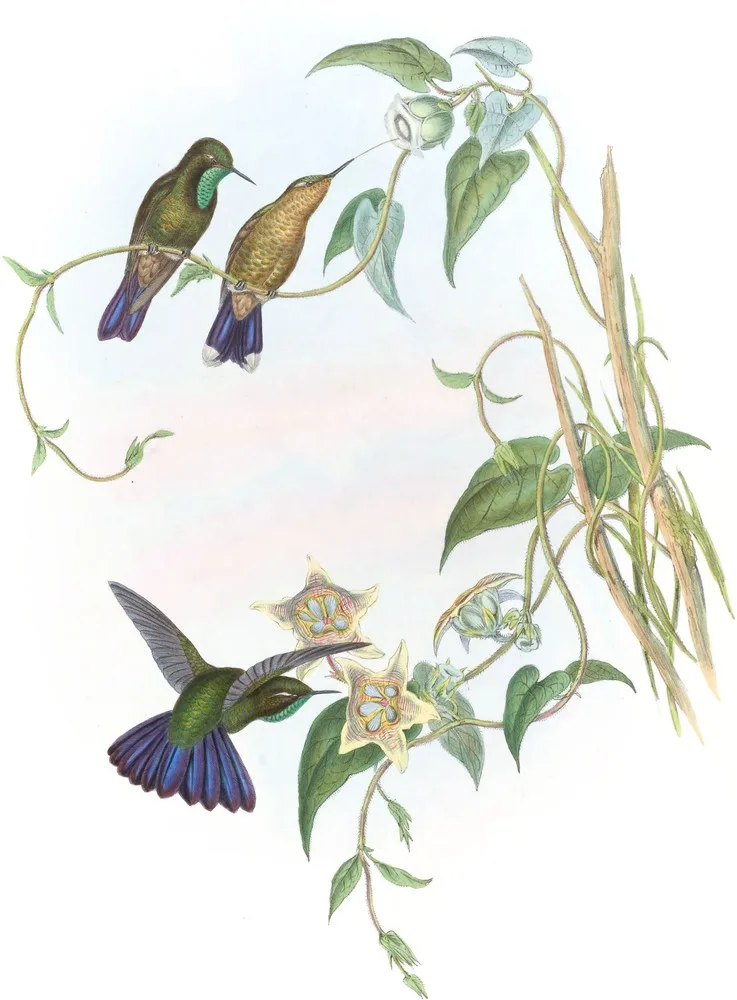
The male has the head, all the upper surface and wing-coverts dark green; behind the eye a small spot of greyish white; down the centre of the throat an oblong mark of luminous green; wings purplish brown; tail reddish violet with green reflexions above, and reddish violet beneath; under surface of the body bronzy green; bill black.
The female is golden or bronzy green above, and buff, glossed with green, beneath; wings purplish brown; tail violet-purple, the lateral feathers tipped, and the centre ones slightly fringed at the end with greyish white; a small spot of greyish white behind the eye, and no trace of the gorget.
The figures are of the natural size. The plant is the Dictyanthus Pavoni.
References
- Orthorhynchus smaragdinicollis, D’Orb. et Lafr. Syn., p. 31. No. 23.—D’Orb. Voy. dans l’Amér. Mérid., tom. iv. p. 375. atlas, Ois., pl. 59. fig. 2.
- Mellisuga smaragdinicollis, Gray and Mitch. Gen. of Birds, vol. i. p. 112, Mellisuga, sp. 42.
- Metallura smaragdinicollis, Bonap. Consp. Gen. Av., p. 75, Metallura, sp. 3.—Reich. Auf. der Col., p. 8.—Bonap. Rev. Zool. 1854, p. 253.