Metallura Williami
辉尾蜂鸟属·Metallura Williami
Metallura Williami
Purple-Tail
About this plate
Popayan
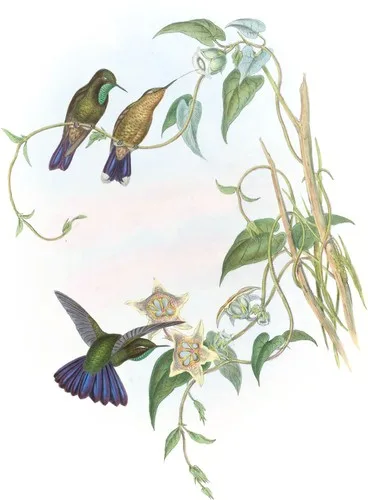
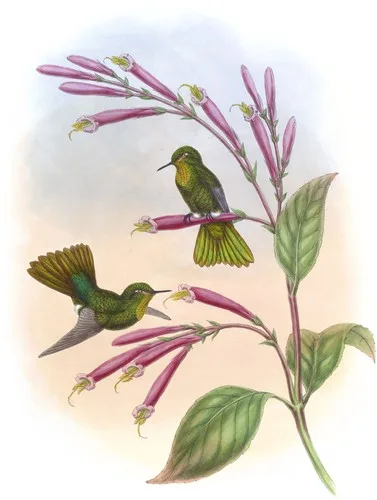
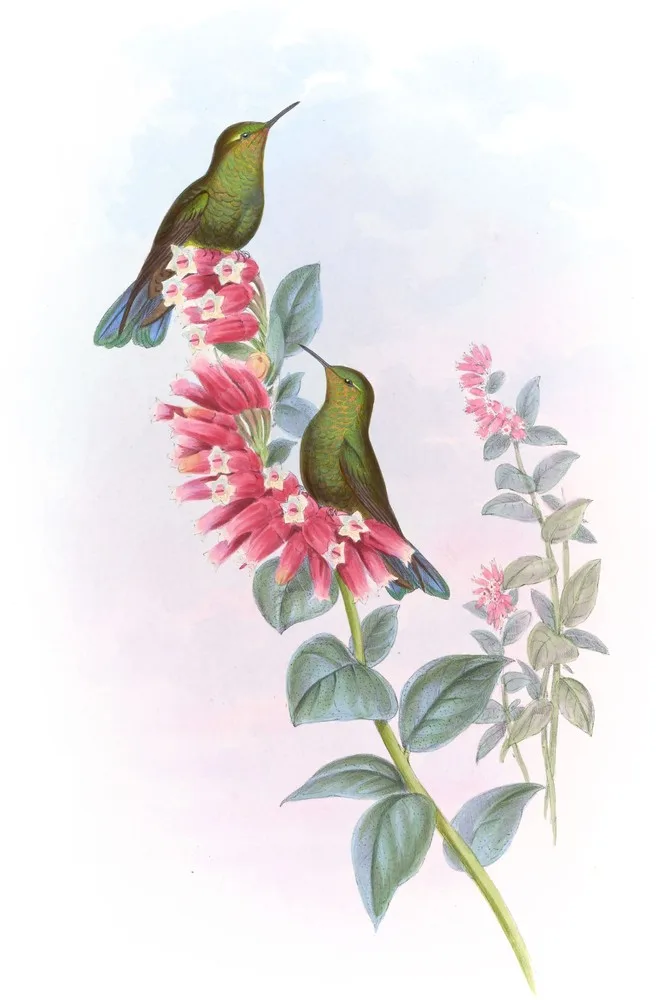
The rich and little known country of Popayan, in New Grenada, is the favourite residence or habitat of this rare species, which is in every respect a true Metallura, and which, even with the most careless glance, cannot be confounded with any one of the already known species.
In size it is intermediate between M. smaragdinicollis and M. æneicauda; but it differs from those, and every other species of the genus, in its sombre or obscure style of colouring, and particularly in the deep and peculiar violaceous blue colouring of the tail.
With regard to any difference in the plumage of the sexes, I can say but little. The specimen in my collection, which is supposed to be a female, has the entire under surface mottled with green and buff; in other respects she is similarly clothed to the male.
This species has been named in honour of Mr. William S. Wilson of Paris, brother of Dr. T. B. Wilson of Philadelphia, who has so largely enriched the fine collection of natural history in the Academy of Sciences of that city.
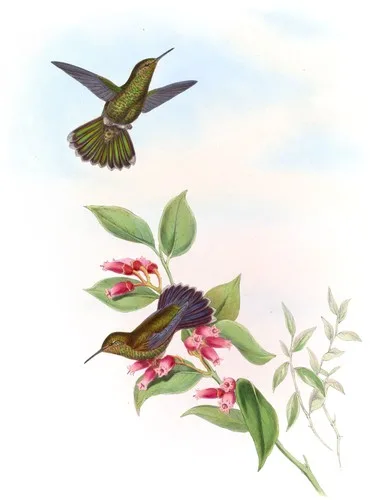
The male has the head and the whole of the upper and under surface and wing-coverts deep green, a very small spot of greyish white behind the eye; on the throat the green is lighter and brilliant; tail sordid purplish green above, beneath deep violet; bill black.
The female is very similar, but has no trace of the bright green on the throat. The description of this sex is necessarily imperfect, as I have only an indifferent specimen to describe from.
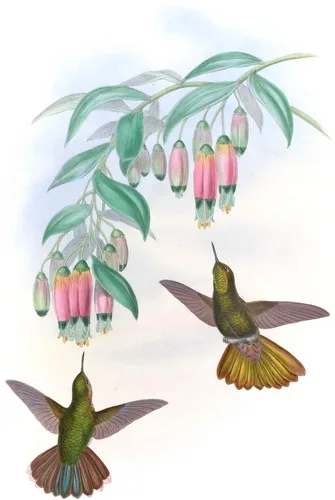
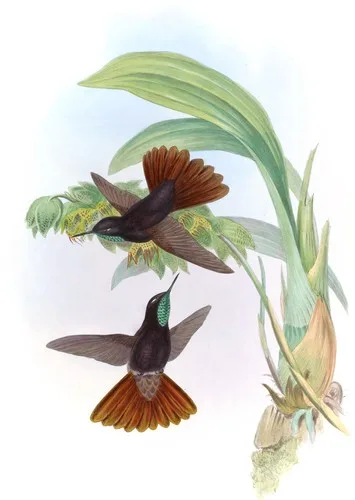
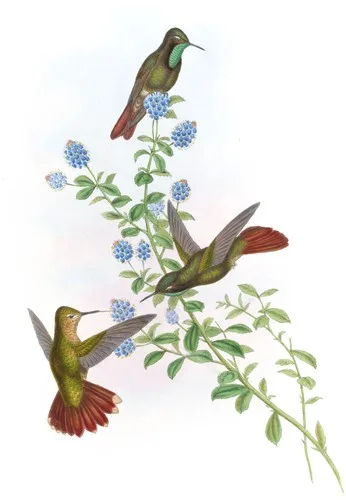
The figures are of the natural size. The plant is the Macleania punctata.
References
- Trochilus Williami, Bourc. et De Latt. Rev. Zool. 1846, p. 308.
- Mellisuga Williami, Gray and Mitch. Gen. of Birds, vol. i. p. 112, Mellisuga, sp. 38.
- Metallura William, Bonap. Consp. Gen. Av., p. 75, Metallura, sp. 5.—Reich. Auf. der Col., p. 8.
- Metallura william, Bonap. Rev. Zool. 1854, p. 253.
Twelve ways of seeing
- upright 1.52 : 1
- published 1852
- Pl. 193, Vol. III
Not a catalogue entry but a way of looking: how to stand, what to notice, how the line was cut, when it flowers, where it came from, who made it — and then the poems and the classics that taught China to see the same flower. Read the twelve in order and the plate opens.
-
First Look
真山水之川谷,远望之以取其势,近看之以取其质。
—— 宋·郭熙《林泉高致·山水训》
Mountains and valleys: from afar take their momentum, up close take their texture — the two distances from which any picture is read.
The sheet is vertical: the eye climbs and settles on the bird. Take the posture before the plumage. Then step in close: watch where colour meets line, and whether the line ever breaks. Third, find the darkest small patch: the whole tonal order is measured from there.
-
Name and Thing
The binomial is Metallura williami: the first word is the genus it belongs among, the second the epithet that sets it apart. Two words carry a whole provenance. No established Chinese name exists, so it is cited by its binomial alone.
-
Form and Colour
The smallest of birds: a needle-fine bill, a forked tubular tongue, wings beating so fast the bird hovers and even flies backwards. Its colour is not pigment but structure — light bent by feather barbules, changing with the angle.No colour group is recorded. Read the outline, then the colour layers, then the brush.
-
Composition
Tall and narrow, the bird perched mid-branch with generous margins above and below. (about 1.52 : 1) No details are appended: a plate for looking, not for keying out. Old plates set the plant slightly off centre, with unequal margins — that small imbalance is what keeps it alive.
-
Line and Colour
In the later nineteenth century chromolithography took over: colour printed rather than painted, line demoted. Take a loupe to three places: petal edge, leaf vein, caption. An unbroken line means engraving; colour crossing the outline means a hand.
-
Season
In tropical America they are present all year, their season set by flowers; temperate hummingbirds follow the bloom north and back, thousands of kilometres a year. The year 1852 on the plate is that of publication, not of flowering — the gathering came a year or two earlier. Note the season. Phenology is the most practical tool of appreciation.
-
Provenance
Americas only, from southern Alaska to Tierra del Fuego, richest in the Andes. China has no hummingbirds and no classical record of them; the name arrives with late-Qing travel writing. In the same volume the kin are shelved together; set several plates side by side.
-
The Book and the Hand
“Gould's Hummingbirds” was drawn by John Gould and published 1849-1887. This plate is Pl. 193, Vol. III, book page 193. The image is public domain; the hand-colouring is still one person's hand.
-
Poetic Resonance
夫列子御风而行,泠然善也,旬有五日而后反。
—— 《庄子·逍遥游》
Liezi rode the wind and came back after fifteen days, so light was his going.
The poem gives the mood first and the picture supplies the form; set the line beside the plate and the bird itself becomes its resting point.
-
The Written Tradition
竖划三寸,当千仞之高;横墨数尺,体百里之迥。
—— 南朝宋·宗炳《画山水序》
A vertical stroke of three inches stands for a cliff of a thousand fathoms; a few feet of ink holds a hundred li. Smallness of scale was never the obstacle.
Gould's Hummingbirds (1849–1887) used hand-coloured lithography over gold leaf so the iridescence survived on paper — a monument to Victorian printing and collecting alike. You need not parse every word: take the line, and the flower acquires a second face.
-
Symbolism
For the Aztecs the hummingbird was warrior and sun; for Victorian Europe it was the ultimate ornament, millions killed for breast jewellery. China has no tradition here — and that blank is itself a history of exchange. In a flora it is a species first and a symbol second; the order is worth keeping.
-
What to Take Away
Next time you watch a bird: posture first, then where the plumage is deepest, and only then the field guide. A flora exists to be consulted; look long enough and you forget to consult — someone in 1852 gave a whole day to a single flower.