Orthorhynchus christatus
Orthorhynchus christatus
Blue-Crest
- 学名
- Orthorhynchus christatus
- 合集
- 古尔德蜂鸟图谱
- 绘者
- John Gould(约翰·古尔德)
- 年代
- 1854
- 图版号
- Pl. 205, Vol. IV
- 原书页码
- p.205
- 授权
- CC0 1.0 Universal (Public domain)
十观
- 纵幅 1.57∶1
第一眼
凡画山水,意在笔先。
—— 唐·王维《山水论》
下笔之前,心里已经有了整幅画。看画时可以反过来推:画家先定了什么,后添了什么。这一幅是竖的:眼睛从下往上走,落点在中段那只鸟身上。先别急着看羽毛,让姿态先立起来。第二步凑近一寸:看线与色的交界,色有没有压住线,线有没有断。第三步,把视线放到最深的那一小块:整幅的用色秩序,都是从那里排开的。
名与实
学名 Orthorhynchus christatus:前一词是属,管它归在哪一类;后一词是种加词,管它在这一类里凭什么与众不同。双名制的好处是唯一:全世界叫这个名字的,只能是这一种。此幅尚无通行中文名,姑以学名相称;在没有本地名字的地方,学名就是它唯一的身份证。
形与色
蜂鸟为美洲最小之鸟,喙细长如针,舌分叉成管,可伸入花心吸蜜;翼小而振频极高,能悬停、能倒飞。此幅未作色相归档,只能就形制论。看形制不必求全:记住喙形、翼式与栖姿,这一类的骨架就立住了。
构图与呼吸
画幅高而窄,鸟栖在枝的中段,上下留白多——十九世纪鸟谱的标准版式,留给它飞走的余地。全幅只画一只,不作解剖附图——这类图更近于“观赏”,而非“鉴定”。老图谱爱把主株摆在偏中线的位置,左右留得不一样多:这一点偏心,正是画面活起来的原因。
一刀一色
十九世纪后半叶,石版与彩色石印渐成主流:颜色可以直接印出,不再依赖手工,线条反倒退居其次。图像的“准确”提高了,手性却淡了。先判断它是“印”的还是“画”的,再谈好不好看——这是看老版画最实用的一条规矩。想动笔临它的人记住一句:先铺大块的形与色,干后再收细部;石印的柔和层次来自薄涂与网点,水彩分两三遍淡铺即可逼近。
诗境
夫列子御风而行,泠然善也,旬有五日而后反。
—— 《庄子·逍遥游》
蜂鸟悬停于空,不落不飞,最近于“御风”。庄子说的是一种自由的姿态,蜂鸟把它做成了生理事实。古人写到这一层,已不只是赏花,是借花说人;画面则只负责把那朵花留住。
花语
阿兹特克以蜂鸟为战神与太阳的化身;欧洲维多利亚时代则以蜂鸟为收藏与装饰的极致,百万只羽毛被做成胸饰。中国旧籍无此鸟,故无象征——这空白本身,就是一部博物学交流史。象征多半来自形状与气味:像杯的、像泪的、香的、臭的——先有形状,后有意义。
时与地
温带种类的蜂鸟则随花北迁,一年往返数千公里。仅产美洲,自阿拉斯加南部至火地岛,以安第斯山最为繁盛。中土无蜂鸟,汉籍不载,晚清海外游记始见其名。图上所记的 1854 年是刊行之年,不是采到那只鸟的年份;真正的观察记录通常比出版早一两年。那一代人对这类鸟的知识,多半来自标本与笼养。看这一类图,不妨把产地和季节都当“据说”来读。
书与人
《古尔德蜂鸟图谱》只署了约翰·古尔德一个人的名字。从画稿到成图要过好几双手:转刻的人求准,上色的人求快——快与准之间,就是各幅之间深浅不一的来历。
带走一双眼睛
鉴赏力不是知识,是习惯:每次多看一眼,十年之后你看什么都和别人不一样。1854 年的那只鸟早已化作尘土,它留在纸上的样子,却比任何一只活着的同类都长寿。
关于本图版
本图选自约翰·古尔德的《古尔德蜂鸟图谱》(Gould's Hummingbirds),原书 1849—1887 年间出版。画面主体为 Orthorhynchus christatus,在分类体系中列于蜂鸟科(Trochilidae)。
该合集全编共 421 幅图版,此图为其中之一,图版编号 Pl. 205, Vol. IV,对应原书第 205 页,版式为纵幅。扫描件取自公有领域原件,经高分辨率修复与色彩校正,可按原大放大查看线条与设色。
原书文字(英文 / 法文)
Barbadoes, and St. Vincent
It will have been noticed, while perusing the pages of the present work, that many species of Hummingbirds are confined to very small areas of country, some to the cones of lofty mountains, and some to the craters of extinct volcanos, while others are migratory, and extend their range over vast regions.
A similar law appears to govern some at least of the species inhabiting the West Indian Islands: for instance, two species are found in Jamaica, which up to the present time have not been detected in St. Domingo; on the other hand, of the St. Domingo species two at least are not found in Jamaica: and not only does this law appear to prevail on those two islands alone, the largest of the West Indian group, but to extend to the smaller islands also, most of them being inhabited by a species peculiarly its own; hence it becomes a matter of much interest to ascertain to which of the islands the numerous species of the West Indian Humming-birds really belong. I am aware that in making the above remarks I am digressing from the more immediate subject of the present paper—the history of Orthorhynchus cristatus; but I have done so intentionally, in order to point out the utter confusion which exists with regard to the localities given by the older authors, whose errors, I regret to say, have been perpetuated by most of the more recent writers on the Trochilidæ; thus, one and all of them give St. Domingo as the habitat of the present bird, while, so far as I have been able to ascertain, it is not found within hundreds of miles of that island; and, although I am unable to give the extent of its range, or how many of the islands it frequents, I can positively state that it is a native of Barbadoes, and I believe of St. Vincent’s also. In Martinique its place appears to be occupied by a nearly allied species—the Orthorhynchus exilis. A complete survey of the Windward and Leeward Islands, furnishing an account of the fauna of each, by some competent person, would, in a scientific point of view, be attended with the most interesting results; and I trust the time is not far distant when such a task will be undertaken and accomplished. Up to the present time, numerous examples of this bird, its nest and eggs, have been sent to Europe, but hitherto not one word has been recorded respecting its peculiar actions and habits; an account of which would doubtless prove highly interesting, as they probably differ as much from those of the members of the group as the bird does in its form and colouring.
As is very commonly the case among the Trochilide, the sexes present a marked difference in appearance, the beautiful crest which adorns the male being entirely wanting in the opposite sex.
Sir Robert Schomburgk found this bird in Barbadoes, and specimens collected by him are contained in the Collection at the British Museum. As will be seen on reference to his “History of Barbadoes,” it is the only Humming-bird observed by him in that island.
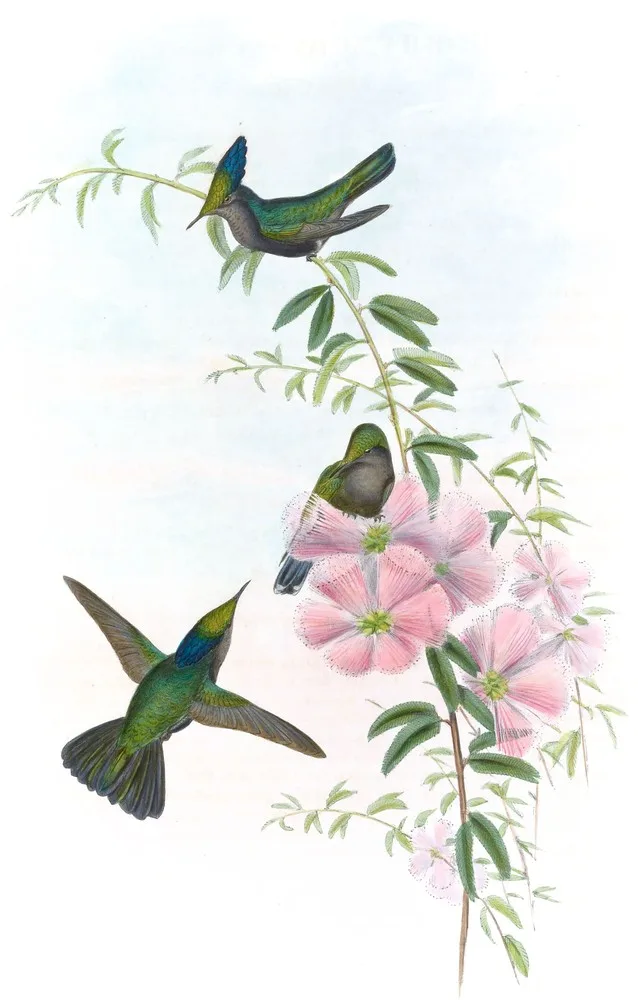
The male has the forehead and crown rich golden-green, blending into the rich deep blue of the elongated crest-feathers; sides and back of the head, upper surface of the body, wing- and tail-coverts dark grassgreen; wings purplish-brown; two centre tail-feathers dark purplish-green, the remainder purplish-black; under surface dull black, with a wash of grey on the throat; bill and feet blackish-brown.
The female has the head, all the upper surface, wing- and tail-coverts bronzy-green; wings purplishbrown; central tail-feathers dark bronzy-green, the remainder purplish-black, the two outer on each side slightly tipped with grey; under surface dark smoky-grey, somewhat lighter on the throat.
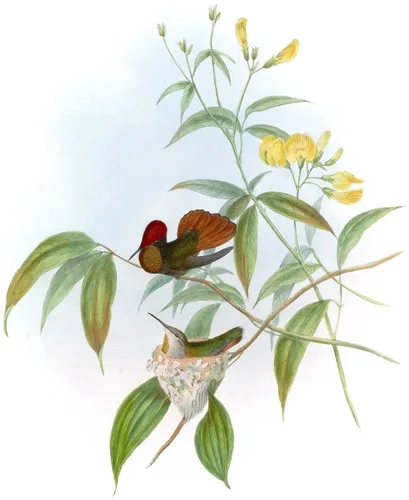
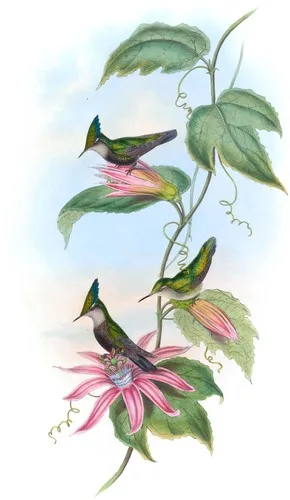
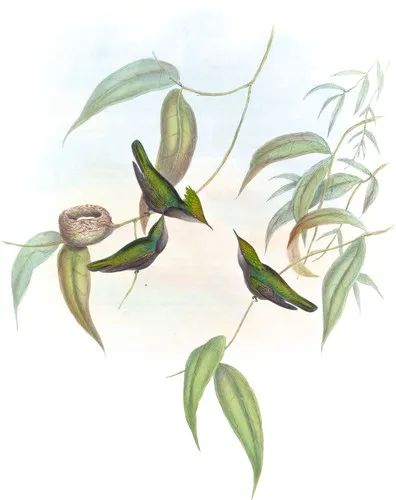
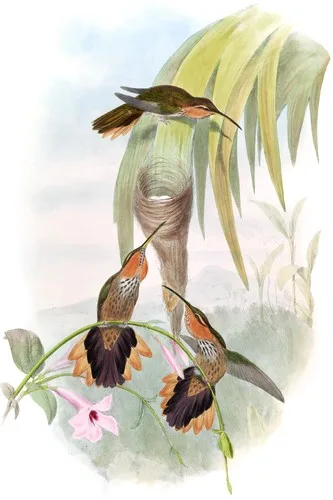
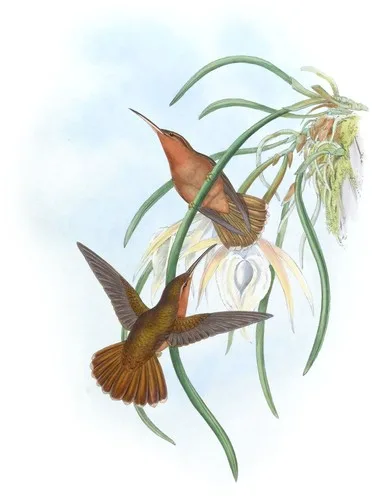
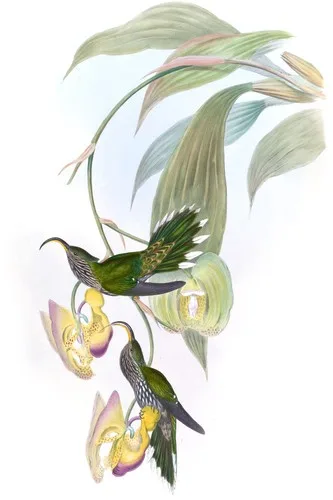
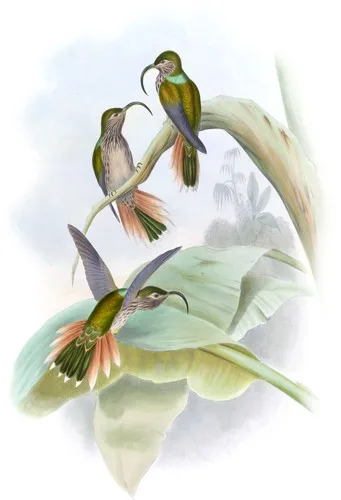
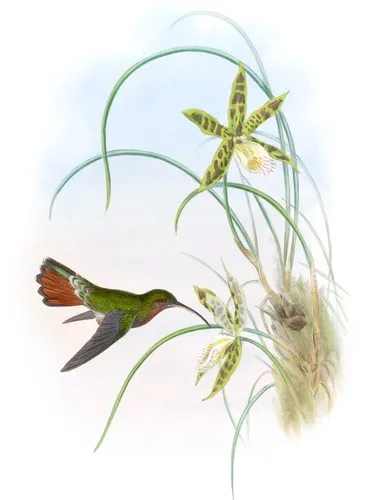
The accompanying Plate represents two males and a female, of the size of life. The plant is the Calliandra brevipes.
References
- Trochilus cristatus, Linn. Syst. Nat., tom. i. p. 192.—Ib. Gmel. Edit., tom. i. p. 498.—Lath. Ind. Orn., tom. i. p. 317.—Swains. Birds of Brazil, pl. 21.—Vieill. Ency. Méth. Orn., part 2. p. 565. pl. 131. fig. 3.—Schomb. Hist. of Barbadoes, p. 681.
- Mellisuga cristata, Briss. Orn., tom. iii. p. 714. pl. xxxvii. fig. 2.—Id. 8vo, tom. ii. p. 35.—Gray and Mitch. Gen. of Birds, vol. i. p. 1138, Mellisuga, sp. 98.
- L’Oiseau-mouche huppé, Buff. Hist. Nat. des Ois., tom. vi. p. 22.—Ib. Sonn. Edit., tom. xvii. p. 173.
- L'Oiseau-mouche huppé de Cayenne, Buff. Pl. Enl. 227. fig. 1.
- Crested Humming-bird, Edw. Nat. Hist. of Birds, vol. i. p. 37. pl. 37.
- Crested Green Humming-bird, Lath. Gen. Syn., vol. ti. p. 783.—Shaw, Gen. Zool., vol. viii. p. 352. pl. 44.—Lath. Gen. Hist., vol. iv. p. 339.
- Orthorhynchus cristatus, Bonap. Consp. Gen. Av., p. 83, Orthorhynchus, sp. 1—Reichenb. Aufz. der Colibris, p. 11.—Bonap. Rev. et Mag. de Zool. 1854, p. 256.
- Ornismya cristata, Less. Les Troch., p. 20. pl. 4.—Ib. Traité d’Orn., p. 285.—Ib. Ind. Gen. et Syn. des Ois. du Gen. Trochilus, p. xxx.
- Trochilus pileatus, Lath. Ind. Orn., vol. i. p. 318.
- Trochilus puniceus, Gmel. Edit. Linn. Syst. Nat., tom. i. p. 497.
- L’Oiseau-mouche à huppé bleue, Aud. et Vieill. Ois. dor., tom. i. p. 112. pl. 63.
- Crested Brown Humming-bird, Lath. Gen. Syn., vol. u. p. 784.—Shaw, Gen. Zool., vol. viii. p. 354.—Lath. Gen. Hist., vol. iv. p. 340.