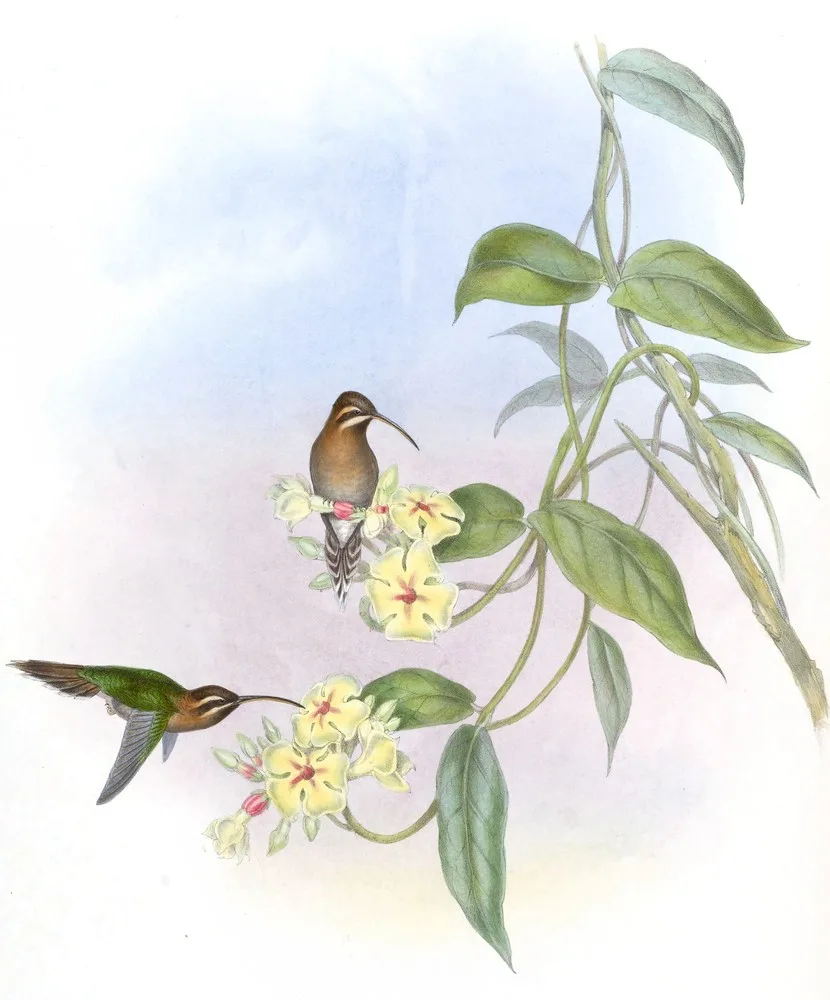
Phaëthornis obscura
Phaëthornis obscura
Obscure Hermit
Ten ways of seeing
- slightly upright 1.20 : 1
First Look
夫象物必在于形似,形似须全其骨气。
—— 唐·张彦远《历代名画记》
Likeness is the threshold; bone-and-breath is the point.
Slightly taller than wide; the eye lands on the bird's head, a little above centre. Then step in close: watch where colour meets line, and whether the line ever breaks. Third, find the darkest small patch: the whole tonal order is measured from there.
Name and Thing
No reliable binomial survives, so the printed title must serve. Neither name nor binomial survives: the printed title must do.
Form and Colour
The smallest of birds: a needle-fine bill, a forked tubular tongue, wings beating so fast the bird hovers and even flies backwards. Its colour is not pigment but structure — light bent by feather barbules, changing with the angle.No colour group is recorded. A single plant, laid out with nothing hidden.
Composition
Slightly taller than wide, the bird set a little above centre, the eye landing at head and bill. No details are appended: a plate for looking, not for keying out. Blank paper is not unfinished work: it is where the eye rests.
Line and Colour
The first half of the nineteenth century moved from copper to steel to lithography; stipple could render the softest transition. Take a loupe to three places: petal edge, leaf vein, caption. An unbroken line means engraving; colour crossing the outline means a hand. If you mean to copy it: take its skeleton, its margins and the order of its colours; the burin's hatching is the language of copper — suggest it with pencil density, do not imitate it stroke for stroke.
Poetic Resonance
穿花蛱蝶深深见,点水蜻蜓款款飞。
—— 唐·杜甫《曲江二首》
Butterflies thread the flowers, seen deep within; dragonflies touch the water and fly on, slow and deliberate.
The poem gives the mood first and the picture supplies the form; set the line beside the plate and the bird itself becomes its resting point.
Symbolism
For the Aztecs the hummingbird was warrior and sun; for Victorian Europe it was the ultimate ornament, millions killed for breast jewellery. China has no tradition here — and that blank is itself a history of exchange. Meanings change their tune: the same flower can say opposite things within a century.
Season and Place
temperate hummingbirds follow the bloom north and back, thousands of kilometres a year. the name arrives with late-Qing travel writing. The year 1849 on the plate is that of publication, not of flowering — the gathering came a year or two earlier. Read the locality and the flowering season both with a discount: one is hearsay, the other a ten-day peak.
The Book and the Hand
“Gould's Hummingbirds” carries only John Gould's name. The image is public domain; the hand-colouring is still one person's hand.
What to Take Away
Next time you watch a bird: posture first, then where the plumage is deepest, and only then the field guide. A flora exists to be consulted; look long enough and you forget to consult — someone in 1849 gave a whole day to a single flower.
About this plate
Brazil
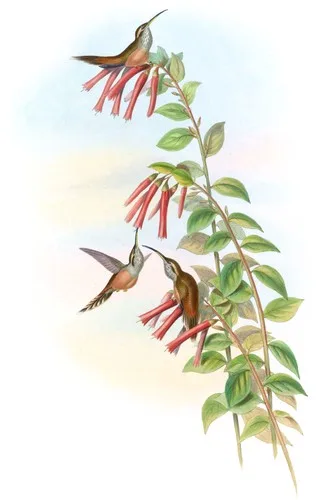
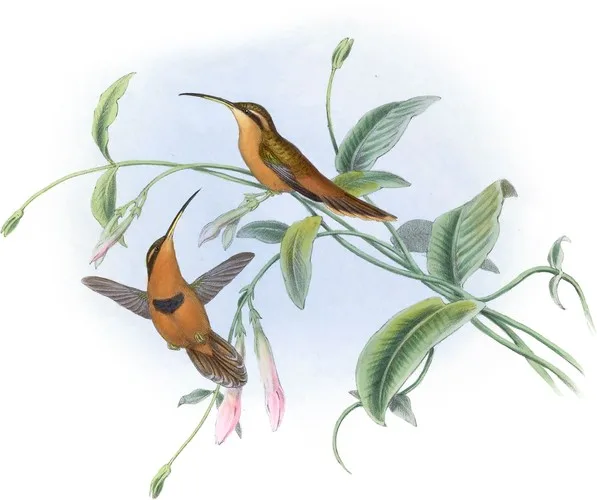
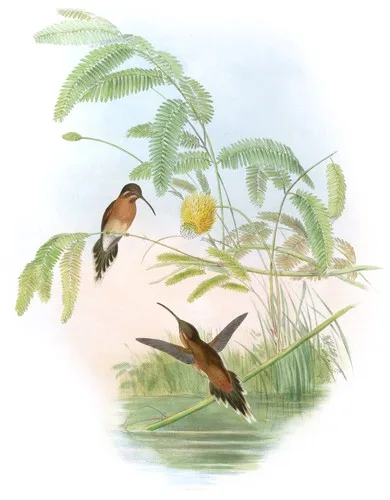
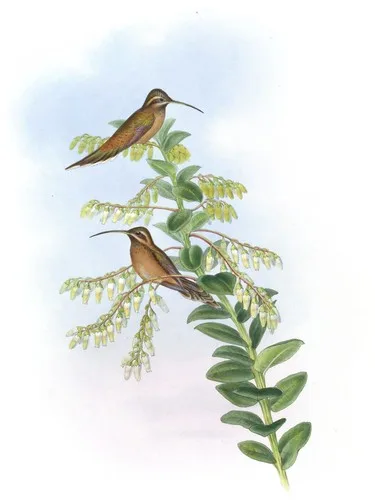
It can scarcely be supposed but that the great country of Brazil will, from time to time, present us with new species of this group of birds; the great and almost interminable forests, particularly those toward the western frontier, having been but partially traversed, and by no means closely investigated. By the way of Rio de Janeiro, several examples of this new Phaëthornis have reached Europe, and at this moment four specimens are before me, two of which belong to my own collection, the other two to that of M. Bourcier of Paris, by whom they have been kindly lent to me for the purposes of the present work: the whole of them were collected in the interior of Brazil.
The Phaëthornis obscura differs from all its congeners in its dark, clouded style of colouring, and in the absence of buff on the rump. It belongs to that division of the Hermits to which the name of Pygmornis has been given, and which, although I have not adopted this generic appellation, appears to me to constitute a very natural section of the group. If we may judge from what we know of some other members of the genus, the males of this species will have shorter and more rounded tails than the females; but this must be verified by actual dissection before it can be positively affirmed.
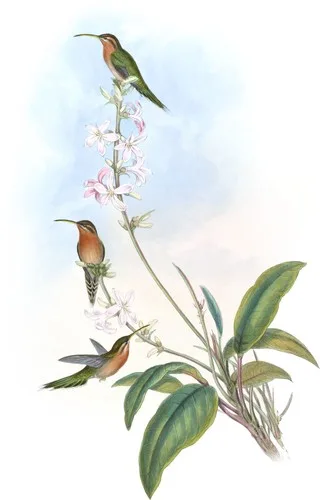
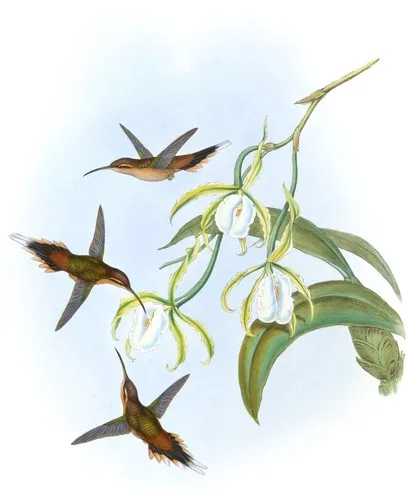
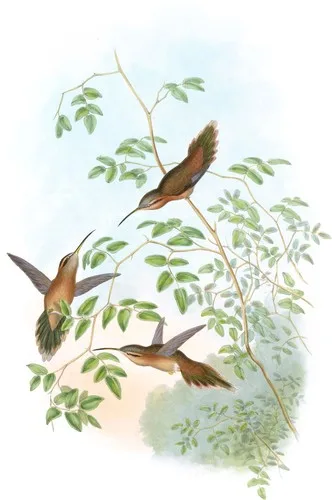
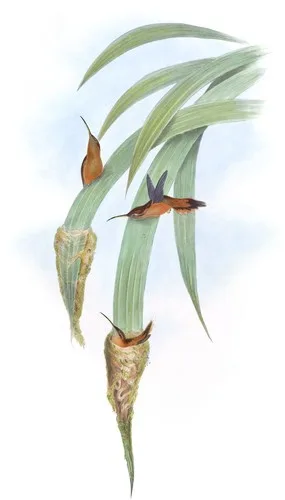
Head, upper surface and wing-coverts dark bronzy green; stripe behind the eye buff; wings purplish brown; tail dark bronzy brown, each feather narrowly margined externally and slightly tipped with white; throat smoky black, between which and the eye is a stripe of light buff; chest clouded chestnut or coffeecolour, passing into dark grey on the abdomen, and fading into white on the vent; under tail-coverts greyish white; upper mandible and tip of the lower black; basal three-fourths of the latter yellow.
The figures are of the natural size. The plant is the Echites Franciscea.
References
- Phaëthorms obscura, Gould in Proc. of Zool. Soc., part xxv. p. 14.