Phaëthornis Longuemareus
Phaëthornis Longuemareus
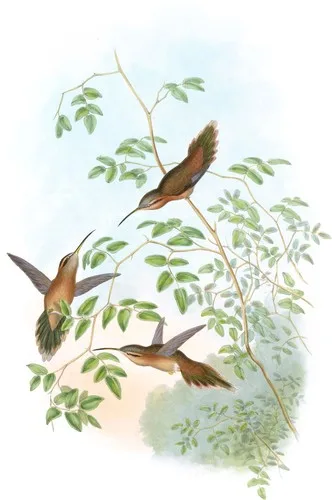
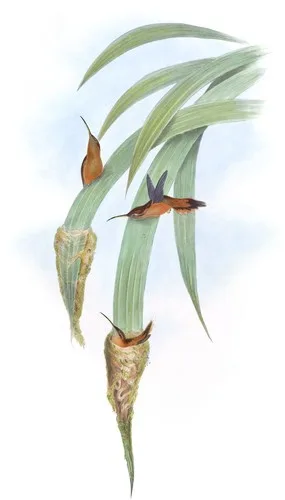
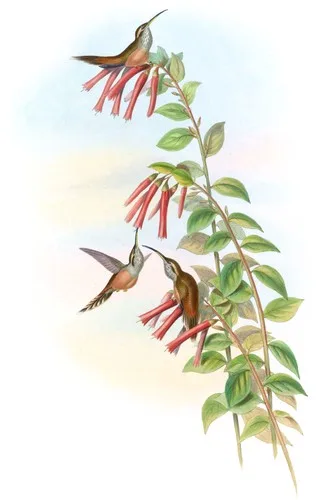
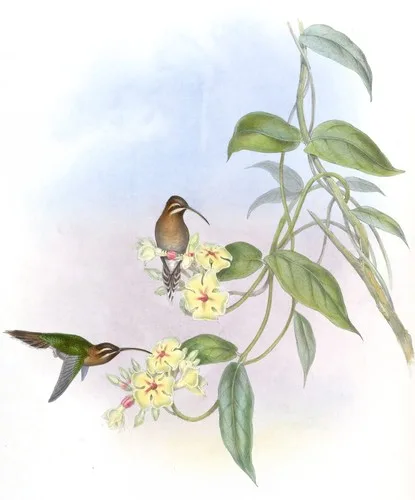
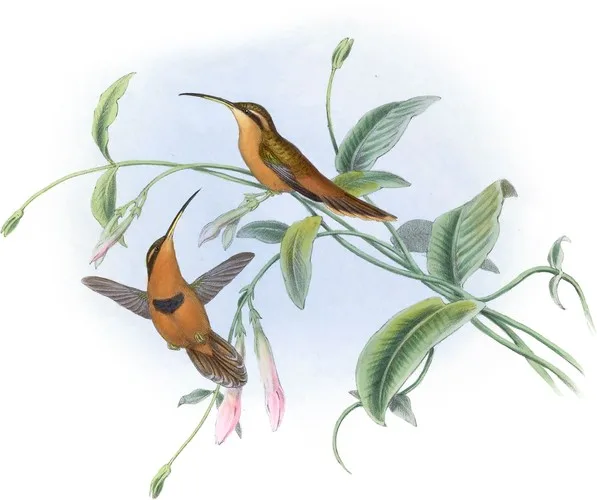
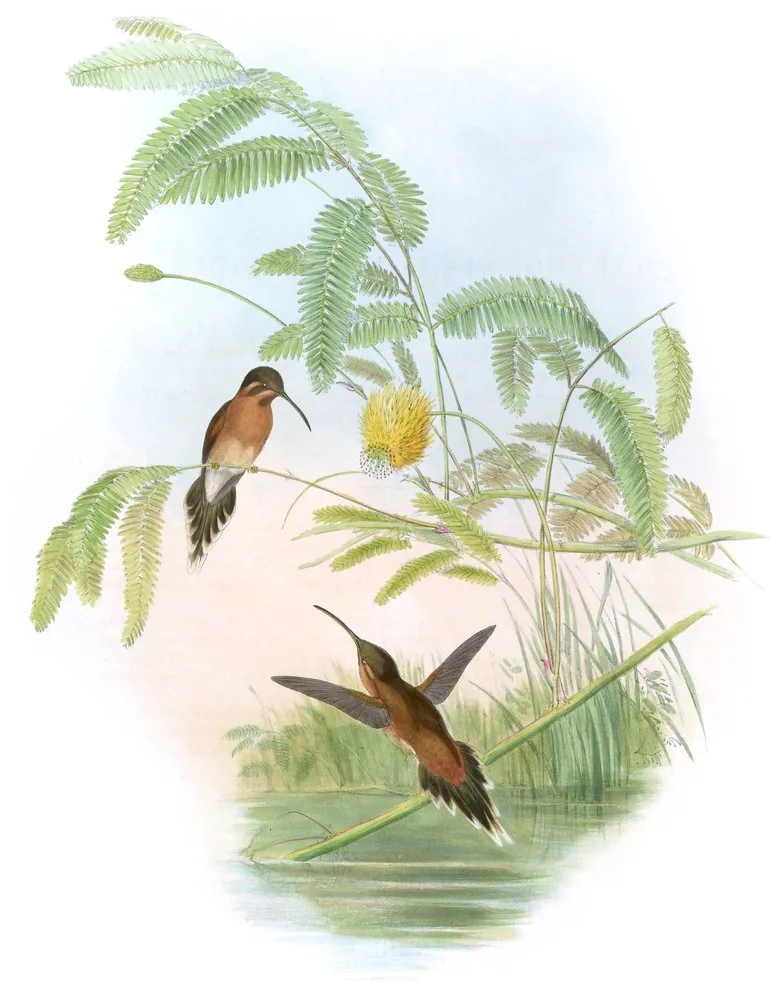
Longuemare’s Hermit
About this plate
Cayenne, Guiana, Trinidad, and the eastern part of Venezuela.
It is believed by M. Bourcier and other continental ornithologists that the Phaëthorms Longuemareus and P. intermedius of Lesson are one and the same species; nevertheless, without doubting such good authorities, I have figured a well-known, but very different Brazilian bird under the latter title, and reserved the former for the present species; which course I know to be correct, as I possess the identical specimen from which Lesson’s figure and description were taken.
So regularly and so gradually do the species of the genus Phaëthornis advance both in size and colouring from the smallest to the largest, that it would be difficult to say to which genus of the group, as subdivided by Prince Charles L. Bonaparte, this bird should be assigned: if these subdivisions be generally adopted, it may remain where the Prince has placed it, with the Pygmornes, in which case it will be the largest species of that genus.
If any one member of the Phaëthornes be more commonly sent to Europe than another, it is the bird here represented, which is a native of Guiana, Cayenne and Trinidad. Mr. William Tucker informs me that in the latter country it frequents shady places among the high woods; and he adds that the sexes are alike in colouring.
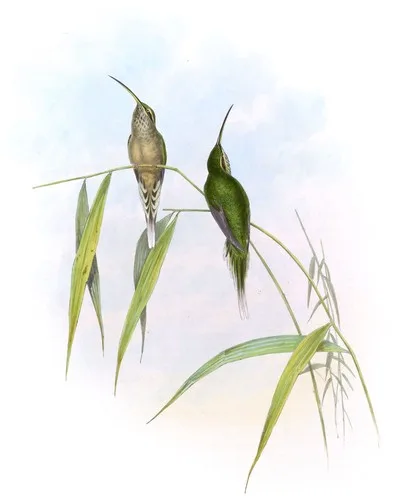
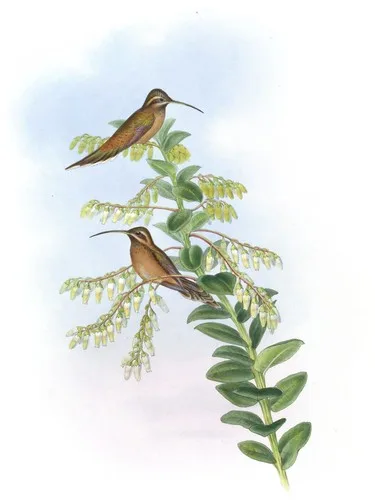
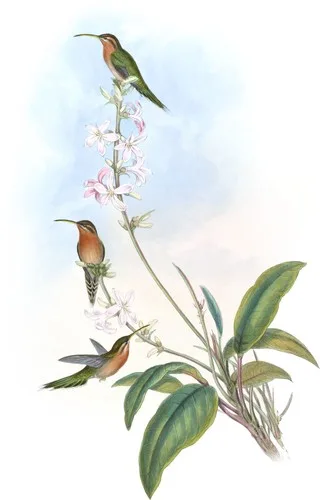
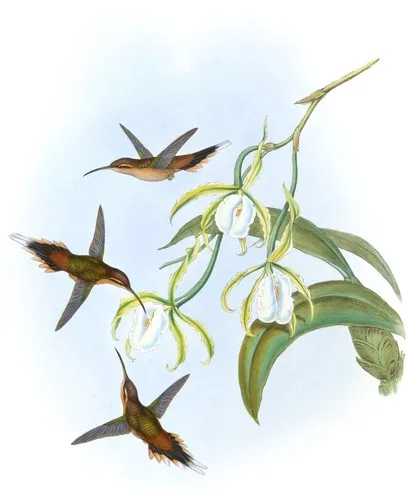
Crown of the head greyish-brown; ear-coverts and chin dull black; all the upper surface, wing- and tailcoverts bronzy-brown; wings purplish-brown; under surface, superciliary mark, and stripe from the angle of the mouth buff; under tail-coverts grey; tail bronzy-green at the base, succeeded by bronzy blackishbrown, which gradually fades into grey near the tip of the two central feathers;; all the feathers tipped with white; the tips of the lateral ones tinged with buff; upper mandible black; basal two-thirds of the under mandible yellow, the tip black; feet pure yellow.
The Plate represents the birds of the natural size. The plant is the Neptunia plena.
References
- Trochilus Longuemareus, Less. Les Troch., pp. 15, 160. pls. 2, 62.—Ib. Ind. Gen. et Syn. des Ois. du gen. Trochilus, p. xv.
- Phætorms Longuemareus, Gray and Mitch. Gen. of Birds, vol. i. p. 104, Phætornis, sp. 11.
- Phaëtorms longuemareus, Bonap. Consp. Gen. Av., p. 67, Phaëtornis, sp. 10.
- Phaëthornis Longuemari, Reich. Aufz. der Col., p. 14.
Twelve ways of seeing
- slightly upright 1.28 : 1
- published 1849
- Pl. 31, Vol. I
Not a catalogue entry but a way of looking: how to stand, what to notice, how the line was cut, when it flowers, where it came from, who made it — and then the poems and the classics that taught China to see the same flower. Read the twelve in order and the plate opens.
-
First Look
搜尽奇峰打草稿。
—— 清·石涛《苦瓜和尚画语录》
Exhaust the strange peaks, and then make the sketch.
Slightly taller than wide; the eye lands on the bird's head, a little above centre. Then step in close: watch where colour meets line, and whether the line ever breaks. Third, find the darkest small patch: the whole tonal order is measured from there.
-
Name and Thing
No reliable binomial survives, so the printed title must serve. Neither name nor binomial survives: the printed title must do.
-
Form and Colour
The smallest of birds: a needle-fine bill, a forked tubular tongue, wings beating so fast the bird hovers and even flies backwards. Its colour is not pigment but structure — light bent by feather barbules, changing with the angle.No colour group is recorded. Three things fix the habit: leaf arrangement, tepal count, and how the flower is borne.
-
Composition
Slightly taller than wide, the bird set a little above centre, the eye landing at head and bill. (about 1.28 : 1) No details are appended: a plate for looking, not for keying out. Cover the margins with your thumb and the plate suffocates; uncover them and the flower breathes again.
-
Line and Colour
The first half of the nineteenth century moved from copper to steel to lithography; stipple could render the softest transition. Take a loupe to three places: petal edge, leaf vein, caption. An unbroken line means engraving; colour crossing the outline means a hand.
-
Season
In tropical America they are present all year, their season set by flowers; temperate hummingbirds follow the bloom north and back, thousands of kilometres a year. The year 1849 on the plate is that of publication, not of flowering — the gathering came a year or two earlier. Note the season. Phenology is the most practical tool of appreciation.
-
Provenance
Americas only, from southern Alaska to Tierra del Fuego, richest in the Andes. China has no hummingbirds and no classical record of them; the name arrives with late-Qing travel writing. In the same volume the kin are shelved together; set several plates side by side.
-
The Book and the Hand
“Gould's Hummingbirds” was drawn by John Gould and published 1849-1887. This plate is Pl. 31, Vol. I, book page 31. The image is public domain; the hand-colouring is still one person's hand.
-
Poetic Resonance
穿花蛱蝶深深见,点水蜻蜓款款飞。
—— 唐·杜甫《曲江二首》
Butterflies thread the flowers, seen deep within; dragonflies touch the water and fly on, slow and deliberate.
The poem gives the mood first and the picture supplies the form; set the line beside the plate and the bird itself becomes its resting point.
-
The Written Tradition
人无癖不可与交,以其无深情也。
—— 明·张岱《陶庵梦忆》
Never make a friend of a man without an obsession: he has no deep feeling.
Gould's Hummingbirds (1849–1887) used hand-coloured lithography over gold leaf so the iridescence survived on paper — a monument to Victorian printing and collecting alike. The difference is not of quality but of question: Europe asks what it is, China asks whom it resembles.
-
Symbolism
For the Aztecs the hummingbird was warrior and sun; for Victorian Europe it was the ultimate ornament, millions killed for breast jewellery. China has no tradition here — and that blank is itself a history of exchange. Meanings change their tune: the same flower can say opposite things within a century.
-
What to Take Away
Appreciation is not knowledge but habit — one more look each time. The flower of that year is dust, yet its image on paper has outlived every living cousin.