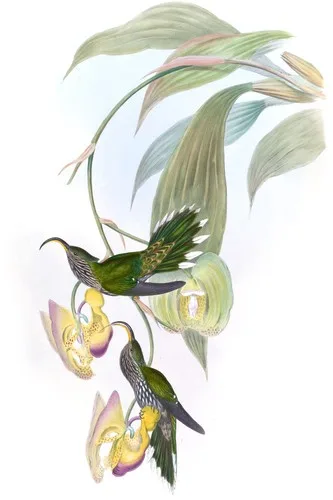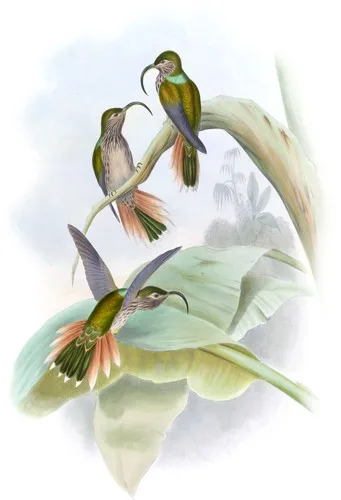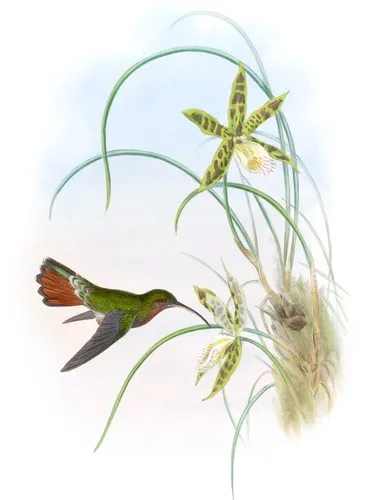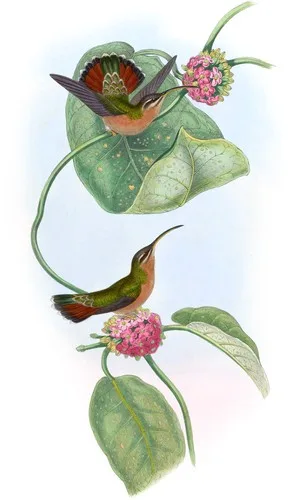
Pinarolæma buckleyi
Pinarolæma buckleyi
Buckley’s Mountain Humming-bird
Ten ways of seeing
- upright 1.31 : 1
First Look
真山水之川谷,远望之以取其势,近看之以取其质。
—— 宋·郭熙《林泉高致·山水训》
Mountains and valleys: from afar take their momentum, up close take their texture — the two distances from which any picture is read.
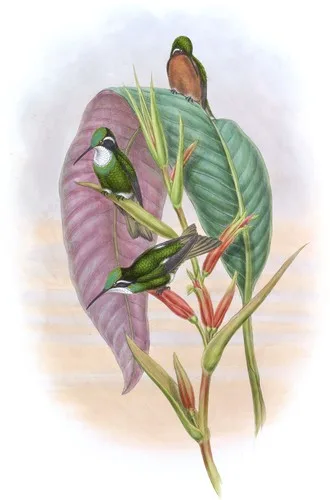
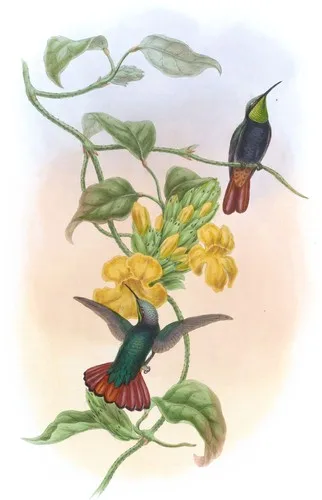
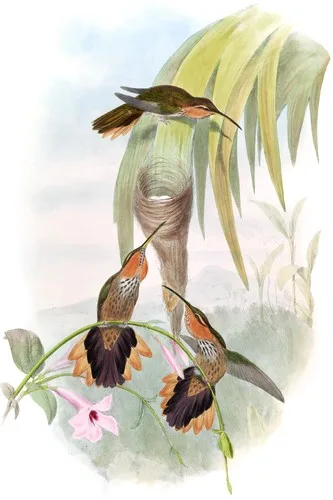
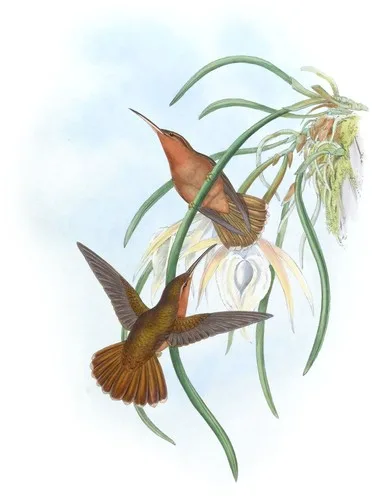
The sheet is vertical: the eye climbs and settles on the bird. Take the posture before the plumage. Then step in close: watch where colour meets line, and whether the line ever breaks. Third, find the darkest small patch: the whole tonal order is measured from there.
Name and Thing
No reliable binomial survives, so the printed title must serve. Neither name nor binomial survives: the printed title must do.
Form and Colour
The smallest of birds: a needle-fine bill, a forked tubular tongue, wings beating so fast the bird hovers and even flies backwards. Its colour is not pigment but structure — light bent by feather barbules, changing with the angle.No colour group is recorded. A single plant, laid out with nothing hidden.
Composition
Tall and narrow, the bird perched mid-branch with generous margins above and below. No details are appended: a plate for looking, not for keying out. Old plates set the plant slightly off centre, with unequal margins — that small imbalance is what keeps it alive.
Line and Colour
In the later nineteenth century chromolithography took over: colour printed rather than painted, line demoted. Take a loupe to three places: petal edge, leaf vein, caption. An unbroken line means engraving; colour crossing the outline means a hand. If you mean to copy it: block in the broad shapes and colours first, detail last; lithographic softness comes from thin washes — two or three pale layers will get you close.
Poetic Resonance
夫列子御风而行,泠然善也,旬有五日而后反。
—— 《庄子·逍遥游》
Liezi rode the wind and came back after fifteen days, so light was his going.
The poem gives the mood first and the picture supplies the form; set the line beside the plate and the bird itself becomes its resting point.
Symbolism
For the Aztecs the hummingbird was warrior and sun; for Victorian Europe it was the ultimate ornament, millions killed for breast jewellery. China has no tradition here — and that blank is itself a history of exchange. Meanings change their tune: the same flower can say opposite things within a century.
Season and Place
In tropical America they are present all year, their season set by flowers. the name arrives with late-Qing travel writing. The year 1887 on the plate is that of publication, not of flowering — the gathering came a year or two earlier. Read the locality and the flowering season both with a discount: one is hearsay, the other a ten-day peak.
The Book and the Hand
“Gould's Hummingbirds” carries only John Gould's name. From drawing to plate the sheet passed through several hands — the engraver aimed at accuracy, the colourist at speed, and between them lies each plate's unevenness.
What to Take Away
If you keep one line, keep Guo Xi's: from afar its momentum, up close its texture. The flower of that year is dust, yet its image on paper has outlived every living cousin.
About this plate
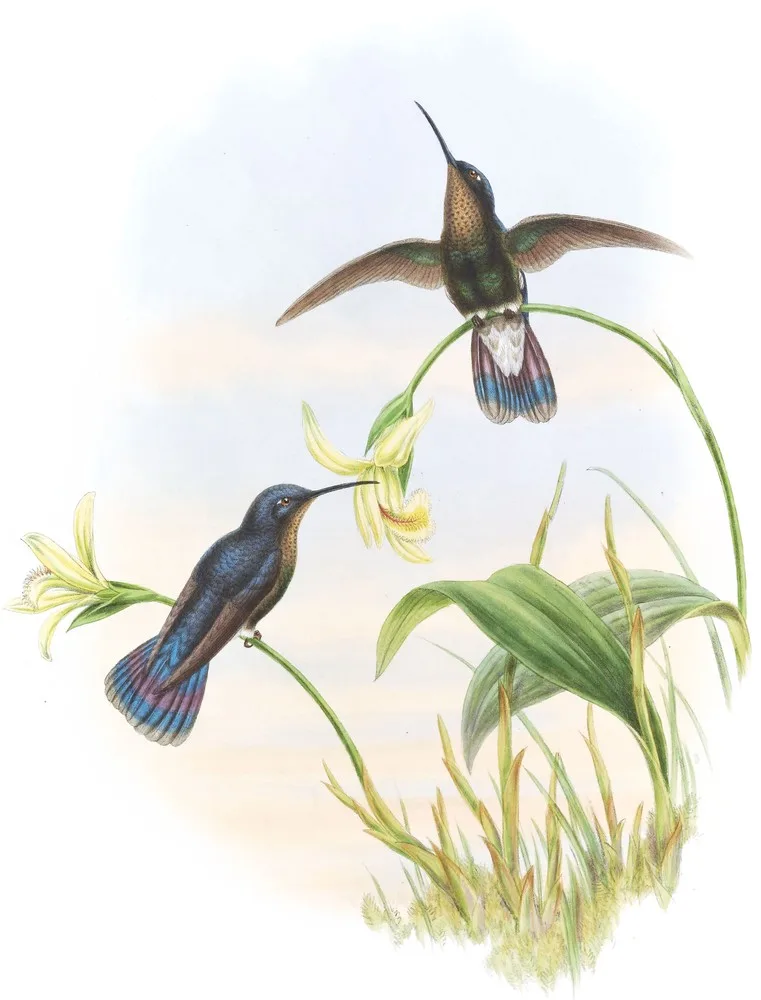
A single specimen only of this species has as yet been obtained.
This is in such ragged plumage that its markings can only be determined with difficulty. The specimen was moulting when it was shot; and much of the colour has faded from the old feathers. The tail and the throat, however, are pretty perfect; and these parts, together with a few new feathers, are tinted so as to indicate sufficiently clearly the colour of the plumage of the perfect bird. Any Trochilidist would be instantly convinced of the fact that this specimen belongs to a new species of Humming-bird in a bad state of plumage; and it rests with future travellers to discover others in perfect plumage where this individual was procured. Some Trochilidists believe the specimen to be a female, others a male; my own opinion is that it is the latter; but the bird is in moult, and probably very much altered. Mr. Buckley, whose name it bears, was the discoverer of this bird; he killed it at Misqui, in Bolivia, the height of the spot where it was found being 10,000 feet above the sea.
When the male of this bird is clean-mantled, I think, judging by the tail and throat and the spots of purple alternating with the old brown feathers in places throughout the upper surface, it will prove to be a finer bird than it now appears.
I regret I have no information to give respecting its actions, habits, and mode of feeding; but, from its long wings and little feet, I judge that the present bird is a good flyer, and perhaps depends for its food upon insects caught in the air rather than taken from flowers in the usual way.
I regret I have nothing more to add to the little already published, which runs as follows:—
The general appearance of this bird reminds me of Lampornis; but it has an extremely long wing. In the latter respect it resembles Oreotrochilus; but it differs from that genus in its strongly curved and lengthened bill and in its very broad tail-feathers, while its extremely small feet seem peculiar to the genus.”
So much refers to form; in what follows, colour and admeasurements are attended to.
Brown, with a purplish gloss on the back; the upper tail-coverts and tail-feathers brown, glossed with purple, and having a subterminal band of steel-blue; under surface of body brown, slightly washed with metallic green; the throat lighter brown, the feathers edged with paler brown, giving a scaly appearance; vent and under tail coverts white, the latter washed with brown.
Total length 4·6 inches, culmen 1·05, wing 2·95, tail 1·85, tarsus 0·15.
Habitat. Misqui, Bolivia, 10,000 feet.
References
- Pinarolema Buckleyi, Gould, Ann. & Mag. of Nat. Hist. ser. 5, vol. v. p. 489 (June 1880).