Lampornis calosoma
宝石蜂鸟属
Lampornis calosoma
Elliot’s Topaz
About this plate
It is now ten years ago since this beautiful species was described by my friend Mr. Elliot; and the specimen still remains unique in the collection of the latter gentleman.
As he observes, I gave him my opinion at the time that the species ought to be placed in the genus Chrysolampis; and although in deference to the judgment of Mr. Salvin and Mr. Elliot I go so far as to follow them in the present work and place it in the genus Lampornis, I believe in my innermost heart that they are mistaken, and that the bird is a true Chrysolamps—if, indeed, it should not be placed in a genus by itself. I would ask any body to compare the figures which I have drawn in order to show both the back and front views of the bird, and to say which form the present species most resembles, Lampornis or Chrysolampis. It has not the long bill nor the forked tail of the former genus, characters in my opinion quite sufficient to separate it from that; but, on the other hand, let it be compared with Chrysolampis moschitus, in how many characters they agree ! First, there is the small bill, the metallic crown, the darker back, and the rounded tail, with the copperybrown central tail-feathers, though it is true that in L. calosoma the remainder of the rectrices are purple; still the general character of the plumage is like that of C. moschitus; and, again, on the under surface the metallic throat, the dark belly, the chestnut under tail-coverts, and the under surface of the tail all remind us of the last-named species. If, therefore, as I anticipate, the bird should be one day replaced in the genus Chrysolampis, the specific name of chlorolæmus will have to be restored as well.
Mr. Elliot writes:—
The habitat of this species is unknown; but it is not unlikely that it may be a native of the West-Indian Islands, of whose ornithology we at present know nothing. If this supposition should prove to be correct, a fine field still remains unexplored for some enterprising naturalist; for among the members of the genus Lampornis the present species is one of the very handsomest, and doubtless many equally fine birds in this and other families are still unknown to science to reward the researches of the explorer.
The following description is given by Mr. Elliot in his ‘Synopsis:’—
Male. Top of head and neck pale metallic silvery green, in some lights purplish; a black band across the back; rest of upper parts dark green; tail fiery copper-colour, the feathers margined with blackish purple; throat brilliant emerald-green; underparts purplish black; spot of white on the flanks; under tailcoverts chestnut; bill black.
Total length 4 inches, wing 2
, tail 1 , culmen .
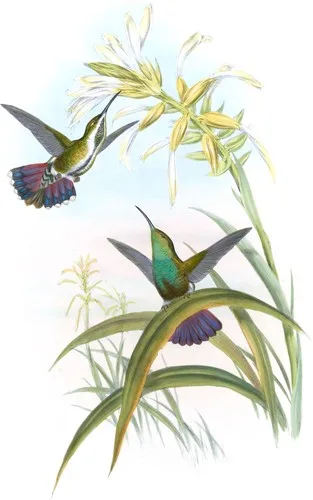
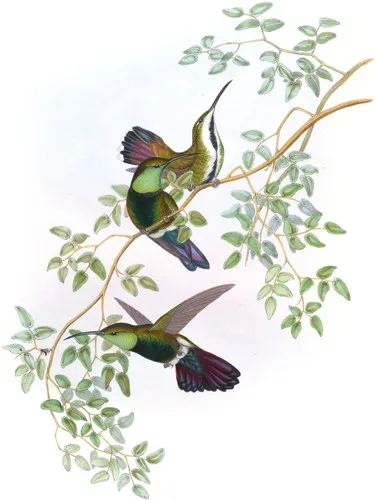
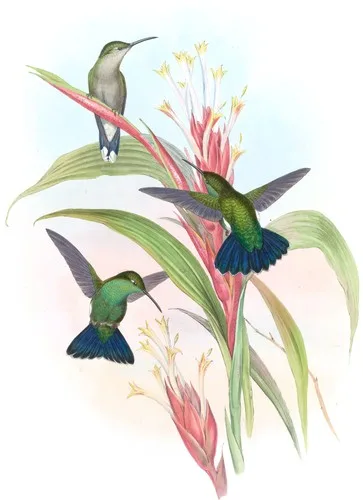
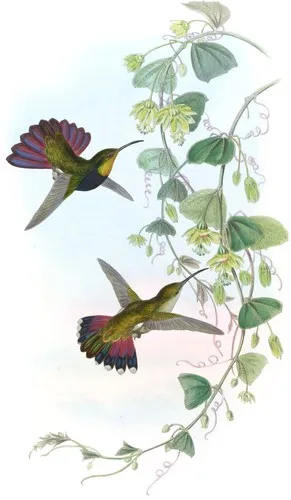
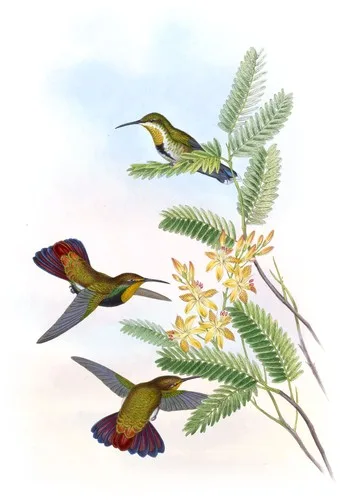
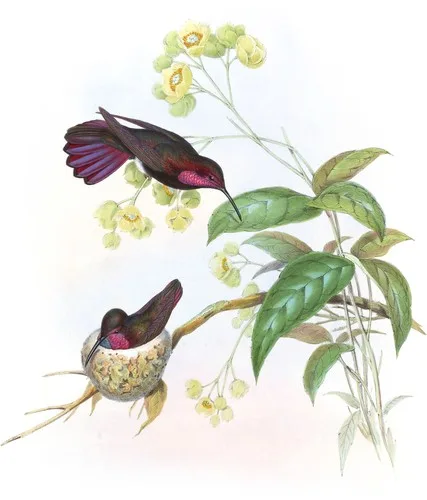
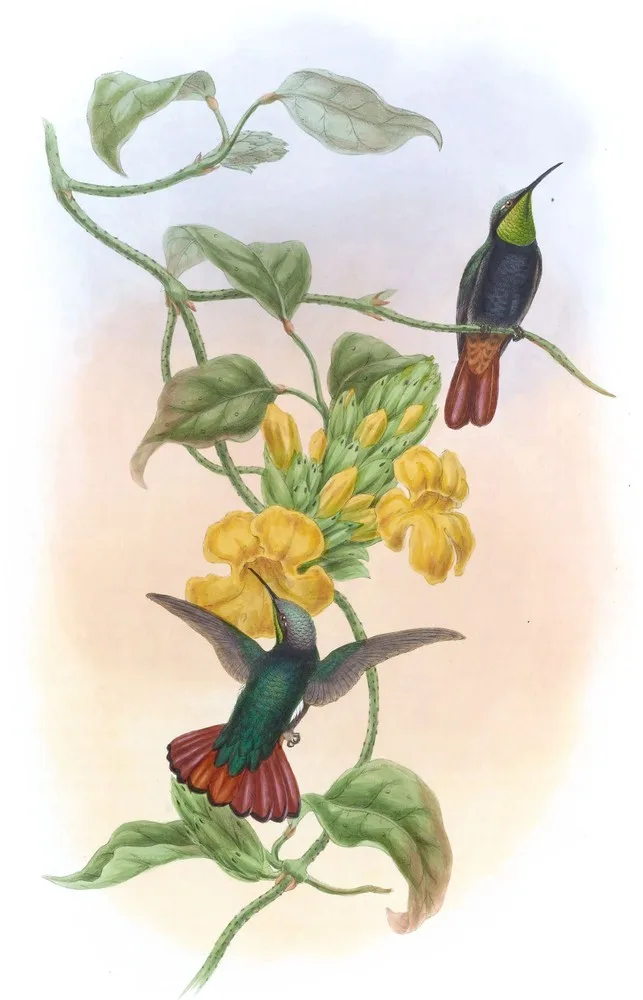
The Plate contains two figures of the unique type, and shows both back and front views of the bird, for reasons specified above. Iam indebted to Mr. Elliot for the loan of the specimen from which the figures are drawn.
References
- Chrysolampis chlorolemus, Elliot, Ann. & Mag. Nat. Hist. (4) vi. p. 846 (1870).
- Lampornis calosoma, Sclater & Salvin, Ibis, 1871, p. 429.—Elliot, Ibis, 1872, p. 351.— Mulsant, Hist. Nat. Ois.-Mouches, i. p. 177.—Elliot, Synops. Humming-birds, p. 41.
Twelve ways of seeing
- upright 1.56 : 1
- published 1887
- Pl. 369, Suppl. Vol.
Not a catalogue entry but a way of looking: how to stand, what to notice, how the line was cut, when it flowers, where it came from, who made it — and then the poems and the classics that taught China to see the same flower. Read the twelve in order and the plate opens.
-
First Look
竖划三寸,当千仞之高;横墨数尺,体百里之迥。
—— 南朝宋·宗炳《画山水序》
A vertical stroke of three inches stands for a cliff of a thousand fathoms; a few feet of ink holds a hundred li.
The sheet is vertical: the eye climbs and settles on the bird. Take the posture before the plumage. Then step in close: watch where colour meets line, and whether the line ever breaks. Third, find the darkest small patch: the whole tonal order is measured from there.
-
Name and Thing
The binomial is Lampornis calosoma: the first word is the genus it belongs among, the second the epithet that sets it apart. Two words carry a whole provenance. The Chinese name 宝石蜂鸟属 is a modern rendering of the Latin, not an old garden name.
-
Form and Colour
The smallest of birds: a needle-fine bill, a forked tubular tongue, wings beating so fast the bird hovers and even flies backwards. Its colour is not pigment but structure — light bent by feather barbules, changing with the angle.No colour group is recorded. Read the outline, then the colour layers, then the brush.
-
Composition
Tall and narrow, the bird perched mid-branch with generous margins above and below. (about 1.56 : 1) No details are appended: a plate for looking, not for keying out. Cover the margins with your thumb and the plate suffocates; uncover them and the flower breathes again.
-
Line and Colour
In the later nineteenth century chromolithography took over: colour printed rather than painted, line demoted. There is evidence on the back too: the plate mark pressed into the paper, the slight relief of the pigment, lines worn shallow in a later printing.
-
Season
In tropical America they are present all year, their season set by flowers; temperate hummingbirds follow the bloom north and back, thousands of kilometres a year. The year 1887 on the plate is that of publication, not of flowering — the gathering came a year or two earlier. The best time to read such a plate is its flowering season: three minutes under the tree explains what no text can.
-
Provenance
Americas only, from southern Alaska to Tierra del Fuego, richest in the Andes. China has no hummingbirds and no classical record of them; the name arrives with late-Qing travel writing. In the same volume the kin are shelved together; set several plates side by side.
-
The Book and the Hand
“Gould's Hummingbirds” was drawn by John Gould and published 1849-1887. This plate is Pl. 369, Suppl. Vol., book page 369. The image is public domain; the hand-colouring is still one person's hand.
-
Poetic Resonance
穿花蛱蝶深深见,点水蜻蜓款款飞。
—— 唐·杜甫《曲江二首》
Butterflies thread the flowers, seen deep within; dragonflies touch the water and fly on, slow and deliberate.
The poem gives the mood first and the picture supplies the form; set the line beside the plate and the bird itself becomes its resting point.
-
The Written Tradition
竖划三寸,当千仞之高;横墨数尺,体百里之迥。
—— 南朝宋·宗炳《画山水序》
A vertical stroke of three inches stands for a cliff of a thousand fathoms; a few feet of ink holds a hundred li. Smallness of scale was never the obstacle.
Gould's Hummingbirds (1849–1887) used hand-coloured lithography over gold leaf so the iridescence survived on paper — a monument to Victorian printing and collecting alike. The difference is not of quality but of question: Europe asks what it is, China asks whom it resembles.
-
Symbolism
For the Aztecs the hummingbird was warrior and sun; for Victorian Europe it was the ultimate ornament, millions killed for breast jewellery. China has no tradition here — and that blank is itself a history of exchange. In a flora it is a species first and a symbol second; the order is worth keeping.
-
What to Take Away
Next time you watch a bird: posture first, then where the plumage is deepest, and only then the field guide. The flower of that year is dust, yet its image on paper has outlived every living cousin.