Spathura Underwoodi
Spathura Underwoodi
White-booted Racket-tail
Ten ways of seeing
- upright 1.47 : 1
- published 1852
- Pl. 162, Vol. III
First Look
江馆清秋,晨起看竹,烟光日影露气,皆浮动于疏枝密叶之间。
—— 清·郑板桥《题画竹》
On an autumn morning at the river lodge I looked at the bamboo: mist, sunlight, dew, all drifting among the sparse and dense leaves.
The sheet is vertical: the eye climbs and settles on the bird. Take the posture before the plumage. Then step in close: watch where colour meets line, and whether the line ever breaks. Third, find the darkest small patch: the whole tonal order is measured from there.
Name and Thing
The binomial is Spathura underwoodi: the first word is the genus it belongs among, the second the epithet that sets it apart. Two words carry a whole provenance. No established Chinese name exists, so it is cited by its binomial alone.
Form and Colour
The smallest of birds: a needle-fine bill, a forked tubular tongue, wings beating so fast the bird hovers and even flies backwards. Its colour is not pigment but structure — light bent by feather barbules, changing with the angle.No colour group is recorded. A single plant, laid out with nothing hidden.
Composition
Tall and narrow, the bird perched mid-branch with generous margins above and below. (about 1.47 : 1) No details are appended: a plate for looking, not for keying out. Blank paper is not unfinished work: it is where the eye rests.
Line and Colour
In the later nineteenth century chromolithography took over: colour printed rather than painted, line demoted. Craft leaves franker evidence than inscriptions. If you mean to copy it: block in the broad shapes and colours first, detail last; lithographic softness comes from thin washes — two or three pale layers will get you close.
Poetic Resonance
夫列子御风而行,泠然善也,旬有五日而后反。
—— 《庄子·逍遥游》
Liezi rode the wind and came back after fifteen days, so light was his going.
The poem gives the mood first and the picture supplies the form; set the line beside the plate and the bird itself becomes its resting point.
Symbolism
For the Aztecs the hummingbird was warrior and sun; for Victorian Europe it was the ultimate ornament, millions killed for breast jewellery. China has no tradition here — and that blank is itself a history of exchange. Flower language was added later; the flower knows nothing of it, and that innocence is part of its power.
Season and Place
temperate hummingbirds follow the bloom north and back, thousands of kilometres a year. the name arrives with late-Qing travel writing. The year 1852 on the plate is that of publication, not of flowering — the gathering came a year or two earlier. The bud and the ripe fruit on one branch tell the season; the name in the title often tells the journey.
The Book and the Hand
“Gould's Hummingbirds” was drawn by John Gould and published 1849-1887. This plate is Pl. 162, Vol. III, book page 162. The image is public domain; the hand-colouring is still one person's hand.
What to Take Away
If you keep one line, keep Guo Xi's: from afar its momentum, up close its texture. The flower of that year is dust, yet its image on paper has outlived every living cousin.
About this plate
The neighbourhood of Bogota, on the Andes, and the hilly portion of eastern Venezuela
This species enjoys a range of habitat over the Columbian Andes extending from the third to the tenth degree of north latitude, but appears to be confined to the regions ranging between five and nine thousand feet above the level of the ocean; it is abundant in the neighbourhood of Santa Fé de Bogota, and is numerous in Galipan between La Guayra and the Caraccas.
Mr. Dyson informs me that when hovering before a flower the actions of its wings are exceedingly rapid, that it produces a loud humming sound, and that the large spatules at the end of the outer tail-feathers show very conspicuously, being kept in continual motion by the rapid movements of the bird, and the repeated closing and expanding of the tail; its whitebooted legs also are equally noticeable: it is strictly an inhabitant of the hills, and loves to examine the flowers growing in the open passes and glades of the forest for its insect food, which it procures from the highest trees as well as those near the ground. During flight it passes through the air with arrow-like swiftness, the tail being carried in a horizontal position.
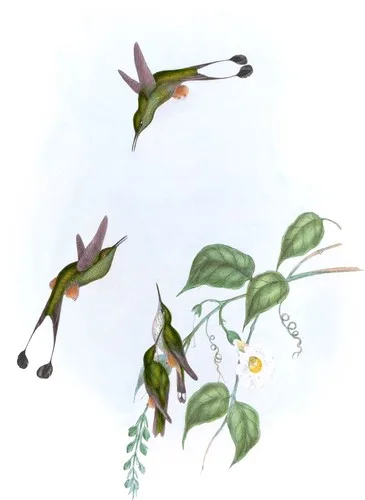
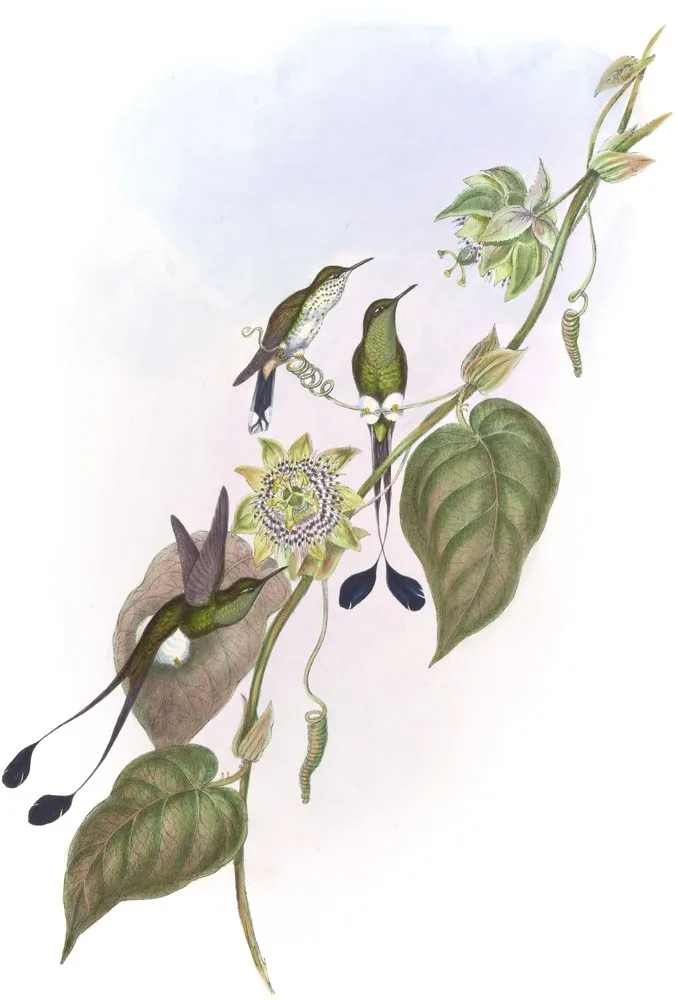
The plumage of the two sexes is widely different; the female being entirely devoid of the rich lustrous green on the throat, and having only a rudiment of the white boots so conspicuous in the male: the structure of the tail of the two birds is also very dissimilar, as will be seen on reference to the accompanying Plate.
The male has the whole of the upper surface, the abdomen, flanks and under tail-coverts bronzy green, becoming richer and of a coppery hue on the upper tail-coverts; throat and chest rich lustrous green; wings purplish brown; tail brown, with the exception of the spatulate tips of the lateral tail-feathers, which are black with greenish reflexions; tarsi thickly clothed with white downy feathers; bill black; feet yellow.
Total length, 5
The female has the upper surface and two middle tail-feathers bronzy green, the bronzy hue predominating on the head and the green on the tail-feathers; wings purplish brown; lateral tail-feathers brown, the outer one on each side largely tipped with white, the remainder with a wash of bronzy green at their extremities; under surface white, spotted on the sides of the breast and flanks with bronzy green; under tailcoverts buff; tarsi clothed with white feathers; feet yellow.
Total length, 3
The figures represent two males and a female of the natural size, on a branch of the Passiflora lingularis,
References
- Ornismya Underwoodii, Less. Troch., p. 105. pl. 37.
- Trochilus Underwoodii, Jard. Nat. Lib, Humming Birds, vol. ii. p. 110. pl. 22.
- Fan-tailed Humming Bird, Lath. Gen. Hist., vol. iv. p. 339.
- Trochilus ventilabrum, Lath. MSS.
- Mellisuga Underwoodii, Gray and Mitch. Gen. of Birds, Mellisuga, sp. 56.