Spathura melananthera
Spathura melananthera
Ecuadorian Racket-tail
About this plate
Ecuador
It is to Sir William Jardine, Bart., that the credit is due of giving the first description of this very distinct species of Spathura, which appears to take the place in Ecuador of the more generally known S. Underwood so commonly sent from Bogota in Columbia.
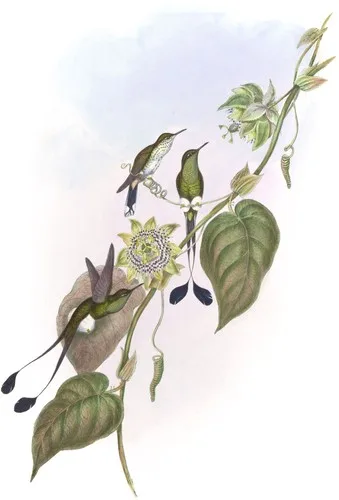
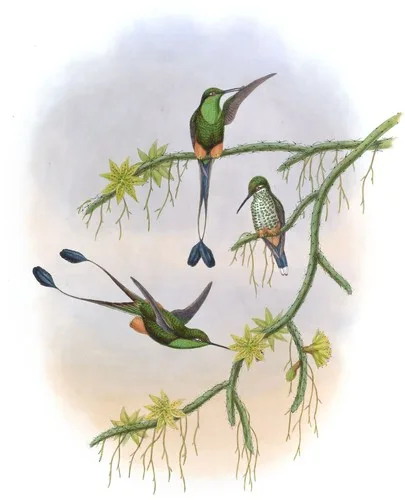
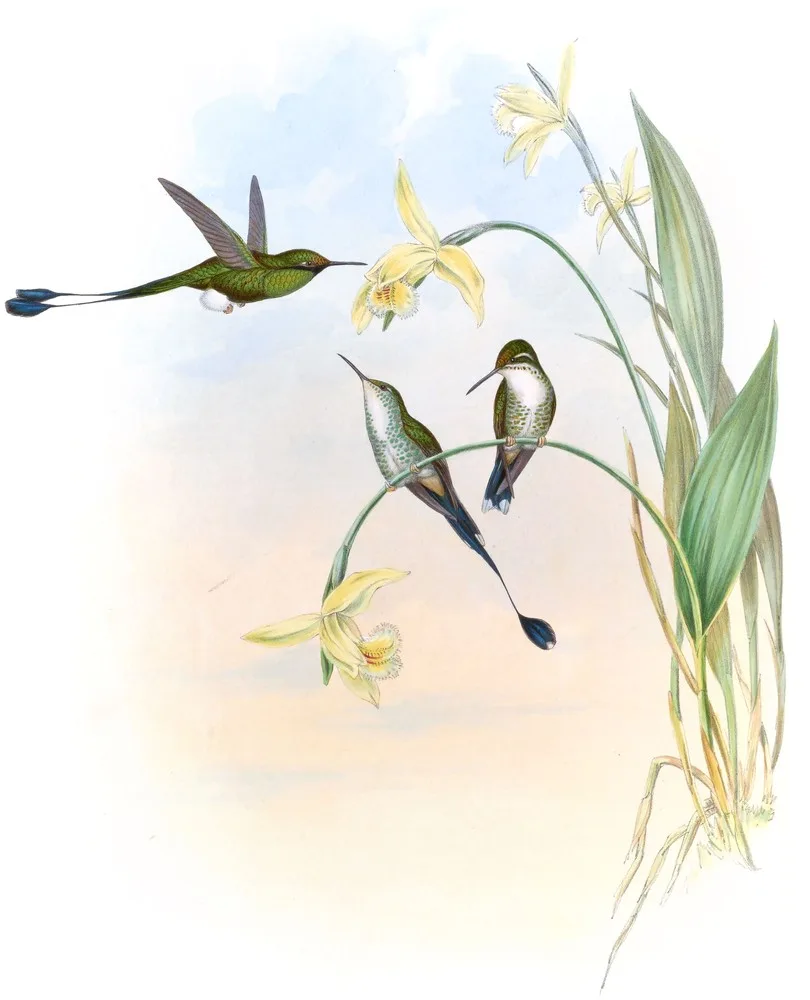
Both these birds are hill species, and both doubtless have similar habits and economies. The S. melananthera differs from S. Underwoodi in being of a smaller size, and in the form of the spatules, those of the former being shorter and more club-shaped than those of the latter; there is also a difference in the colouring of the spatules, those of the smaller bird frequently having a tinge of shining green pervading them, while the colour of those of S. Underwoodi is steel-blue; the S. melananthera has also a broad black band on the throat, while the corresponding mark in S. Underwoodi is smaller and often almost obsolete. The greatest difference, however, occurs in the females of the two species; the breast and centre of the abdomen of that sex being pure white in S. melananthera, while the same parts in the female of S. Underwoodi are spangled with green.
All the specimens of S. melananthera I have seen are from Ecuador, whence they have been sent by Professor Jameson and Mr. Fraser.
Sir William Jardine, when first describing this species in his “Contributions to Ornithology for 1851,” says,
The last post from Quito brought us some Humming-birds which were of great interest; among them was one belonging to the subgroup which has been called Spathura, and of which the beautiful species S. Underwoodii, with its white boots and racket-tail, has been considered typical. This species, figured in the only Number yet published of Mr. Gould’s Monograph, is found in the neighbourhood of Santa Fé de Bogota, and in Galipan, between La Guayra and the Caraccas, at an elevation of from 5000 to 9000 feet. Of the specimen lately received, Professor Jameson writes (considering it to be S. Underwoodii),—“I am not aware of its being hitherto met with to the south of the equator.” Along with a true S. Underwoodii, Mr. Gould had enclosed a female of a Spathura with an unspotted breast, with an opinion that the male of the latter would prove distinct; and on comparing the Quitian birds with these and the figure and description in the Monograph, there appears to be a considerable difference. The proportions and tints vary, and the large space of black on the chin and maxilla is very marked. We are not aware whether M. Bourcier has noticed it, and an examination of more specimens must decide whether it be only a local variety; but meanwhile we have applied the above specific name quite provisionally, until the point as to species is cleared up, and give a description from the specimen before us.
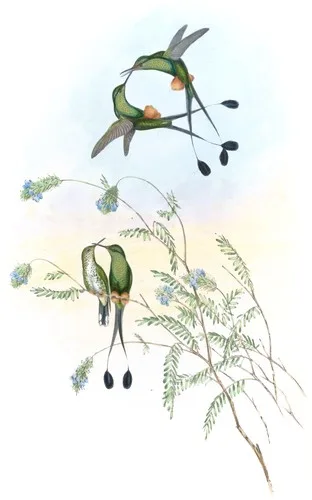
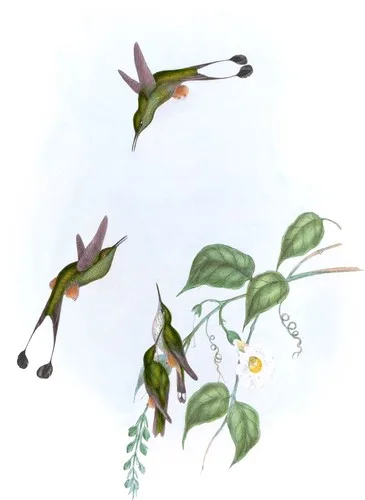
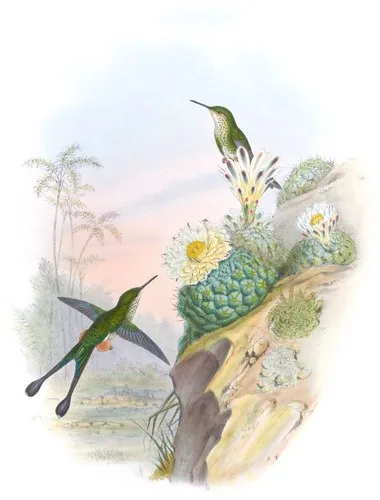
Male, above green, bronzed on the upper tail-coverts; wings purplish black; tail bronzy green, the long exterior feathers black, the spatulate ends velvet-black, with rich green reflexions below; chin and maxilla velvet-black; centre of the throat and stretching round below the auriculars, with the sides of the neck, emerald-green, forming a brilliant gorget; belly and vent green; boots large and pure white.
Female, above green, much bronzed on the whole of the crown; tail slightly forked; the outer feather tipped with white, the second with only a slight indication of it; below pure white; flanks green, with a few spots on the sides of the belly; under tail-coverts pale sienna-brown.
The figures represent both sexes of the size of life. The plant is the Sobrahli fragrans.
References
- Trochilus (Spathura) melananthera, Jard. Cont. to Orn. 1851, p. 111. pl. lxxx.
- Steganura melananthera, Reich. Auf. der Col., p. 8.
- Discura melananthera, Bonap. Rev. Zool. 1854, p. 256.
Ten ways of seeing
- slightly upright 1.23 : 1
- published 1852
- Pl. 163, Vol. III
Not a catalogue entry but a way of looking: how to stand, what to notice, how the line was cut — then, halfway, a line of Chinese poetry: how the ancients saw this same flower. After it, the flower's language, its season and homeland, its book; and at the end one line of classical prose — and a pair of eyes to take away.
-
First Look
竖划三寸,当千仞之高;横墨数尺,体百里之迥。
—— 南朝宋·宗炳《画山水序》
A vertical stroke of three inches stands for a cliff of a thousand fathoms; a few feet of ink holds a hundred li.
Slightly taller than wide; the eye lands on the bird's head, a little above centre. Then step in close: watch where colour meets line, and whether the line ever breaks. Third, find the darkest small patch: the whole tonal order is measured from there.
-
Name and Thing
The binomial is Spathura melananthera: the first word is the genus it belongs among, the second the epithet that sets it apart. Two words carry a whole provenance. No established Chinese name exists, so it is cited by its binomial alone.
-
Form and Colour
The smallest of birds: a needle-fine bill, a forked tubular tongue, wings beating so fast the bird hovers and even flies backwards. Its colour is not pigment but structure — light bent by feather barbules, changing with the angle.No colour group is recorded. Three things fix the habit: leaf arrangement, tepal count, and how the flower is borne.
-
Composition
Slightly taller than wide, the bird set a little above centre, the eye landing at head and bill. (about 1.23 : 1) No details are appended: a plate for looking, not for keying out. Cover the margins with your thumb and the plate suffocates; uncover them and the flower breathes again.
-
Line and Colour
In the later nineteenth century chromolithography took over: colour printed rather than painted, line demoted. Decide first whether it was printed or painted; only then discuss whether it is beautiful. If you mean to copy it: block in the broad shapes and colours first, detail last; lithographic softness comes from thin washes — two or three pale layers will get you close.
-
Poetic Resonance
夫列子御风而行,泠然善也,旬有五日而后反。
—— 《庄子·逍遥游》
Liezi rode the wind and came back after fifteen days, so light was his going.
The poem gives the mood first and the picture supplies the form; set the line beside the plate and the bird itself becomes its resting point.
-
Symbolism
For the Aztecs the hummingbird was warrior and sun; for Victorian Europe it was the ultimate ornament, millions killed for breast jewellery. China has no tradition here — and that blank is itself a history of exchange. In a flora it is a species first and a symbol second; the order is worth keeping.
-
Season and Place
In tropical America they are present all year, their season set by flowers. the name arrives with late-Qing travel writing. The year 1852 on the plate is that of publication, not of flowering — the gathering came a year or two earlier. Read the locality and the flowering season both with a discount: one is hearsay, the other a ten-day peak.
-
The Book and the Hand
“Gould's Hummingbirds” was drawn by John Gould and published 1849-1887. This plate is Pl. 163, Vol. III, book page 163. The image is public domain; the hand-colouring is still one person's hand.
-
The Written Tradition
宁古无时,宁朴无巧,宁俭无俗。
—— 明·文震亨《长物志》
Better old than fashionable, better plain than clever, better spare than vulgar.
Gould's Hummingbirds (1849–1887) used hand-coloured lithography over gold leaf so the iridescence survived on paper — a monument to Victorian printing and collecting alike. The difference is not of quality but of question: Europe asks what it is, China asks whom it resembles.
What to Take Away
Next time you watch a bird: posture first, then where the plumage is deepest, and only then the field guide. A flora exists to be consulted; look long enough and you forget to consult — someone in 1852 gave a whole day to a single flower.