Spathura cissiura
Spathura cissiura
Scissor-tailed Racket-tail
Ten ways of seeing
- upright 1.32 : 1
First Look
竖划三寸,当千仞之高;横墨数尺,体百里之迥。
—— 南朝宋·宗炳《画山水序》
A vertical stroke of three inches stands for a cliff of a thousand fathoms; a few feet of ink holds a hundred li.
The sheet is vertical: the eye climbs and settles on the bird. Take the posture before the plumage. Then step in close: watch where colour meets line, and whether the line ever breaks. Third, find the darkest small patch: the whole tonal order is measured from there.
Name and Thing
The binomial is Spathura cissiura: the first word is the genus it belongs among, the second the epithet that sets it apart. Two words carry a whole provenance. No established Chinese name exists, so it is cited by its binomial alone.
Form and Colour
The smallest of birds: a needle-fine bill, a forked tubular tongue, wings beating so fast the bird hovers and even flies backwards. Its colour is not pigment but structure — light bent by feather barbules, changing with the angle.No colour group is recorded. Three things fix the habit: leaf arrangement, tepal count, and how the flower is borne.
Composition
Tall and narrow, the bird perched mid-branch with generous margins above and below. No details are appended: a plate for looking, not for keying out. Cover the margins with your thumb and the plate suffocates; uncover them and the flower breathes again.
Line and Colour
In the later nineteenth century chromolithography took over: colour printed rather than painted, line demoted. Decide first whether it was printed or painted; only then discuss whether it is beautiful. If you mean to copy it: block in the broad shapes and colours first, detail last; lithographic softness comes from thin washes — two or three pale layers will get you close.
Poetic Resonance
夫列子御风而行,泠然善也,旬有五日而后反。
—— 《庄子·逍遥游》
Liezi rode the wind and came back after fifteen days, so light was his going.
The poem gives the mood first and the picture supplies the form; set the line beside the plate and the bird itself becomes its resting point.
Symbolism
For the Aztecs the hummingbird was warrior and sun; for Victorian Europe it was the ultimate ornament, millions killed for breast jewellery. China has no tradition here — and that blank is itself a history of exchange. In a flora it is a species first and a symbol second; the order is worth keeping.
Season and Place
In tropical America they are present all year, their season set by flowers. the name arrives with late-Qing travel writing. The year 1852 on the plate is that of publication, not of flowering — the gathering came a year or two earlier. Much of what that generation knew of such birds came from specimens and cages; read locality and season both as hearsay.
The Book and the Hand
“Gould's Hummingbirds” carries only John Gould's name. From drawing to plate the sheet passed through several hands — the engraver aimed at accuracy, the colourist at speed, and between them lies each plate's unevenness.
What to Take Away
Appreciation is not knowledge but habit — one more look each time. A flora exists to be consulted; look long enough and you forget to consult — someone in 1852 gave a whole day to a single flower.
About this plate
Peru
Every traveller who penetrates the little-known country of Peru brings back with him evidence that much has yet to be learnt respecting its natural productions.
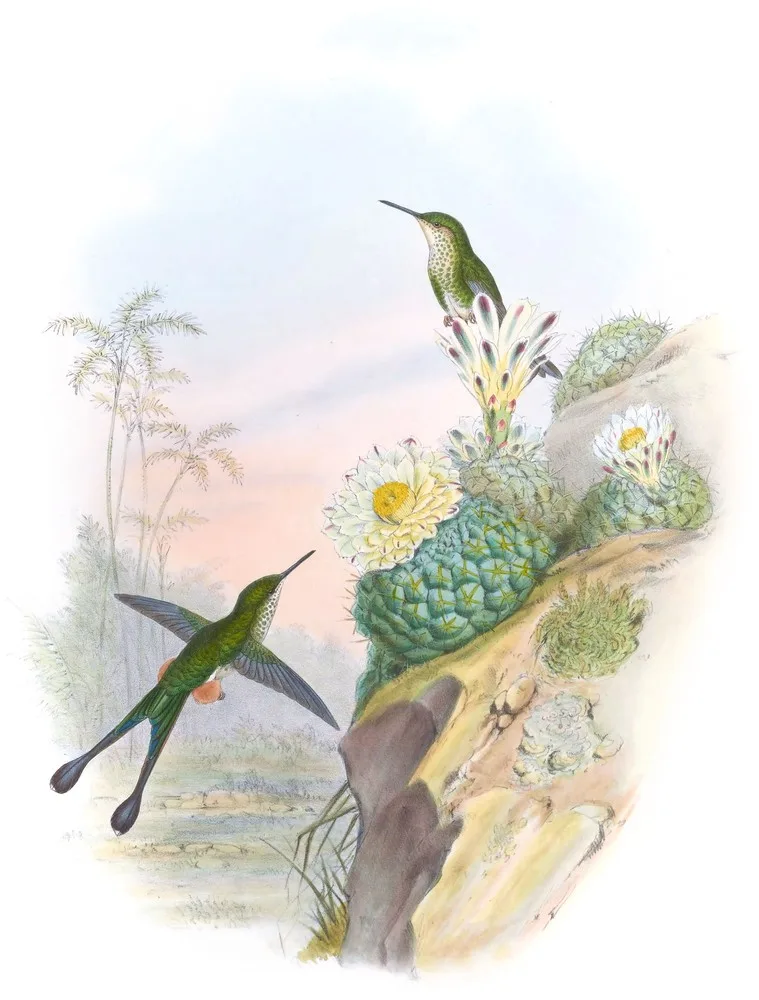
The justly celebrated Warszewicz, in one of his hurried journeys through that interesting country, plucked, as it were, from thence two examples of the remarkable bird here represented. These are now in my own collection, and are doubtless male and female; the male, however, is evidently immature; when fully adult, its throat is, in all probability, of a finer and more luminous green. Wait we must for additional specimens, and it may be years to come before these arrive, and a century, perhaps, elapse before more examples of the T. merabilis and other species (of which only single specimens have reached us) are obtained. We just get a glimpse, as it were—and that is all—of the natural productions of this fine country. In the forests to the eastward of the Cordillera, there is much in store for future ornithologists to examine and describe; for my own part, I am grateful for what I have been permitted to see, and for what I have been allowed to perform. Feebly it is done, I admit; yet I have not failed to exert myself to the best of my abilities in the illustration of my favourite branch of science—Ornithology.
Exceedingly curious in form is the tail of this little bird, and I really would give more than a trifle to see a fine adult male. Will not M. Sallé, who has already done so much for science, direct his attention to the exploration of Peru and Bolivia?
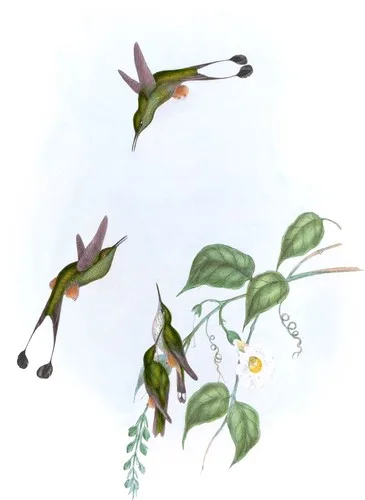
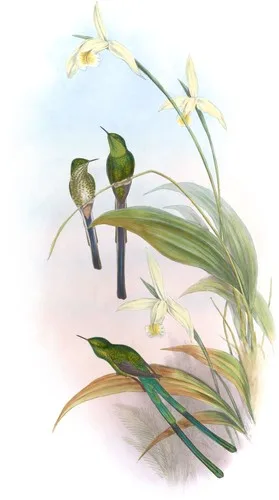
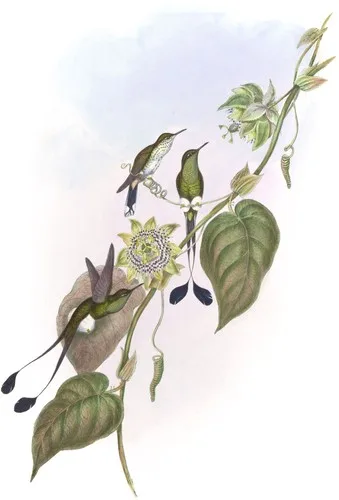
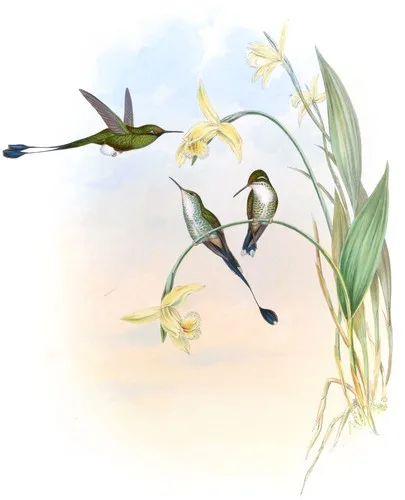
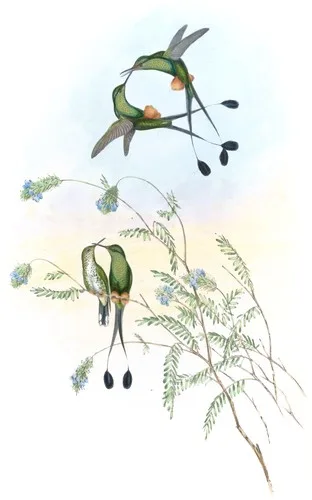
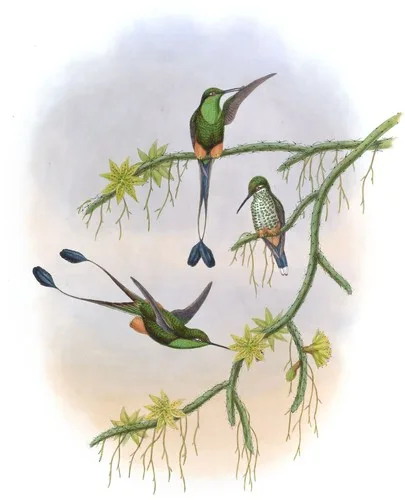
The Spathura cissiura is most nearly allied to S. Peruana, but differs from that, and all the other members of the genus, in having the outer tail-feathers webbed throughout their entire length, and, consequently, the spatulate tips less conspicuous.
General plumage bronzy green; wings purplish brown; four outer tail-feathers purplish steel-black; under surface green, paler on the throat; thighs thickly plumed, and of a reddish buff.
The figures are of the natural size. The plant is the Echinocactus Leeanus.
References
- Spathura cissiura, Gould in Proc. of Zool. Soc., part xxi. p. 109.—Athenzeum, Nov. 26, 1853.