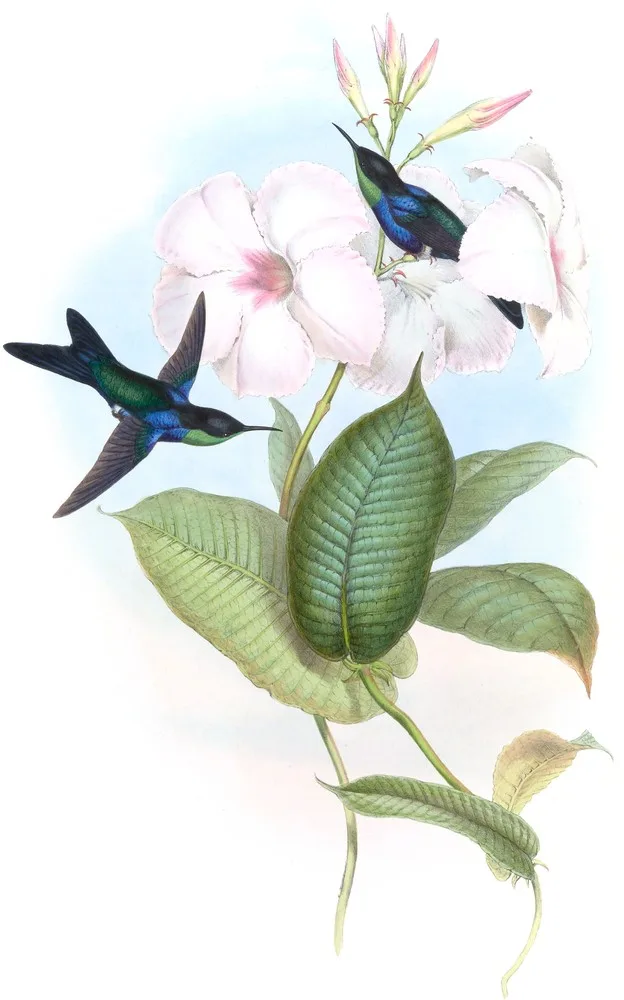
Thalurania refulgens
Thalurania refulgens
Refulgent Wood-Nymph
Ten ways of seeing
- upright 1.60 : 1
First Look
江馆清秋,晨起看竹,烟光日影露气,皆浮动于疏枝密叶之间。
—— 清·郑板桥《题画竹》
On an autumn morning at the river lodge I looked at the bamboo: mist, sunlight, dew, all drifting among the sparse and dense leaves.
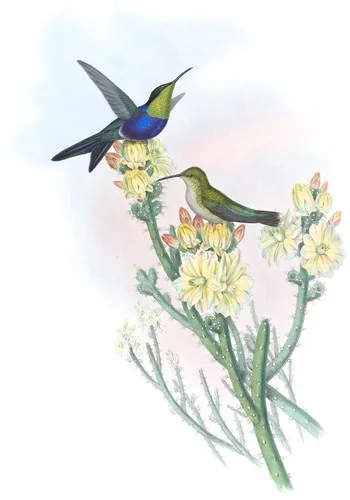
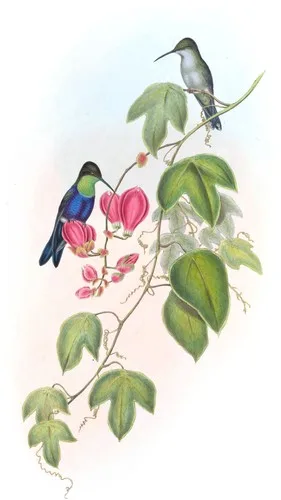
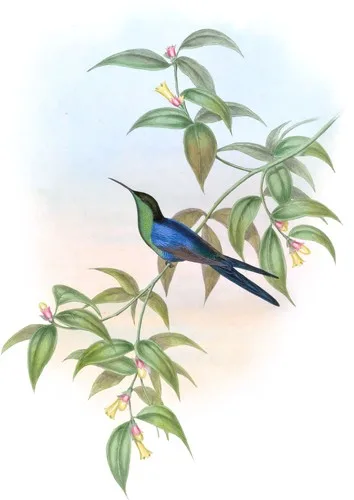
The sheet is vertical: the eye climbs and settles on the bird. Take the posture before the plumage. Then step in close: watch where colour meets line, and whether the line ever breaks. Third, find the darkest small patch: the whole tonal order is measured from there.
Name and Thing
The binomial is Thalurania refulgens: the first word is the genus it belongs among, the second the epithet that sets it apart. Two words carry a whole provenance. No established Chinese name exists, so it is cited by its binomial alone.
Form and Colour
The smallest of birds: a needle-fine bill, a forked tubular tongue, wings beating so fast the bird hovers and even flies backwards. Its colour is not pigment but structure — light bent by feather barbules, changing with the angle.No colour group is recorded. Read the outline, then the colour layers, then the brush.
Composition
Tall and narrow, the bird perched mid-branch with generous margins above and below. No details are appended: a plate for looking, not for keying out. Old plates set the plant slightly off centre, with unequal margins — that small imbalance is what keeps it alive.
Line and Colour
In the later nineteenth century chromolithography took over: colour printed rather than painted, line demoted. Craft leaves franker evidence than inscriptions. If you mean to copy it: block in the broad shapes and colours first, detail last; lithographic softness comes from thin washes — two or three pale layers will get you close.
Poetic Resonance
穿花蛱蝶深深见,点水蜻蜓款款飞。
—— 唐·杜甫《曲江二首》
Butterflies thread the flowers, seen deep within; dragonflies touch the water and fly on, slow and deliberate.
The poem gives the mood first and the picture supplies the form; set the line beside the plate and the bird itself becomes its resting point.
Symbolism
For the Aztecs the hummingbird was warrior and sun; for Victorian Europe it was the ultimate ornament, millions killed for breast jewellery. China has no tradition here — and that blank is itself a history of exchange. Flower language was added later; the flower knows nothing of it, and that innocence is part of its power.
Season and Place
In tropical America they are present all year, their season set by flowers. Americas only, from southern Alaska to Tierra del Fuego, richest in the Andes. China has no hummingbirds and no classical record of them. The year 1850 on the plate is that of publication, not of flowering — the gathering came a year or two earlier. Much of what that generation knew of such birds came from specimens and cages; read locality and season both as hearsay.
The Book and the Hand
“Gould's Hummingbirds” carries only John Gould's name. The image is public domain; the hand-colouring is still one person's hand.
What to Take Away
Next time you watch a bird: posture first, then where the plumage is deepest, and only then the field guide. The flower of that year is dust, yet its image on paper has outlived every living cousin.
About this plate
Unknown; supposed to be Venezuel
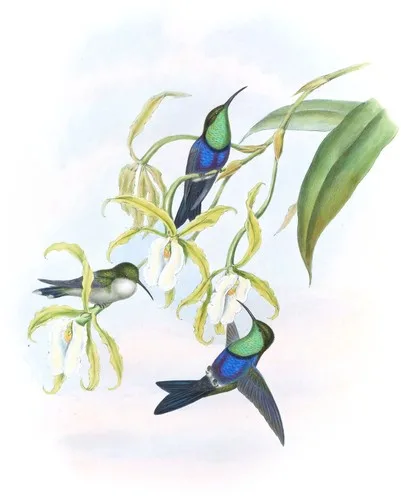
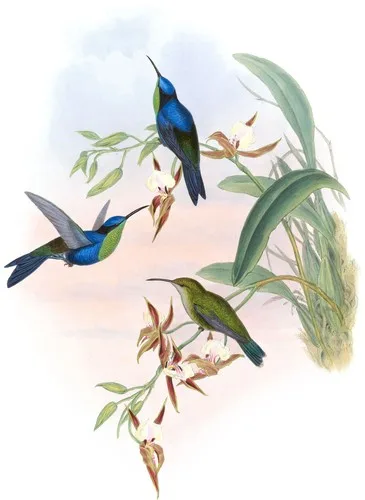
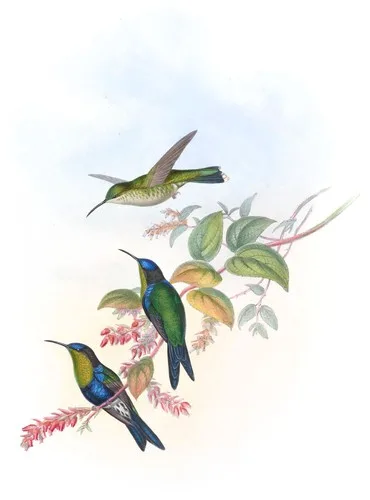
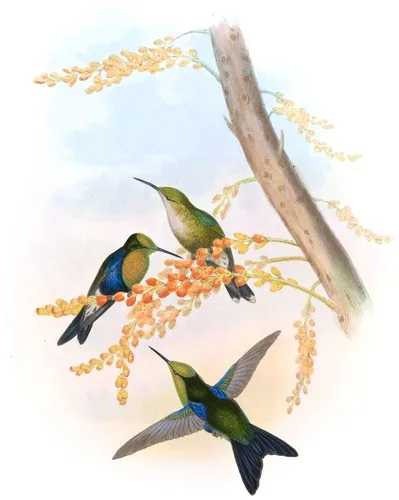
The bird figured in the accompanying Plate, to which I have given the name of Thalurania refulgens, is distinguished from most of the other members of the genus by its large size, its extreme beauty and strongly contrasted markings.
In its general style of colouring, as well as in the form and disposition of its gular patch, it is perhaps more nearly allied to the T. furcata than to any other species; but independently of its larger size, it is distinguished from that bird by the jet-black colour of its forehead, crown and nape, and its deep steel-black under tail-coverts. It so far exceeds in all its admeasurements the thousands of specimens of T. furcata I have seen and examined, that there is no doubt in my mind of its being specifically distinct; while the form of its green throat-mark, which is square or truncate below, separates it at once from the bird I have called nigrofasciata; besides which it is of larger size even than that species.
My collection contains two examples of this fine bird, one of which was presented to me by T. F. Erskine, Esq., a gentleman enthusiastically attached to the Trochilide, and whose knowledge of the species of this family is perhaps scarcely surpassed by any devotee of this lovely group of birds.
Up to the present time no example of the female has, so far as I am aware, been collected; neither is it in my power to direct the attention of collectors to the native localities of the species, whereby this desideratum might be supplied; in all probability the interior of Demerara and the neighbouring country of the Caraccas is its true habitat.
It will be seen that I have united with this bird one of the most delicate and beautiful flowering plants which America has yet given us; the drawing was made by Mr. Richter from a freshly expanded blossom which flowered in the stove at Berry Hill, near Taplow in Buckinghamshire; and it gives me great pleasure to offer thus publicly my thanks to Mr. Noble, for his kindness in directing this beautiful specimen of the Dipladenia splendens to be placed at my disposal for the purpose of figuring; thereby adding another to the many acts of liberality proffered by this gentleman for the furtherance of art and science.
Crown of the head velvety black; throat rich metallic green; breast and shoulders beautiful purplish blue; wings purplish brown; tail black; under tail-coverts steel-black.
Total length, 5 inches; bill, 1; wing, 2
The figures are of the natural size.
References
- Thalurama refulgens, Gould in Proc. of Zool. Soc., part xx. p. 9.—Bonap. Rev. et Mag. de Zool. 1854, p. 254.—Reich. Auf. der Col., p. 7.
- Coeligena refulgens, Reich. Troch. Enum., p. 3.