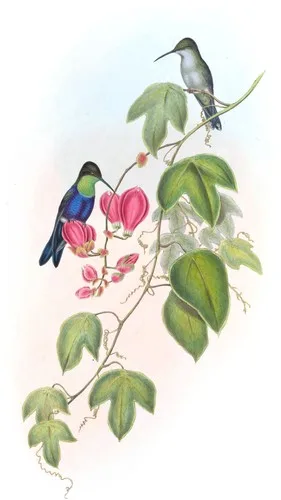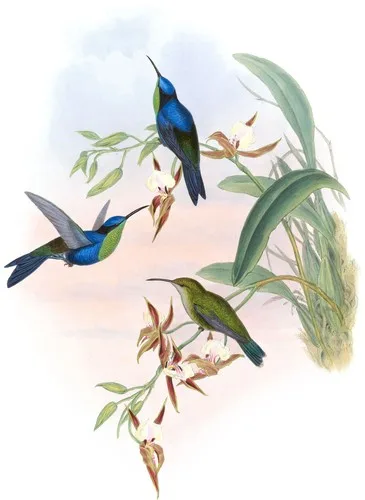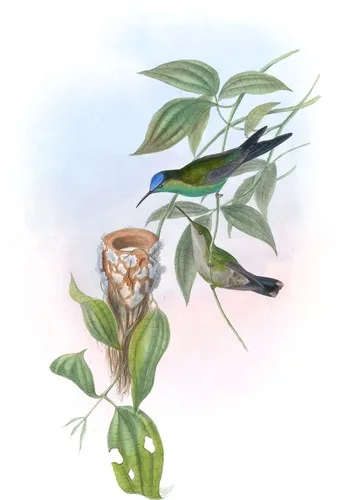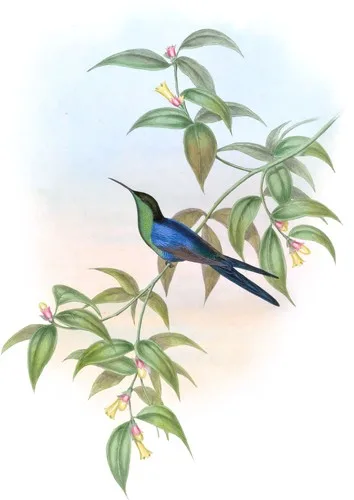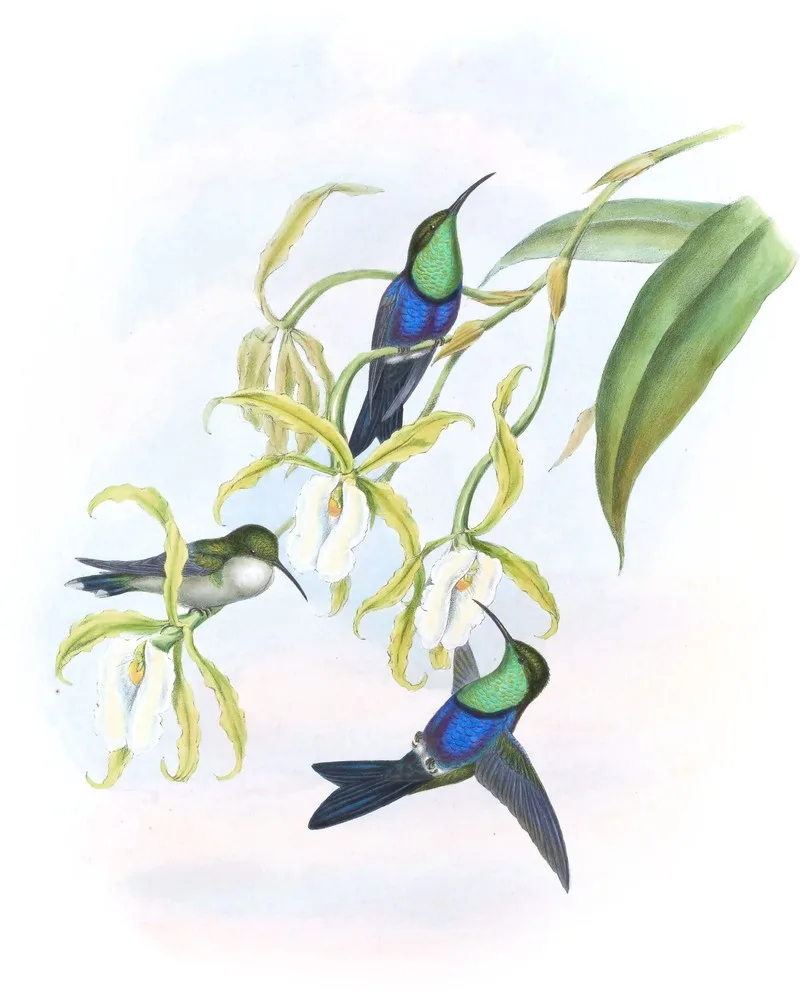
Thalurania nigrofasciata
Thalurania nigrofasciata
Black-banded Wood-Nymph
About this plate
Upper Amazon and Rio Napo.
There Is not perbaps a better defined group in the great family of Humming-Birds than that to which I have given the generic name of Thalurania, since all the species of which it is composed bear a very general resemblance to each other, and all are alike distinguished by an exceedingly beautiful style of colouring, of which blue and green are the prevailing tints; but so variously are these hues disposed in the several species, that each is readily distinguishable from the other.
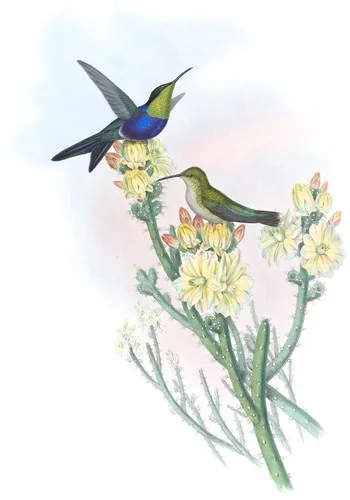
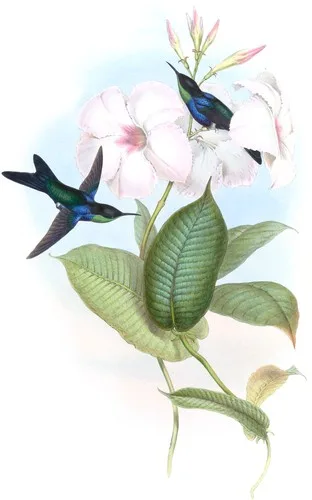
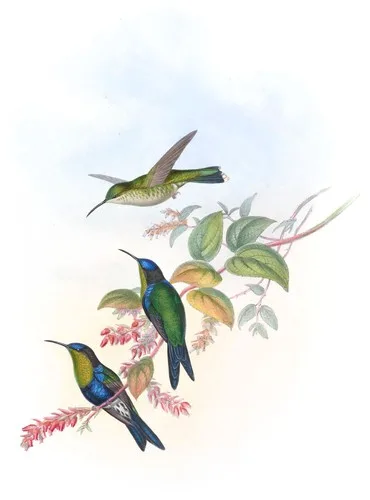
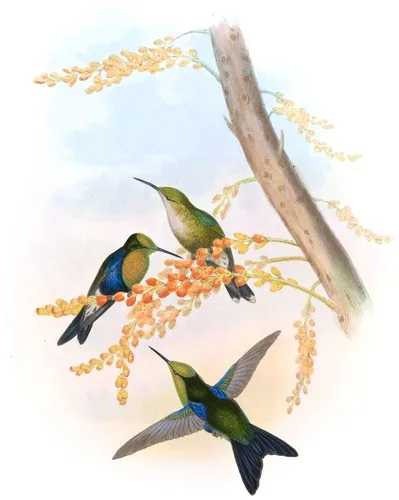
The present bird (T. nigrofasciata) is rendered remarkably distinct from its congeners by the deep band of black which crosses the breast and separates the green of the throat from the rich blue of the abdomen. This band, which of course follows the curvature of the base of the throat-mark, is broad and conspicuous in some specimens, while in others it is almost obsolete, a circumstance which induced me at one time to believe that the banded and non-banded birds were two distinct species, and to give to the latter the name of virzdipectus; an examination, however, of a great number of specimens has since convinced me that both that term and nigrofasciata have reference to one and the same bird: viridipectus, therefore, which was proposed in 1848, two years after that of nigrofasciata, has been placed in the rank of a synonym.
The true habitat of this bird is the forests which border the upper parts of the rivers Amazon and Rio Negro; but it is also found in Bogota; and I have even received specimens in a collection from Quito; whence we may infer that it ranges over a vast extent of country, perhaps over the whole of the eastern dip of the Andes, of Ecuador, and Columbia.
The sexes present the usual differences in colour; the female being clothed in a most sombre livery, particularly on the under surface, a part which is so richly adorned in the male.
Throat lustrous green; edge of the shoulders and abdomen shining blue, separated from the green of the throat by a lunate band of black; head and back of the neck bronze; back and wing-coverts brownish green; wings purplish brown; tail dull steel-blue; bill black.
The female has the head, all the upper surface, and wing-coverts green; wings purplish brown; tail green at the base, passing into steel-blue at the extremity, and with a spot of white at the tip of the two outer feathers; all the under surface light brownish grey; bill black.
The figures are of the natural size. The plant is the Pilumna fragrans.
References
- Trochilus (———?) nigrofasciatus, Gould in Proc. of Zool. Soc., part xiv. p. 98.
- Thalurania ngrofasciata, Gould in Proc. of Zool. Soc., part xx. p. 8.—Reich. Auf. der Col., p. 7.—Cab. Mus. Hein., Theil iii. p. 23.
- Thalurania nigrofasciatus, Bonap. Consp. Gen. Av., p. 76, Thalurania, sp. 2.
- Polytmus nigrofasciatus, Gray and Mitch. Gen. of Birds, vol. i. p. 108, Polytmus, sp. 62.
- Thalurania nigrifasciata, Bonap. Rev. et Mag. de Zool. 1854, p. 254.
- Coeligena nigrofasciata, Reich. Troch. Enum., p. 3. t. dclxxxiv. fig. 4506?
- Thalurania viridipectus, Gould in Proc. of Zool. Soe. 1848, p. 18.—Bonap. Consp. Gen. Av., tom. 1. p. 76, Thalurania, sp. 3.—Reich. Auf. der Col., p. 7.—Bonap. Rev. et Mag. de Zool. 1854, p. 254.
- Coeligena viridipectus, Reich. Troch. Enum., p. 3.
Twelve ways of seeing
- slightly upright 1.25 : 1
- published 1850
- Pl. 104, Vol. II
Not a catalogue entry but a way of looking: how to stand, what to notice, how the line was cut, when it flowers, where it came from, who made it — and then the poems and the classics that taught China to see the same flower. Read the twelve in order and the plate opens.
-
First Look
真山水之川谷,远望之以取其势,近看之以取其质。
—— 宋·郭熙《林泉高致·山水训》
Mountains and valleys: from afar take their momentum, up close take their texture — the two distances from which any picture is read.
Slightly taller than wide; the eye lands on the bird's head, a little above centre. Then step in close: watch where colour meets line, and whether the line ever breaks. Third, find the darkest small patch: the whole tonal order is measured from there.
-
Name and Thing
The binomial is Thalurania nigrofasciata: the first word is the genus it belongs among, the second the epithet that sets it apart. Two words carry a whole provenance. No established Chinese name exists, so it is cited by its binomial alone.
-
Form and Colour
The smallest of birds: a needle-fine bill, a forked tubular tongue, wings beating so fast the bird hovers and even flies backwards. Its colour is not pigment but structure — light bent by feather barbules, changing with the angle.No colour group is recorded. Read the outline, then the colour layers, then the brush.
-
Composition
Slightly taller than wide, the bird set a little above centre, the eye landing at head and bill. (about 1.25 : 1) No details are appended: a plate for looking, not for keying out. Cover the margins with your thumb and the plate suffocates; uncover them and the flower breathes again.
-
Line and Colour
In the later nineteenth century chromolithography took over: colour printed rather than painted, line demoted. Decide first whether it was printed or painted; only then discuss whether it is beautiful.
-
Season
In tropical America they are present all year, their season set by flowers; temperate hummingbirds follow the bloom north and back, thousands of kilometres a year. The year 1850 on the plate is that of publication, not of flowering — the gathering came a year or two earlier. Note the season. Phenology is the most practical tool of appreciation.
-
Provenance
Americas only, from southern Alaska to Tierra del Fuego, richest in the Andes. China has no hummingbirds and no classical record of them; the name arrives with late-Qing travel writing. In the same volume the kin are shelved together; set several plates side by side.
-
The Book and the Hand
“Gould's Hummingbirds” was drawn by John Gould and published 1849-1887. This plate is Pl. 104, Vol. II, book page 104. The image is public domain; the hand-colouring is still one person's hand.
-
Poetic Resonance
穿花蛱蝶深深见,点水蜻蜓款款飞。
—— 唐·杜甫《曲江二首》
Butterflies thread the flowers, seen deep within; dragonflies touch the water and fly on, slow and deliberate.
The poem gives the mood first and the picture supplies the form; set the line beside the plate and the bird itself becomes its resting point.
-
The Written Tradition
气之动物,物之感人,故摇荡性情,形诸舞咏。
—— 南朝梁·钟嵘《诗品序》
The vital breath moves things, things move men, and the stirred heart takes shape in song.
Gould's Hummingbirds (1849–1887) used hand-coloured lithography over gold leaf so the iridescence survived on paper — a monument to Victorian printing and collecting alike. The difference is not of quality but of question: Europe asks what it is, China asks whom it resembles.
-
Symbolism
For the Aztecs the hummingbird was warrior and sun; for Victorian Europe it was the ultimate ornament, millions killed for breast jewellery. China has no tradition here — and that blank is itself a history of exchange. Flower language was added later; the flower knows nothing of it, and that innocence is part of its power.
-
What to Take Away
Carry three rules away: whole before detail; line before colour; picture before book. A flora exists to be consulted; look long enough and you forget to consult — someone in 1850 gave a whole day to a single flower.