Thalurania glaucopis
紫顶妍蜂鸟
Thalurania glaucopis
Brazilian Wood Nymph
About this plate
South-eastern Brazil
This is one of the Humming Birds, the breasts and crowns of which constitute the materials so extensively used for the construction of the beautiful artificial feather-flowers so frequently forwarded to this country and to the Continent; and we cannot but wonder, when we remember the wholesale destruction with which the bird is visited, that it has not become very scarce, or even extirpated; but the contrary seems to be the case, for no one member of the family is more frequently to be seen in collections, many hundreds of specimens being annually sent to Europe from Rio de Janeiro, which appears to be its head-quarters, as, according to Mr. Reeves, it is found there during the whole of the year.
It is also common in Minas-Geraes, Santa Catharina, and other provinces of Brazil. It is said to be in full plumage in August and September, at which season it is principally procured, and supplied to the nuns for the purpose above alluded to.
Mr. Reeves informs me, that “the numbers annually killed for the fabrication of artificial flowers are immense. Its haunts are the margins of rivers, the virgin forests, and gardens. Its nest is generally se to the drooping branch of a Creeper; on being disturbed, it utters a note which may be described Fip-fip-fip-fip, quickly pronounced.”
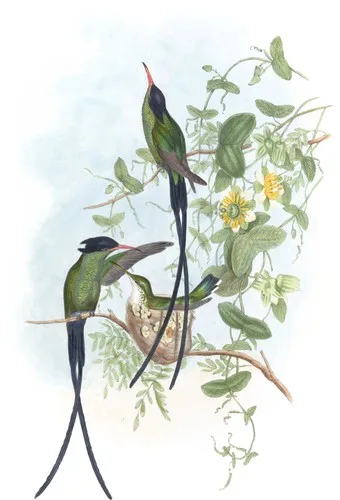
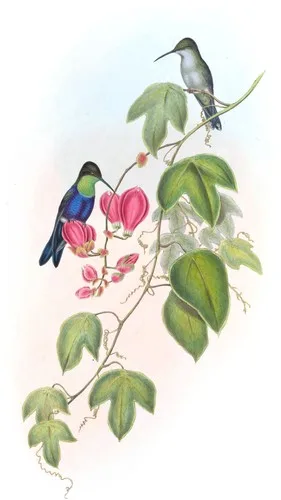
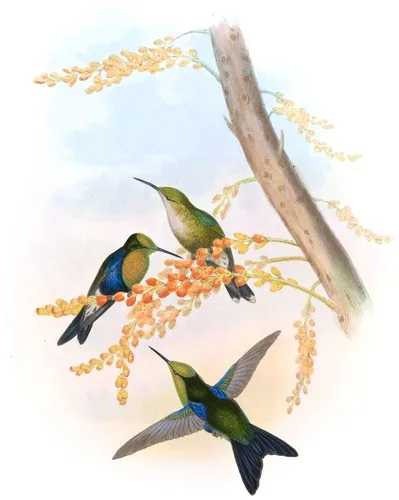
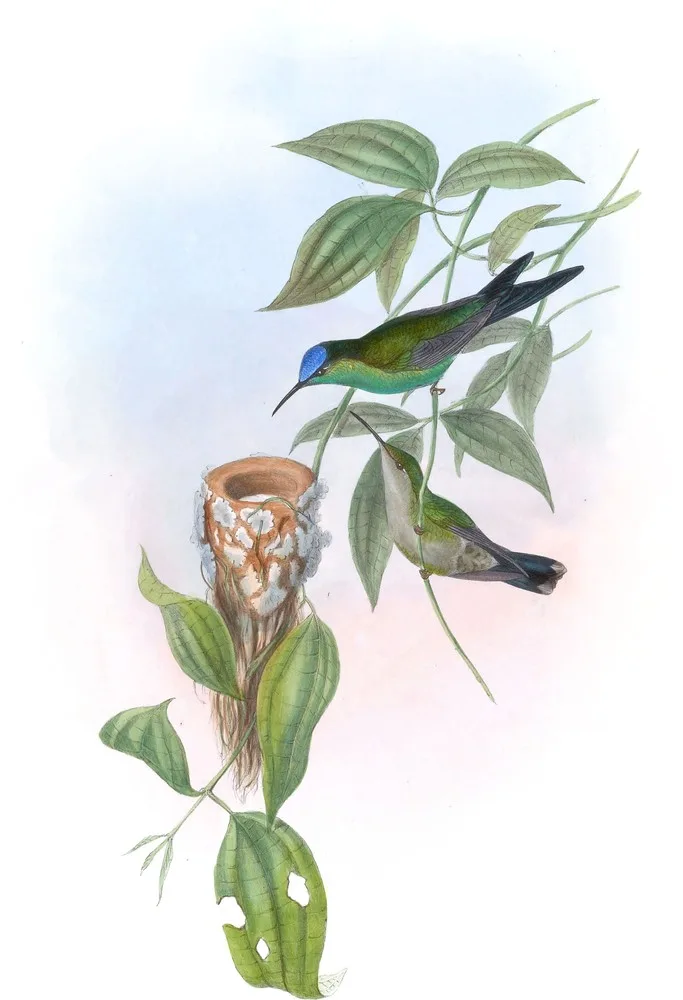
The females appear to escape the wholesale destruction, none of their colours being bright or attractive; indeed, as will be seen on reference to the accompanying Plate, few birds are less gaily adorned.
The nest of this species is of a lengthened form, with a cup-shaped depression at the top: the materials of which it is constructed vary in accordance with those that may be at hand in the situations in which it is placed, but it is generallly composed of the brown inner fibres of the Palm fruit, and beautifully decorated with flat pieces of lichen of various sizes and colour.
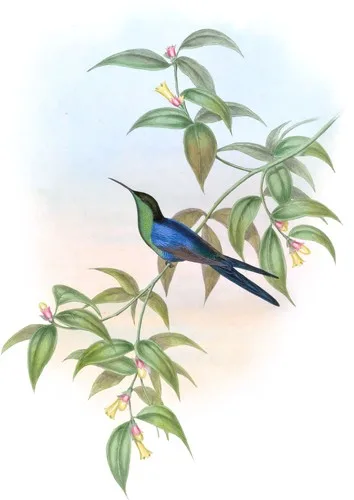
The male has the centre of the crown fine metallic blue; sides and back of the head and nape dark green, appearing black when viewed in front; upper surface, shoulders and wing-coverts green, becoming of a brighter green on the upper tail-coverts; wings purplish black; tail black, with steel-blue reflexions; the whole of the under surface, including the under tail-coverts, yellowish shining green; bill and feet blackish brown.
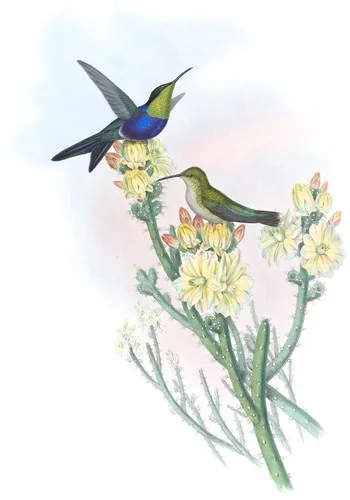
The female has the whole of the upper surface green; wings purplish black; two central tail-feathers ‘and the basal portion of the lateral ones bronzy green; the remainder of the lateral feathers black, with steel-blue reflexions, and the external one tipped with grey; under surface grey, washed with green on the flanks.
The figures are the size of life.
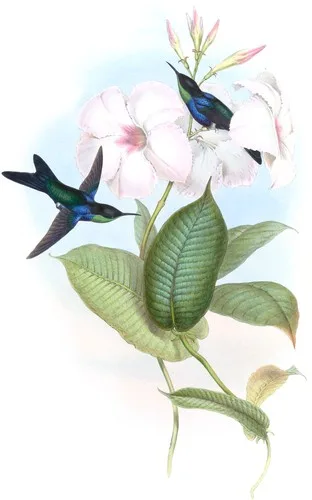
For the drawing of the Brazilian plant, the name of which is unknown to me, I am indebted to T. Reeves, Esq.
References
- Trochilus glaucopis, Gmel. Edit. Linn. Syst. Nat., tom. i. p. 497.—Pr. Max. Beitr. zur Naturg. von Bras., p. 85.—Vieill. 2nde Edit. du Nouv. Dict. d’Hist. Nat., tom. vil. p. 370, et tom. xxi. p. 428.—Ib. Ency. Méth. Orn., part i. p.557.—Jard. Nat. Lib. Humming Birds, vol. ii. p. 86.
- Mellisuga Brasiliensis cauda bifurca, Briss. Orn., tom. iii. p. 724. pl. xxvii. fig. 5?
- Ornismya glaucopis, Less. Hist. Nat. des Ois. Mou., p. 175. pls. 58, 59.—Ib. Traité d’Orn., p. 273.
- Polytmus glaucopis, Gray and Mitch. Gen. of Birds, vol. i. p. 108, Polytmus, sp. 58.
- Trochilus frontalis, Lath. Ind. Orn., vol. 1. p. 318.
- Bluefronted Humming Bird, Lath. Gen. Syn., vol. ii. p. 786.—Ib. Gen. Hist., vol. iv. p. 352.
- L’Oiseau-mouche à queue fourchue du Brésil, Vieill. Ois. dor., tom. i. p. 116.
- Thalurama glaucopis, Bonap. Consp. Gen. Av., p. 77, Thalurania, sp. 5.—Ib. Rev. et Mag. de Zool. 1854, p. 254.—Reichenb. Aufz. der Colibris, p. 7.
- Coeligena glaucopis, Reichenb. Troch. enumer., p. 3. pl. dclxxxv. figs. 4509, 4510.
Twelve ways of seeing
- upright 1.46 : 1
- published 1850
- Pl. 99, Vol. II
Not a catalogue entry but a way of looking: how to stand, what to notice, how the line was cut, when it flowers, where it came from, who made it — and then the poems and the classics that taught China to see the same flower. Read the twelve in order and the plate opens.
-
First Look
江馆清秋,晨起看竹,烟光日影露气,皆浮动于疏枝密叶之间。
—— 清·郑板桥《题画竹》
On an autumn morning at the river lodge I looked at the bamboo: mist, sunlight, dew, all drifting among the sparse and dense leaves.
The sheet is vertical: the eye climbs and settles on the bird. Take the posture before the plumage. Then step in close: watch where colour meets line, and whether the line ever breaks. Third, find the darkest small patch: the whole tonal order is measured from there.
-
Name and Thing
The binomial is Thalurania glaucopis: the first word is the genus it belongs among, the second the epithet that sets it apart. Two words carry a whole provenance. The Chinese name 紫顶妍蜂鸟 is a modern rendering of the Latin, not an old garden name.
-
Form and Colour
The smallest of birds: a needle-fine bill, a forked tubular tongue, wings beating so fast the bird hovers and even flies backwards. Its colour is not pigment but structure — light bent by feather barbules, changing with the angle.No colour group is recorded. Read the outline, then the colour layers, then the brush.
-
Composition
Tall and narrow, the bird perched mid-branch with generous margins above and below. (about 1.46 : 1) No details are appended: a plate for looking, not for keying out. Blank paper is not unfinished work: it is where the eye rests.
-
Line and Colour
In the later nineteenth century chromolithography took over: colour printed rather than painted, line demoted. There is evidence on the back too: the plate mark pressed into the paper, the slight relief of the pigment, lines worn shallow in a later printing.
-
Season
In tropical America they are present all year, their season set by flowers; temperate hummingbirds follow the bloom north and back, thousands of kilometres a year. The year 1850 on the plate is that of publication, not of flowering — the gathering came a year or two earlier. The plate records ten days of peak; the other three hundred are leaf, fruit and rest.
-
Provenance
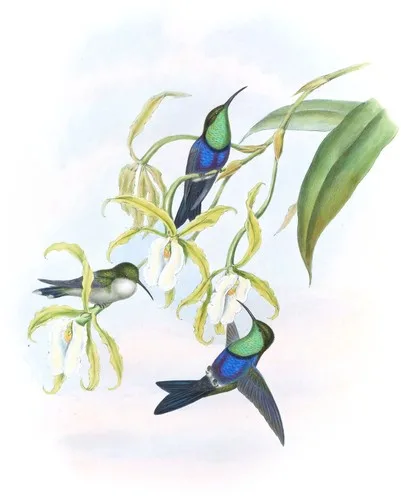
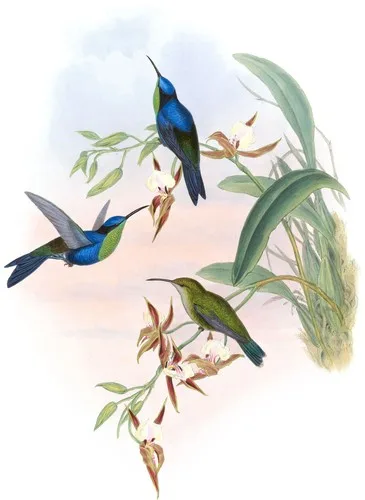
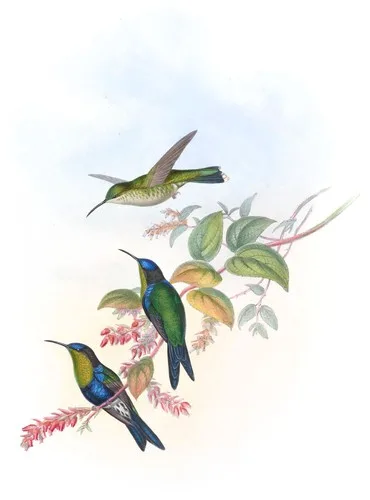
Americas only, from southern Alaska to Tierra del Fuego, richest in the Andes. China has no hummingbirds and no classical record of them; the name arrives with late-Qing travel writing. In the same volume the kin are shelved together; set several plates side by side.
-
The Book and the Hand
“Gould's Hummingbirds” was drawn by John Gould and published 1849-1887. This plate is Pl. 99, Vol. II, book page 99. The image is public domain; the hand-colouring is still one person's hand.
-
Poetic Resonance
穿花蛱蝶深深见,点水蜻蜓款款飞。
—— 唐·杜甫《曲江二首》
Butterflies thread the flowers, seen deep within; dragonflies touch the water and fly on, slow and deliberate.
The poem gives the mood first and the picture supplies the form; set the line beside the plate and the bird itself becomes its resting point.
-
The Written Tradition
人无癖不可与交,以其无深情也。
—— 明·张岱《陶庵梦忆》
Never make a friend of a man without an obsession: he has no deep feeling.
Gould's Hummingbirds (1849–1887) used hand-coloured lithography over gold leaf so the iridescence survived on paper — a monument to Victorian printing and collecting alike. You need not parse every word: take the line, and the flower acquires a second face.
-
Symbolism
For the Aztecs the hummingbird was warrior and sun; for Victorian Europe it was the ultimate ornament, millions killed for breast jewellery. China has no tradition here — and that blank is itself a history of exchange. Meanings change their tune: the same flower can say opposite things within a century.
-
What to Take Away
If you keep one line, keep Guo Xi's: from afar its momentum, up close its texture. A flora exists to be consulted; look long enough and you forget to consult — someone in 1850 gave a whole day to a single flower.