Thaumatias albiventris
Thaumatias albiventris
White-bellied Emerald
Ten ways of seeing
- slightly upright 1.25 : 1
First Look
夫象物必在于形似,形似须全其骨气。
—— 唐·张彦远《历代名画记》
Likeness is the threshold; bone-and-breath is the point.
Slightly taller than wide; the eye lands on the bird's head, a little above centre. Then step in close: watch where colour meets line, and whether the line ever breaks. Third, find the darkest small patch: the whole tonal order is measured from there.
Name and Thing
The binomial is Thaumatias albiventris: the first word is the genus it belongs among, the second the epithet that sets it apart. Two words carry a whole provenance. No established Chinese name exists, so it is cited by its binomial alone.
Form and Colour
The smallest of birds: a needle-fine bill, a forked tubular tongue, wings beating so fast the bird hovers and even flies backwards. Its colour is not pigment but structure — light bent by feather barbules, changing with the angle.No colour group is recorded. Three things fix the habit: leaf arrangement, tepal count, and how the flower is borne.
Composition
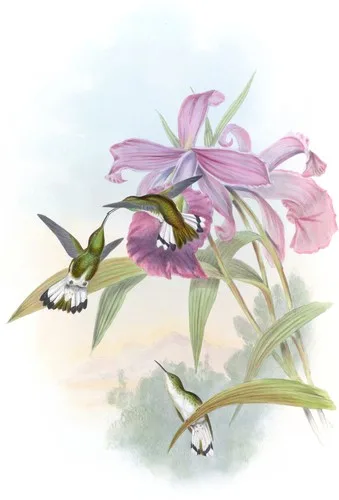
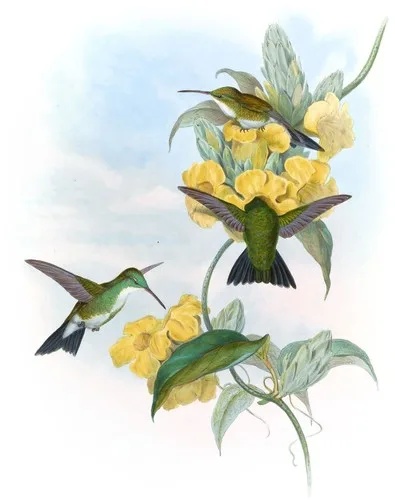
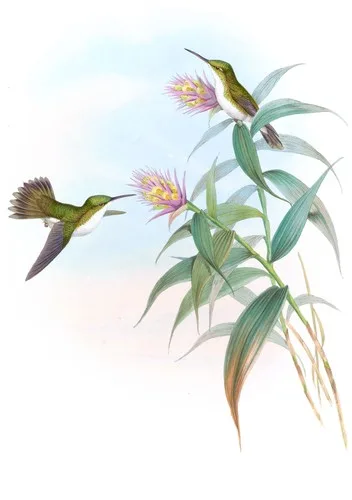
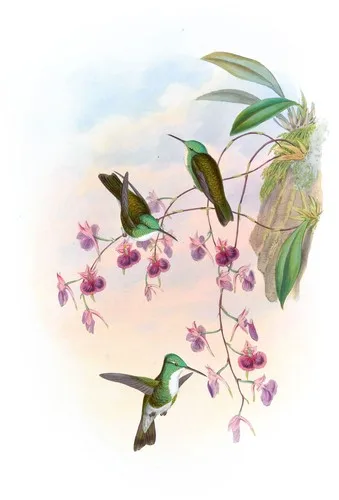
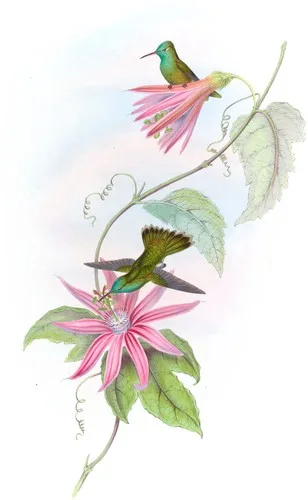
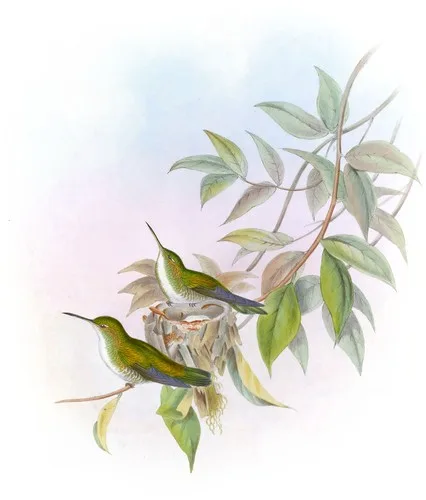
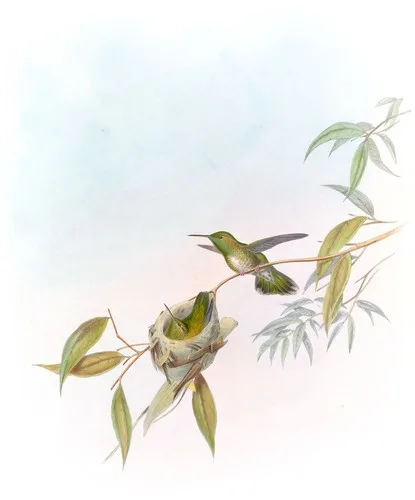
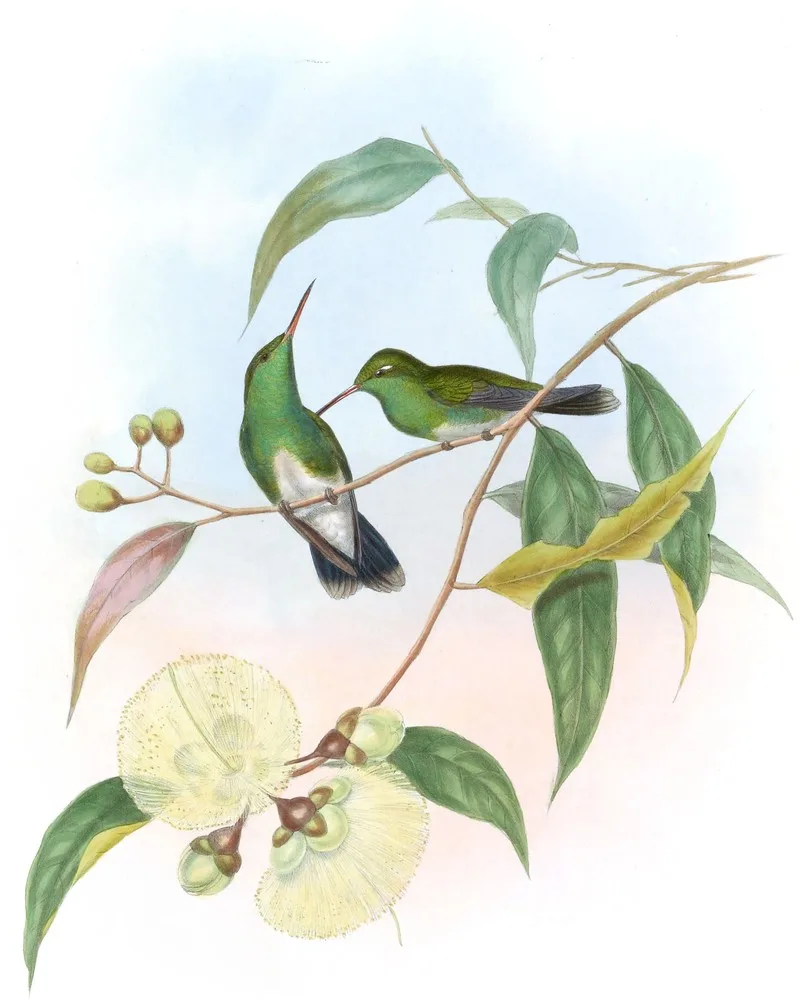
Slightly taller than wide, the bird set a little above centre, the eye landing at head and bill. No details are appended: a plate for looking, not for keying out. Cover the margins with your thumb and the plate suffocates; uncover them and the flower breathes again.
Line and Colour
In the later nineteenth century chromolithography took over: colour printed rather than painted, line demoted. Decide first whether it was printed or painted; only then discuss whether it is beautiful. If you mean to copy it: block in the broad shapes and colours first, detail last; lithographic softness comes from thin washes — two or three pale layers will get you close.
Poetic Resonance
夫列子御风而行,泠然善也,旬有五日而后反。
—— 《庄子·逍遥游》
Liezi rode the wind and came back after fifteen days, so light was his going.
The poem gives the mood first and the picture supplies the form; set the line beside the plate and the bird itself becomes its resting point.
Symbolism
For the Aztecs the hummingbird was warrior and sun; for Victorian Europe it was the ultimate ornament, millions killed for breast jewellery. China has no tradition here — and that blank is itself a history of exchange. Flower language was added later; the flower knows nothing of it, and that innocence is part of its power.
Season and Place
In tropical America they are present all year, their season set by flowers. the name arrives with late-Qing travel writing. The year 1861 on the plate is that of publication, not of flowering — the gathering came a year or two earlier. Much of what that generation knew of such birds came from specimens and cages; read locality and season both as hearsay.
The Book and the Hand
“Gould's Hummingbirds” carries only John Gould's name. A plate is collective work: drawer, engraver and colourist were different hands, and the unnamed ones decided how good it looks.
What to Take Away
Carry three rules away: whole before detail; line before colour; picture before book. A flora exists to be consulted; look long enough and you forget to consult — someone in 1861 gave a whole day to a single flower.
About this plate
Brazil, the neighbourhood of Sta. Catharina (Bourcier).
This well-marked species differs from all the other members of its genus in being of a larger size than either of them, and in having a greater amount of white on the abdomen and under tail-coverts.
The two sexes are so much alike in outward appearance that I have looked in vain for any decided difference by which they may be distinguished; I observe, however, that the female, as is the case with most of the Humming Birds, is somewhat smaller and less pure in her colouring.
M. Bourcier informs me that this bird inhabits Santa Catharina, in Brazil, and remarks that it bears a great resemblance to the Thaumatias Linnæi, but differs from that species in the larger size of its body, and in the abdomen being always white in the adult.
M. Bourcier also tells me, that the specimen from which Vieillot took his description of tephrocephalus is still in the museum at Paris, but in a very bad state, with the feathers of the head much worn and faded, and presenting a grey appearance, which doubtless suggested the appellation Vieillot assigned to it, and which, being intended to express a feature that does not exist, must give place to that of albiventris, applied to it by M. Lesson.
Besides Santa Catharina, the northern parts of Brazil, and the Delta of the Amazon, near its embouchure, and the neighbouring country are frequented by this bird.
Head, all the upper surface, wing- and tail-coverts dark green; wings purplish brown; two central tailfeathers and the basal portion of the remainder dull green, the extent of which decreases as they recede from the centre, middle portion of the lateral feathers blackish brown; the tips brownish grey, increasing in extent as the feathers recede from the centre; throat and chest shining grass-green; flanks dull green; abdomen and under tail-coverts white.
The figures represent the two sexes of the size of life. The plant is copied from a drawing sent to me by Mr. Reeves.
References
- Trochilus tephrocephalus, Vieill. Nouv. Dict. d’ Hist. Nat., tom. xxi. p. 430.—Ib. Ency. Méth. Orn., part ii. p. 560.—Ib. Traité d’Orn., p. 283.
- Ornismya tephrocephalus, Less. Hist. Nat. des Ois. Mou., p. 182. pl. 62.
- Ornismya albiventris, Less. Hist. Nat. des Ois. Mou., p. 209. pl. 76.—Ib. Les Troch., p. 94. pl. 82.—Ib. Traité d’Orn., p. 283.
- Polytmus thaumatias, Gray and Mitch. Gen. of Birds, vol. i. p. 108, Polytmus, sp. 40.
- Coeligena tephrocephala, Reichenb. Aufz. der Colibris, p. 7.—Ib. Troch. enumer., p. 3. pl. dclxxxvii. fig. 4518.
- Argytria albiventris, Reichenb. Troch. enumer., p. 7. pl. dcclvii. figs. 4744, 4745.
- Thaumatias albwentris, Bonap. Consp. Gen. Av., p. 78, Thaumatias, sp. 1.
- Thaumantias albwentris, Bonap. Rev. et Mag. de Zool. 1854, p. 255.