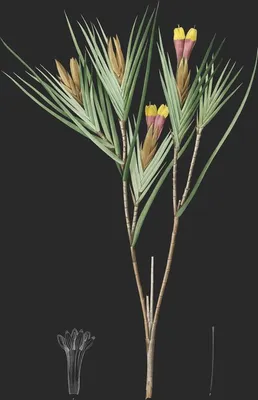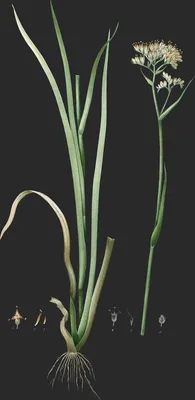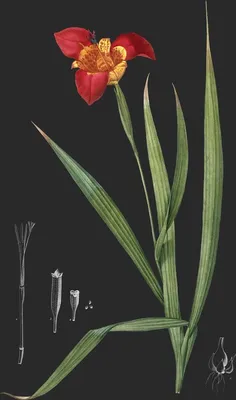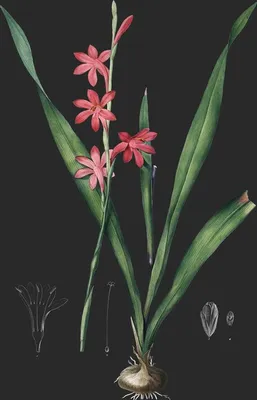
Galaxia Ovata
南乳鱼属·Galaxia Ovata
Galaxia a Feuilles Ovales
About this plate
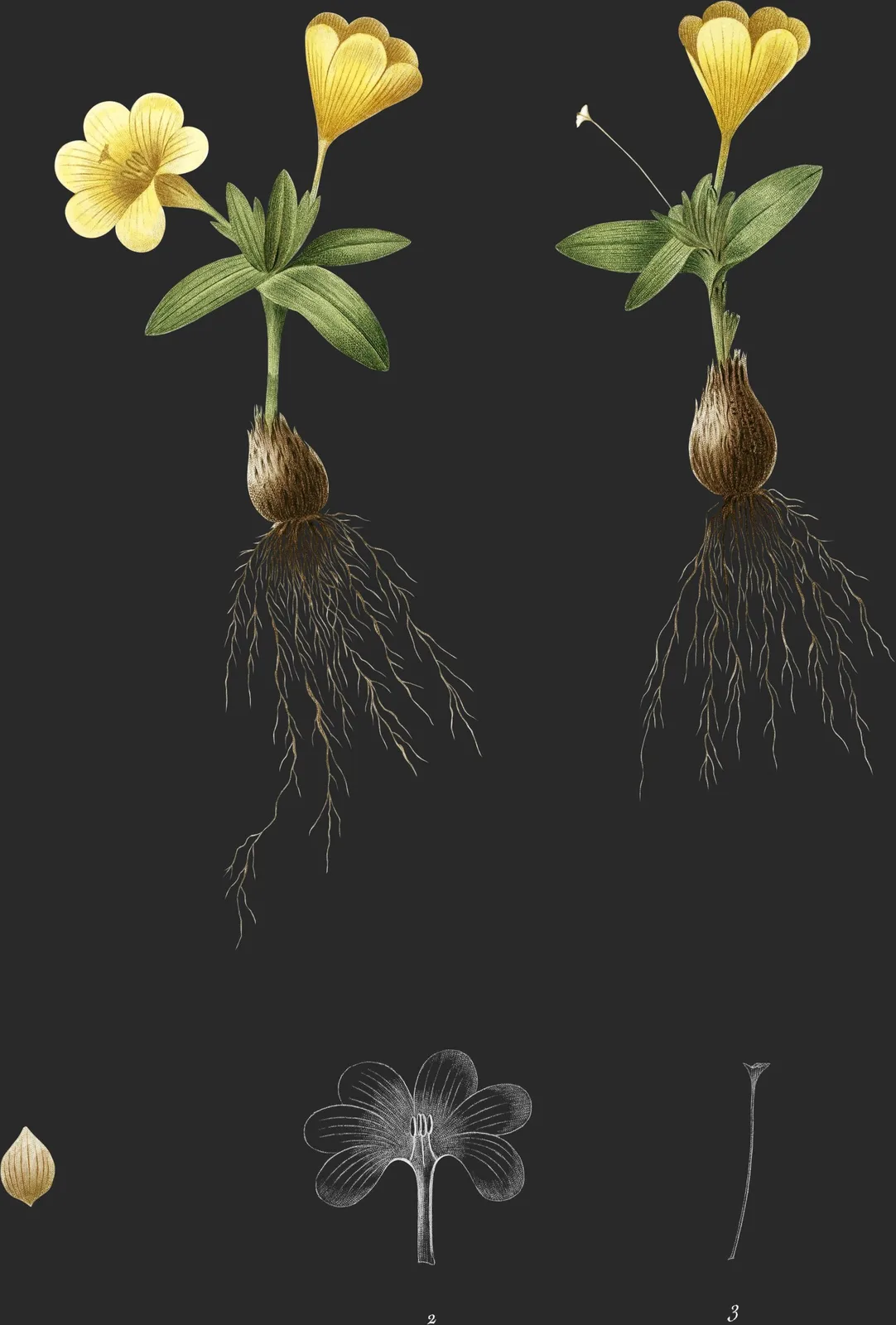
Cette petite plante sort d’une bulbe ovale-oblongue, grosse comme une petite noisette, couverte de deux ou trois plants d’une tunique brune épaisse, composée de fibres longitudinales tres-fortes, que réunissent d’autres fibres transversales plos fines, de manière à former avec elles un réseau A jour très-régulier. La base de cette balbe émet un grand nombre de fibrilles rameuses et flexueuses. De son sommet nait une tige toujours très-courte, le plus souvent enfouie en totalité dans la terre, et couverte par des gaines membraneuses, dont l’intérieure, plus longue que les autres, se prolonge en une feuille radicale plus ou moins développée. Cette tige porte à son extrémité deux feuilles opposées, ovales-oblongues, longues d’environ vingt-cinq millimètres, un peu obtuses, cartilagineuses sur les bords, qui sont tantôt parfaitement entiers, tantôt finement dentés et ciliés. Chacune d’elles embrasse à sa base un faisceau de feuilles pareilles, mais plus petites, au milieu duquel naissent les fleurs. Celles-ei sont le plus souvent solitaires dans chaque fascicule, droites, sessiles et entourées par une bractée ou spathe univalve, membraneuse, blanchätre, ovale et rétrécie en pointe au sommet.
Le périgone est en forme d’entonnoir. Son tube est cylindrique, droit, grèle, long de quinze à ving-cing centimètres, jaune à sa partie supérieure. Son limbe, le plus souvent jaune, mais quelquefois pourpre ou violet, est divisé en six segments ovales-oblongs, un peu élargis au sommet, très-étalés, toujours jaunes à la base, suivant l’observation de Jacquin.
Les filaments des étamines, au nombre de trois soudes ensemble par leur base, et libres au sommet, sont insérés a l’entrée du tube du périgone, au-dessus de laquelle ils s’élèvent un peu. Les anthères sont jaunes, oblongues, droites, fendues à la base.
L’ovaire est ovale, soudé avec le périgone. Le style est filiforme, droit, terminé par un stigmate jaune, et divisé en trois lanières frangées.
Histoire
La Galaxia à feuilles ovales, ainsi que les autres espèces connues de ce genre, croit au Cap de Bonne-Espérance, où elle a été découverte par les voyageurs Sparmann et Thunberg. Suivant ce dernier auteur, ses flears se ferment à quatre heures du soir, et se roulent sur elles-mèmes en se fanant. On l’a introduite dans quelques jardins de l’Europe; mais elle est encore fort peu répandue. Nous la décrivons d’après des échantillons desséchés, recueillis au Cap par Bruguières, et conservés, ainsi qu’ane description manuscrite du même naturaliste dans l’herbier de M. Decandolle.
Observations
Il ne faut pas confondre notre plante avec celle qu’Andrewe a figurée sous le même nom dans le Botanical repository, et que M. Persoon a considéré avec raison comme une espèce distinete, & laquelle il a assigné le nom de Galaxia ciliata. Elle en diffère en effet par son port et par ses fleurs, dont le tube est constamment droit. Mais il est à remarquer que le caractère assigné par ce dernier auteur pour la Galaxia ovata est inexact, en ce qu’il indique les feuilles comme parfaitement glabres, tandis qu’elles sont souvent ciliées sur les bords.
Explication de la planche
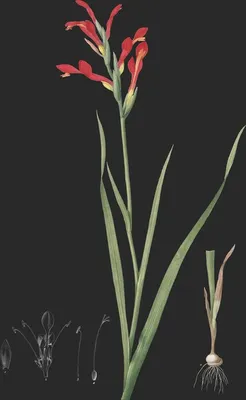
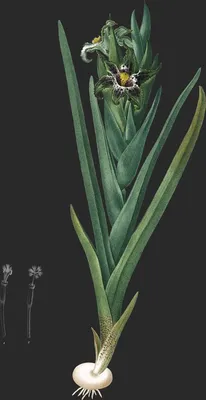
La Plante entière de grandeur naturelle.
- Le périgone fendu dans sa longueur, et étalé.
- Le style.
Fam. des Iris. Juss.—Triandrie monogynie. Lin.
- Galaxia ovata. G. foliis ovatis, corollis rectis.
- Galaxia ovata. G. foliis ovatis margine cartilagineis glabris. Pers. ench. 1. p. 41.
- Galaxia ovata. G. subacaulis, foliis oblongis, spathâ univalvi unillorâ. Willd. sp. pl. 1. p. 583.
- Galaxia ovata. G. foliis ovatis. Thunb. prodr. 10. Nov. gen. p. 50. tab. 3. Jacq. coll. p. 137. Ic. rar. 2. t. 291. Cavan. diss. 6. p. 341. tab. 189. f. 2. Lam. dict. 2. p. 591.
- Ixia Galaxia. I. monadelpha, spathâ radicali, foliis ovatis planis nervosis. Lin. suppl. 93.
Twelve ways of seeing
- measured cast yellow-green
- upright 1.48 : 1
- published 1809
- Plate 246
Not a catalogue entry but a way of looking: how to stand, what to notice, how the line was cut, when it flowers, where it came from, who made it — and then the poems and the classics that taught China to see the same flower. Read the twelve in order and the plate opens.
-
First Look
凡画山水,意在笔先。
—— 唐·王维《山水论》
In painting, the intention precedes the brush.
The sheet is vertical: the eye climbs and settles in the upper half. Let the plant stand before you look for detail. Then step in close: watch where colour meets line, and whether the line ever breaks. Third, find where the yellow is deepest: the whole tonal order is measured from that patch.
-
Name and Thing
The binomial is Galaxia ovata: the first word is the genus it belongs among, the second the epithet that sets it apart. Two words carry a whole provenance. The older system filed it under Iridaceæ by overall affinity; Linnaeus, counting stamens only, placed it in Monadelphia — two ways of asking what a plant is. No established Chinese name exists, so it is cited by its binomial alone.
-
Form and Colour
Measured on this plate: flower colour covers 4.1% of the sheet, foliage 2.8%, the cast yellow-green with a second note of amber. No other plate shares exactly this measure. Irises carry rhizomes or bulbs, sword-shaped leaves in two ranks, and six tepals — three falls drooping, often bearded or speckled, three standards erect. Filed under yellow — a honey-yellow, built in washes from a pale ground. A single plant, laid out with nothing hidden.
-
Composition
Tall and narrow, the plant rising in one movement with generous margins — the upright format of most floras. (about 1.48 : 1) No details are appended: a plate for looking, not for keying out. The plant covers only 9% of the sheet, centred above centre; the emptiness is where the eye rests. Blank paper is not unfinished work: it is where the eye rests.
-
Line and Colour
The first half of the nineteenth century moved from copper to steel to lithography; stipple could render the softest transition. There is evidence on the back too: the plate mark pressed into the paper, the slight relief of the pigment, lines worn shallow in a later printing.
-
Season
Late spring to early summer, peaking in April and May, before the summer rains. The year 1809 on the plate is that of publication, not of flowering — the gathering came a year or two earlier. The plate records ten days of peak; the other three hundred are leaf, fruit and rest.
-
Provenance
Temperate north. In China iris and sweet flag belong to the Dragon Boat festival; in Europe Iris germanica gave the perfume trade its orris root. The volume was made in 1802-1816, when most of this knowledge came from living plants under glass.
-
The Book and the Hand
“The Liliaceae” was drawn by Pierre-Joseph Redouté and published 1802-1816. This plate is Plate 246, book page 246. The image is public domain; the hand-colouring is still one person's hand.
-
Poetic Resonance
君家兰杜久萋萋,近养菖蒲绿未齐。
—— 宋·朱熹《寄謝劉彥集菖蒲之貺二首 其一》
The poem gives the mood first and the picture supplies the form; set the line beside the plate and the yellow the corolla becomes its resting point.
-
The Written Tradition
五月五日,采艾以为人,悬门户上,以禳毒气。
—— 南朝梁·宗懔《荆楚岁时记》
On the fifth of the fifth month they gather mugwort, shape it into a figure and hang it on the door to drive off fever — plant as medicine and as charm.
The Bencao Gangmu lists iris and sweet flag among herbs; the Jingchu seasonal records describe hanging mugwort and flag at the door at midsummer — a custom unbroken for a thousand years. The difference is not of quality but of question: Europe asks what it is, China asks whom it resembles.
-
Symbolism
In China sweet flag hung at the door wards off evil at midsummer; in Europe the iris is the messenger, since Iris was the rainbow goddess who carried divine words. This plate leans yellow, which in flower language adds one more degree of feeling. Meanings change their tune: the same flower can say opposite things within a century.
-
What to Take Away
If you keep one line, keep Guo Xi's: from afar its momentum, up close its texture. A flora exists to be consulted; look long enough and you forget to consult — someone in 1809 gave a whole day to a single flower.