Ixia Bulbocodium
Ixia Bulbocode
About this plate
Description
L’Ixia bulbocode est extrêmement distinet de toutes les espèces du même genre, par sa hampe simple, plus courte que les feuilles, et chargée d’une seule fleur; par les deux bractées vertes et embrassantes qui se trouvent à la base de la fleur; enfin, par son stigmate dont les trois lanières sont si profondément bifurquées, qu’on croirait voir un stigmate à sis divisions. Cette plante est tellement connue des Botanistes, comme l’atteste la synonymie citée plas haut, que nous croyons inutile d’entrer dans aucun détail sur sa structure; nous nous contenterons d’indiquer les nombreuses variétés qu’elle présente. Ces variétés peuvent se réduire à deus races principales que nous avons indiquées plus haut, et qui peut-être sont deux espèces distinctes.
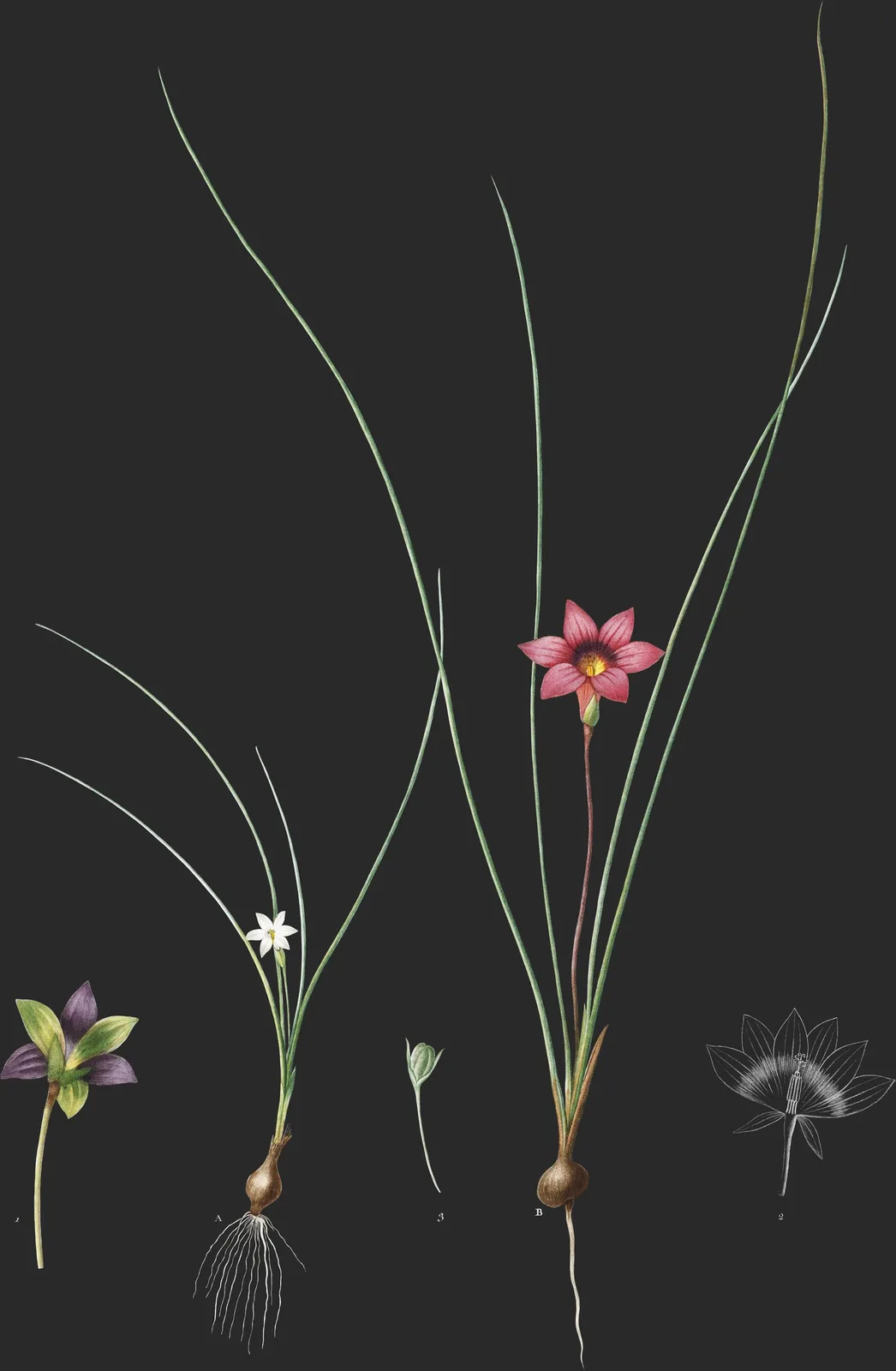
L’Ixia bulbocode à petite fleur, dont on trouve une figure sur la planche ci-jointe, est une petite plante dont la longueur totale ne dépasse jamais un déci-mètre, dont la balbe est ovoide, et dont la fleur n’a pas e centimètres de diamètre; il présente plusieura sous-variétés, quant à la couleur de sa corolle qui est tantôt blanche, tantôt bleuâtre, tantôt parparine ou violette, quelquefois légèrement panachée.
L’Ixia balbocode a grande fleur est plus développé dans toutes ses parties; il acquiert jusqu’à a décimètres de longueur; sa leur atteint 3 et 4 centim. de diamètre; sa balbe est plus arrondie; il présente aussi diverses nuances dans la couleur de sa fleur; elle est quelquefois blanche, quelquefois violette, souvent jaune dans le fond de la petite cloche que forme le limbe.
Chacune de ces variétés présente encore des différences quant à la largeur de ses feuilles, qui sont filiformes et tris-mennes dans la plupart des individus et quon trouve quelquefois plancs et linéaires dans les individus vigoureux; chaque bulbe ne produit ordinairement qu’une senle hampe; mais, dans certains pieds, on trouve deus hampes sortant d e mème racine: cette circons tance se trouve souvent réunie avec l’élargissement des fenilles, et probablement est due à la même cause, savoir la bonté du sol et la vigueur de l’individu.
Histoire
Cet Ixia est la seule espèce de ce genre nombreux qui soit originaire de l’Europe; il se tronve dans les lieux maritimes et sabloneux sur presque toutes les côtes de la Méditerranée, en Barbarie, dans l’Orient, en Italie, dans File de Corse, sur les côtes de France, a Nice et à Narbonne; il a même été retrouvé sur les eôtes de l’Océan, dans les landes de Bayonne. ♃.
Cette petite plante fleurit au printemps; après la fleuraison, la hampe se courbe, et la capsule mirit penchée et couverte par les deus bractées.
Explication de la planche
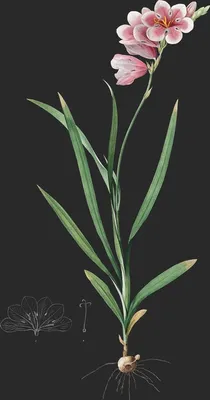
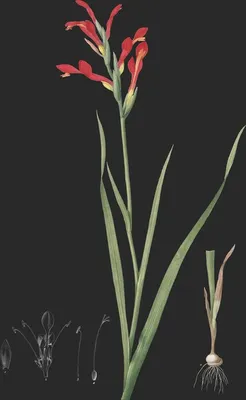
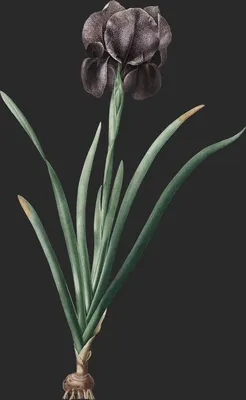
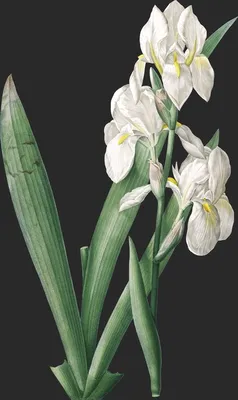
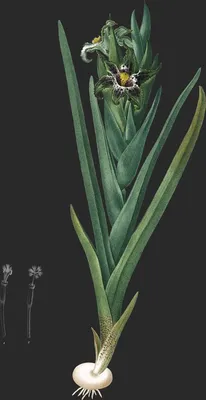
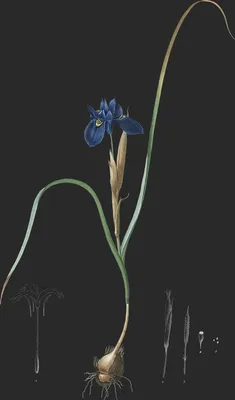
- Fig: I. L’Ixia balbocalo à petito leur de grandeur naturelle.
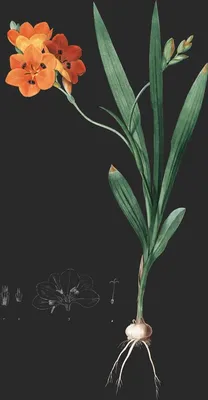
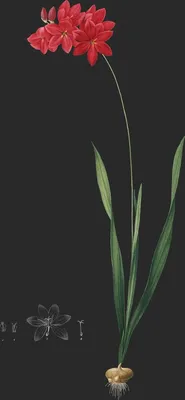
- Fig. II. L’Ixia bulbocode à grande fleur de grandeur naturelle.
- La fleur de la seconde variété vue parderrière pour montrer les feuilles de la spathe.
- La capsule entourée de la spathe.
- La fleur ouverte et étalée pour montrer les étamines et le stigmate.
Fam. des Iridées. Juss.—Triandrie monogynie. Lin.
- Ixia bulbocodiam. I. scapo unifloro brevissimo, folis linearibus. Lin. Spec. 51. Mant. p. 320. Thunb. diss. n. 3.
- Ixia scapo unilloro brevissimo, folis angulatis caulinis, stigmatibus sextuplicibus. Murr. Syst. veg, p. 76.
- Ixia scapo unifloro, foliis linearibus canaliculatis angalatis. Jacq. coll. 3. p. 265. Ic. rar. 2. t. 271.
- Ixia scapo ramoso, ramis unilloris, foliis sulcatis filiformibus. Lam. Dict. 3. p. 335. Illustr. t. 31. f. 1.
- Crocus bulbocodiam. C. spathâ diphyllâ flori adproximatâ, tabo corollæ brevi. Lin. Spec. ed. 1. p. 36.
- Crocus flore fructui imposito, tubo brevi. Roy. luga-b. 41.
A. parvillora. Tab. 88. f. 1.
- Crocus vermus angustifolius I et II. Clus. hist. 1. p. 207. ic.
- Crocus sylvestris hispanicus valgo Nozilicha. Lob. Icon. t. 142.
- Crocus vernas angustifolius parvo flore. C. Bauh. Pin. 67. n. t. 2. Tourn. inst. 352.
B. grandiflora. Tab. 88. f. 2.
- Crocus vernus angustifolius violaceo flore. Clus. hist. 1. p. 208. ic.
- Crocus silvestris minor hispanicus flore patulo, vulgo Nozilicha. Lob. icon. 4. 141.
- Bulbocodium crocifolium flore magno albo fundo luteo. Tourn. Cor. 50.
- Sisyrinchium minus angustifolium flore majore variegato. C. Bauh. Pin. 41.
- Sisyrinchiam angustifolium alterum. Col. ecphr. 2. p. 5. t. 7. f. 1.
- Sisyrinchiam majus angustifolium radice rostratâ flore majore variegato. Moris. hist. 2. p. 345. sect. 4. t. 5. f. 1.
Twelve ways of seeing
- measured cast red
- upright 1.53 : 1
- published 1804
- Plate 88
Not a catalogue entry but a way of looking: how to stand, what to notice, how the line was cut, when it flowers, where it came from, who made it — and then the poems and the classics that taught China to see the same flower. Read the twelve in order and the plate opens.
-
First Look
真山水之川谷,远望之以取其势,近看之以取其质。
—— 宋·郭熙《林泉高致·山水训》
Mountains and valleys: from afar take their momentum, up close take their texture — the two distances from which any picture is read.
The sheet is vertical: the eye climbs and settles in the upper half. Let the plant stand before you look for detail. Then step in close: watch where colour meets line, and whether the line ever breaks. Third, find where the green is deepest: the whole tonal order is measured from that patch. The pose leans right: the upper half carries 19 points further right than the lower — a living thing, not a diagram.
-
Name and Thing
The binomial is Ixia bulbocode: the first word is the genus it belongs among, the second the epithet that sets it apart. Two words carry a whole provenance. The older system filed it under Iridaceæ by overall affinity; Linnaeus, counting stamens only, placed it in Triandria — two ways of asking what a plant is. No established Chinese name exists, so it is cited by its binomial alone.
-
Form and Colour
Measured on this plate: flower colour covers 1.4% of the sheet, foliage 0.8%, the cast red with a second note of yellow-green. No other plate shares exactly this measure. Bulbous plants store the year underground — bulb, corm or tuber — then send up a few thick leaves and a single scape, with six tepals in cup, funnel or star. Filed under green — a moss green, a colour that comes mostly from leaf and stem. Three things fix the habit: leaf arrangement, tepal count, and how the flower is borne.
-
Composition
Tall and narrow, the plant rising in one movement with generous margins — the upright format of most floras. (about 1.53 : 1) No details are appended: a plate for looking, not for keying out. The plant covers only 5% of the sheet, centred below centre; the emptiness is where the eye rests. Old plates set the plant slightly off centre, with unequal margins — that small imbalance is what keeps it alive.
-
Line and Colour
The first half of the nineteenth century moved from copper to steel to lithography; stipple could render the softest transition. Craft leaves franker evidence than inscriptions.
-
Season
Early spring to early summer, genus by genus: tulips and hyacinths first, gladiolus and amaryllis later. The year 1804 on the plate is that of publication, not of flowering — the gathering came a year or two earlier. The best time to read such a plate is its flowering season: three minutes under the tree explains what no text can.
-
Provenance
Three homelands: the Mediterranean, Central Asia and South Africa. The tulip came from Ottoman gardens and became a Dutch mania; South African bulbs filled European glasshouses after 1800. The localities on the plate are those of a century ago; plants travel and places change their names.
-
The Book and the Hand
“The Liliaceae” was drawn by Pierre-Joseph Redouté and published 1802-1816. This plate is Plate 88, book page 88. The image is public domain; the hand-colouring is still one person's hand.
-
Poetic Resonance
东风夜放花千树,更吹落、星如雨。
—— 宋·辛弃疾《青玉案·元夕》
East wind at night sets a thousand trees of flowers alight, then blows them down like rain of stars.
The poem gives the mood first and the picture supplies the form; set the line beside the plate and the green the corolla becomes its resting point.
-
The Written Tradition
宁古无时,宁朴无巧,宁俭无俗。
—— 明·文震亨《长物志》
Better old than fashionable, better plain than clever, better spare than vulgar.
Li Bai's 'orchid wine, fragrant with yujin' is often misread as tulips; the Tang yujin was a turmeric-like root used to scent wine — same name, different plant. You need not parse every word: take the line, and the flower acquires a second face.
-
Symbolism
The tulip was an imperial emblem in Istanbul and a speculative bubble in Amsterdam; the hyacinth sprang from a boy's blood in Greek myth. What bulbs share is concealment: next year kept underground. Flower language was added later; the flower knows nothing of it, and that innocence is part of its power.
-
What to Take Away
Next time you stand before a flowering plant, give it three minutes: leaf arrangement, direction of the flower, the darkest patch. A flora exists to be consulted; look long enough and you forget to consult — someone in 1804 gave a whole day to a single flower.