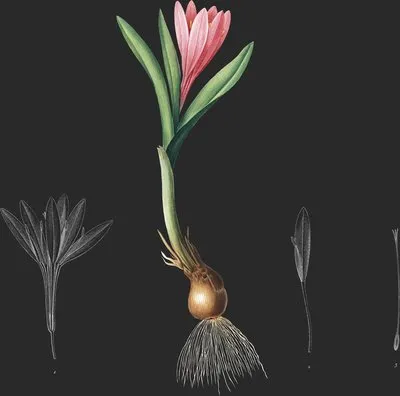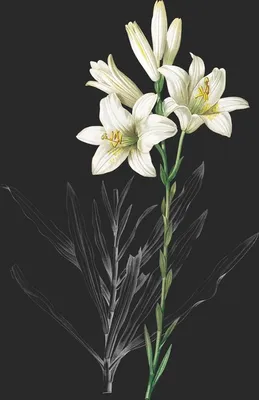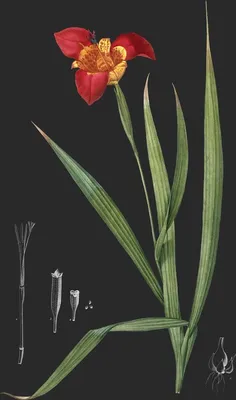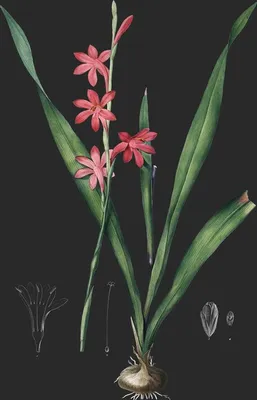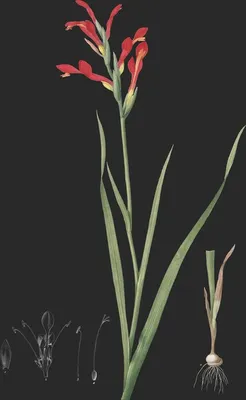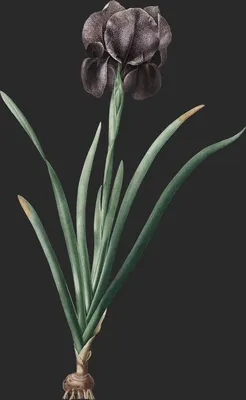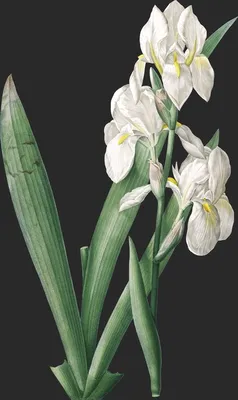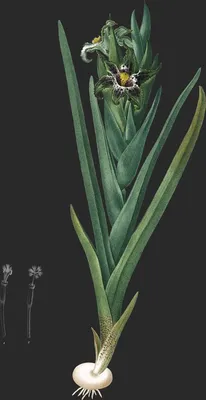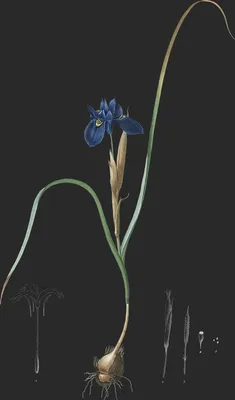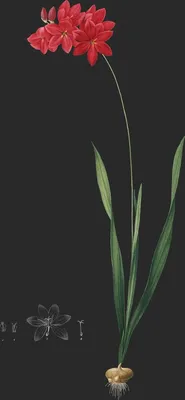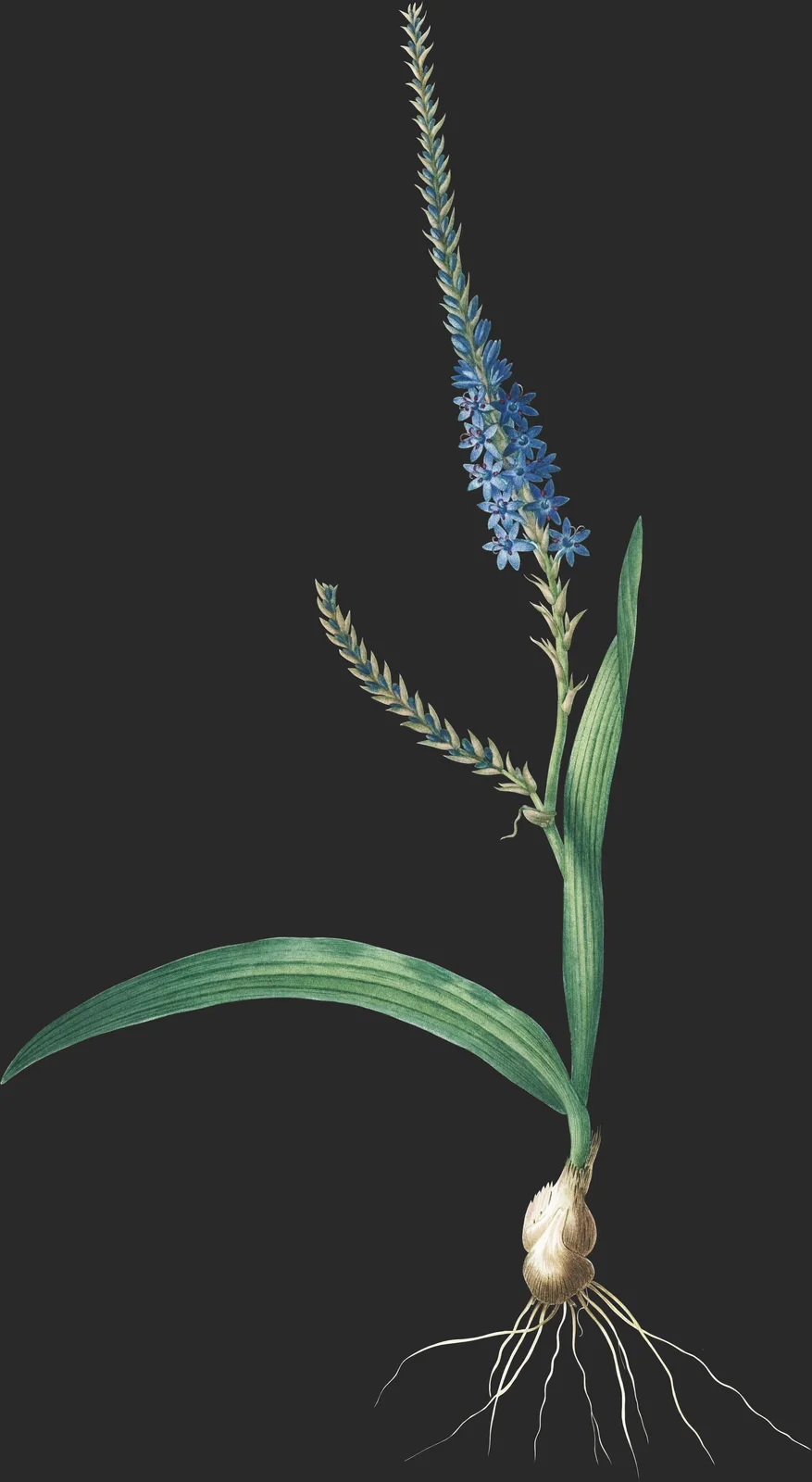
Ixia Plantaginea
Ixia Plantain
Ten ways of seeing
- measured cast blue
- upright 1.82 : 1
First Look
六法者何?一、气韵生动是也;二、骨法用笔是也;三、应物象形是也;四、随类赋彩是也;五、经营位置是也;六、传移模写是也。
—— 南齐·谢赫《古画品录》
The six laws: spirit resonance alive; bone-method in the brush; matching form; colour by kind; planning the placing; copying the masters.
The sheet is vertical: the eye climbs and settles in the upper half. Let the plant stand before you look for detail. Then step in close: watch where colour meets line, and whether the line ever breaks. Third, find where the green is deepest: the whole tonal order is measured from that patch.
Name and Thing
The binomial is Ixia plantain: the first word is the genus it belongs among, the second the epithet that sets it apart. Two words carry a whole provenance. The older system filed it under Iridaceæ by overall affinity; Linnaeus, counting stamens only, placed it in Hexandria — two ways of asking what a plant is. No established Chinese name exists, so it is cited by its binomial alone.
Form and Colour
Measured on this plate: flower colour covers 1.5% of the sheet, foliage 4.1%, the cast blue with a second note of amber. No other plate shares exactly this measure. Bulbous plants store the year underground — bulb, corm or tuber — then send up a few thick leaves and a single scape, with six tepals in cup, funnel or star. a moss green. Read the outline, then the colour layers, then the brush.
Composition
The sheet is tall. No details are appended: a plate for looking, not for keying out. The plant covers only 8% of the sheet, centred below centre; the emptiness is where the eye rests.
Line and Colour
The first half of the nineteenth century moved from copper to steel to lithography; stipple could render the softest transition. Craft leaves franker evidence than inscriptions. If you mean to copy it: take its skeleton, its margins and the order of its colours; the burin's hatching is the language of copper — suggest it with pencil density, do not imitate it stroke for stroke.
Poetic Resonance
满园花菊郁金黄,中有孤丛色似霜。
—— 唐·白居易《重陽席上賦白菊》
The poem gives the mood first and the picture supplies the form; set the line beside the plate and the green the corolla becomes its resting point.
Symbolism
The tulip was an imperial emblem in Istanbul and a speculative bubble in Amsterdam; the hyacinth sprang from a boy's blood in Greek myth. What bulbs share is concealment: next year kept underground. In a flora it is a species first and a symbol second; the order is worth keeping.
Season and Place
Early spring to early summer, genus by genus: tulips and hyacinths first, gladiolus and amaryllis later. South African bulbs filled European glasshouses after 1800. The year 1807 on the plate is that of publication, not of flowering — the gathering came a year or two earlier. Read the locality and the flowering season both with a discount: one is hearsay, the other a ten-day peak.
The Book and the Hand
“The Liliaceae” carries only Pierre-Joseph Redouté's name. A plate is collective work: drawer, engraver and colourist were different hands, and the unnamed ones decided how good it looks.
What to Take Away
Appreciation is not knowledge but habit — one more look each time. Two centuries on, the plant may still flower in some garden; the one on this sheet stopped in the season of 1807.
About this plate
Description
Une bulbe arrondie, brune, de la grosseur d’une petite cerise, donne naissance à une tige feuillée, flexueuse, comprimée, à deux tranchants, haute de trois décimètres ou plus, et ferminée par un long épi de fleurs.
Les feuilles sont au nombre de deux ou trois, comprimées en forme de glaive, engainantes à leur base, aigues à leur sommet, marquées de nervures longitudinales, saillantes. L’inférieure nait immédiatement de la bulbe: sa gaine, assez courte, est renflée à sa base pour recevoir les cayeux qui se développent en cet endroit, Son limbe, long de 15 centimètres environ, et large de 12–15 millimètres, est étalé et courbé en faux. La supérieure, plus petite dans sa totalité, est insérée à la tige, un peu au dessus de son origine, et l’enveloppe par sa gaine jusqu’au près de la naissance des épis. Son limbe est court et presque droit. Il y en a quelquefois une troisième beaucoup plus petite.
Les fleurs sont d’une couleur bleue assez foncée, très-nombreuses, petites, sessiles, alternes et disposées le long de la tige sur deux rangs opposés, de manière a former un épi comprimé et imbriqué, au dessous duquel il en nait pour l’ordinaire un ou deux plus petits. Chacune d’elles est entourée à sa base par deux bractées persistantes, opposées, ovales, concaves et un peu inégales, dont l’extérieure, longue de 8–10 millimètres, est membraneuse sur les bords, et terminée par une courte arête. L’intérieure, plus petite, est presque entièrement membraneuse et marquée de deux nervures saillantes qui se prolongent chacune en une petite pointe.
Le périgone est en forme d’entonnoir, adhérent par sa base à l’ovaire; son tube est eylindrique, un peu plus long que les bractées, légèrement arqué et renflé auprès de sa gorge. Le limbe est à six divisions égales, étalées, oblon-gues, obtuses et concaves.
Les étamines sont au nombre de trois, insérées au tube du périgone, aussi longues que le limbe et un peu ascendantes. Les filaments sont capillaires; ils supportent des anthères oblongues, presque linénires, à deux loges, insérées par leur centre, et redressées.
L’ovaire est ovoide, à trois angles obtus, adhérent au périgone et renfermé entre les deux bractées. Le style est filiforme, égal en longueur aux étamines. Il se divise à son sommet en trois stigmates alongés et réfléchis. Je n’ai pas vu le fruit.
Suivant l’observation de Gawler, il se développe quelquefois de petites bulbes oblongues à la place des fleurs et entre les bractées.
Histoire
L’Isia plantain est indigène du Capde-Bonne-Espérance. Elle y a été trouvée communément par Thunberg, notamment dans le Carro et auprès de Swellendam.
Je n’ai pas vu cette plante vivante. La description précédente et la figure ont été faites d’après des échantillons desséchés.
Fam. des Iris. Juss.—Hexandrie monogynie. Lin.
- Ixia plantaginea. I. polystachia spica imbricatà disticha, foliis ensiformibus nervosis. Willd. Sp. pl. 1. p. 200.
- Ixia plantaginea folis linearibus strictis, spica disticha imbricati. Ait. Kew. 1. ?. 59.
- Watsonia plantaginea. W. foliis lineari-ensiformibus strictis, infimo falento compresso fistuloso, cæteris plano solidis, caule alato ancipiti, spicâ distichâ subamentiformi, limbo aquali campanulato patente. Gawl. in Curt. bot. mag. 353.
- Gladiolus plantagineus. G. spicâ imbricatâ distichâ subramosi, foliis ensiformibus nervosis. Pers. enchir. 1. p. 46.
- Gladiolus alopecuroides. Thunb. diss. de Glad. № 14. prodr. 8.
- Gladiolas alopecuroides. G. foliis linearibus, spicâ distichâ imbricatâ. Lin. Sp. pl. 54. Amœn. acad. 4. p. 301. Lam. Dict. 2. p. 725.